


Saw-Filing
Description
This section is from the book "Exercises In Wood-Working", by Ivin Sickels. Also available from Amazon: Exercises in Wood Working.
Saw-Filing
The easiest saw to file is the rip-saw, with teeth square across and standing at 90°. Fasten the saw in the clamps as shown in Fig. 1. Pass a flat, smooth file lightly over the teeth first, to reduce all the tops to the same level. Examine the teeth carefully, and determine by the amount removed from the points which of them need the most filing, and whether on the square or beveled side. If the teeth are spaced irregularly, each filing should tend to correct the fault.
The triangular file is held in the right hand, its point guided by the thumb and forefinger of the left. For filing large teeth the file should have slanting furrows (6, Fig. 2); for small teeth, finer and less oblique furrows (c, Fig. 2). Pressure is applied only during the forward stroke of the file, it being raised above the tooth or touching very lightly as it comes back, because the brittle cutting edges, which are shaped as at a, Fig. 2, are easily rubbed off, and the file may be ruined by a careless back-stroke. The file should cut in the direction of the set, as at b and c, Fig. 3. One or two strokes are usually sufficient to sharpen a tooth. The first, third, fifth, and so on, are filed first, then the saw is turned and the remainder filed. If the teeth are oblique, as in Fig. 4, then the direction of the file must be adjusted to fit this inclination, as shown by the arrows.
In the cross-cut, the file is held pointing upward and toward the handle of the saw, as shown by the arrows a, a, and b, b, Fig. 5. As this always leaves a wire-edge on each tooth, some prefer to file exactly in the opposite direction - that is, pointing downward and toward the point of the saw.
After filing, the saw should be set. For this important operation a good instrument must be used. Crude instruments, such as a block of wood, a nail punch, and a hammer, in the hands of an inexperienced workman, are more likely to ruin the saw than to benefit it. The teeth must be set with great regularity, in order to secure a smooth and straight cut. Morrill's instrument, shown in Figs. 6 and 7, acts by bending the point of the tooth with the punch c, the amount of the set being regulated by adjusting a and b.
Rip-saws, and also cross-cuts for fine work, should have very little set, and the points only of the teeth should be bent.
After setting the teeth, they should be finally trued, by rubbing the oil-stone lightly on the sides of the points.
Plate F.

Fig. 1

Fig. 2

Fig. 3

Fig. 4
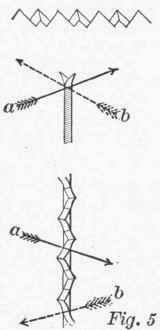

Fig. 6

Continue to:


My Books

