


With The Oil-Stone
Description
This section is from the book "Exercises In Wood-Working", by Ivin Sickels. Also available from Amazon: Exercises in Wood Working.
With The Oil-Stone
To sharpen or whet a chisel, moisten the oil-stone with a few drops of oil; hold the chisel by the blade in the right hand, as shown in Fig. 1, two or three fingers of the left pressing on the face of the chisel near the edge, a. The chisel is moved backward and forward the entire length of the stone, and maintained strictly at a certain angle, about 30° to 35°, depending on the kind of chisel and the work to be done with it; for paring, thinner angles, and for mortising, thicker angles are used.
In the forward movement (a to b, Fig. 2), the tool must be pressed hard on the stone, but lightly as it is drawn back; and the surface formed at the cutting edge should be flat, as shown at c.
Avoid a rocking motion, as shown in Fig. 3, in which the tool is started at too great an angle (a), which becomes less as it moves along, ending in an angle much too small, as at c. This fault, which is a very common one, gives to the edge a curved shape, as shown at d, Fig. 3.
After the stone has worn the steel down to the edge, the chisel is turned on its face, flat on the stone, and moved forward lightly once or twice to remove the wire-edge caused by the grinding.
To sharpen a plane-iron, hold it the same as the chisel, turned so as to bring the corners of the iron within the limits of the stone; press with considerable force in the forward strokes, and keep the iron strictly at its proper angle, about 35°.
The iron of the jack-plane must have a rocking motion sidewise, so as to preserve its curved edge.
When the stone is small or narrow, a circular motion is given to the iron, as at a, Fig. 4. For the finishing touches, the iron is pushed forward lightly, raised from the stone coming back, and removing the wire-edge, as in the case of the chisel.
To sharpen a gouge, hold it and the oil-slip as shown in Fig. 5. Give the slip a back-and-forward motion while the tool is turned to bring all parts of the edge to bear on the stone. Remove the wire-edge with the round side of the slip.
Should the surface of the oil-stone become hollow or uneven, it may be made flat by grinding with fine sand or medium emery on a flat stone or cast-iron plate. To remove oil which has hardened in the pores of the surface, the stone may be placed in boiling, soapy water, or in some strong alkaline solution.
Plate D.

Fig. 1

Fig. 2

Fig. 3
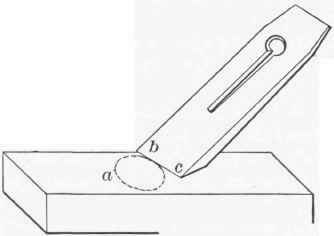
Fig. 4

Fig. 5
Sharpening Tools. (Plate E.)
Continue to:


My Books

