


Lesson II. Knife And Hatchet Continued
Description
This section is from the book "Manual Training: First Lessons In Wood-Working", by Alfred G. Compton. Also available from Amazon: First Lessons In Wood-Working.
Lesson II. Knife And Hatchet Continued
The knife, the hatchet, and similar tools are used for other purposes besides cross-cutting or chopping: they are used for splitting and for hewing or paring.
You have two pieces of pine 1/4 of an inch thick, 2 inches wide, and about 6 inches long, marked A and B. Try to split from one edge a piece half an inch wide. The pieces have been selected by inspecting the grain of the wood, so that in one case this task shall be easy, and in the other case impossible. Take the piece marked A. Set it up endwise on your bench. Place your knife on the end, about an inch from the edge, and press down hard with the right hand. You find that the knife runs out, cutting off too narrow a piece, or runs in, cutting too wide a piece. Take the piece marked B and try the same experiment, and you find no difficulty in splitting off. the piece required. Now, looking at the sides of the pieces, you find that your knife in both cases followed the grain of the wood, indicated by lines that you see on the face if you examine with care. Your experience, then, shows you that when you wish to split wood in a given direction you must pay attention to the grain, and when the grain is not favorable, if you wish to cut along a given line you will have to use some other method than that of splitting. We shall learn, in a few lessons, what this method is, and what tool must be used.
Exercise 3. Splitting With Knife
As thin and soft wood is split with the knife, so heavier and harder wood may be split with the hatchet or the ax. Try the hatchet on a piece of fire-wood, about six or eight inches long, taking first a piece of soft wood, such as pine or hemlock, without knots, and with square ends, so that it will stand upright on the block without being held. At first, to get control of the movement of the hatchet, you may strike a light blow, causing the hatchet to stick in the wood, and then, lifting hatchet and stick together, strike a harder blow, driving the hatchet through. Afterwards, but not till you are quite sure of your ability to strike just where you wish to, even when hitting hard, you may hold the piece steady with the left hand, snatching the hand away just as you strike with the right. This must be practiced with extreme care, and only by one pupil at a time, and under the eye of the instructor. Last of all, when you are quite sure of your stroke, you may venture to strike with the right hand while holding the piece with the left, but use a pretty large piece, and do not try to split off much at once.
Exercise 4. Splitting With Hatchet
From short pieces and soft wood, such as you have just used, it requires only practice to enable you to work up gradually to longer pieces and harder wood, requiring stronger blows and heavier tools.
Besides cutting across the grain and splitting along the grain, we may cut along the grain instead of splitting, for the purpose of trimming the piece down to a given mark.
This operation performed on a small piece with a knife or a chisel, is called paring; on a larger scale, with the hatchet or ax it is hewing. Since, in this case, the cutting is mostly in the direction of the grain, or nearly so, we have to be careful not to let the tool split the wood, so as to run inside of the proposed mark.
Take the piece A again, which has now a crooked edge, and draw a straight line on the side of it with your lead-pencil, about half an inch from the former edge. To prevent the wood from splitting within this mark, the first precaution to be taken is to cut in such a direction that the knife, following the grain, will run outward rather than inward. Thus, if the grain runs as in Fig. 4, in which A B is the line to which the piece is to be pared down, the part from A to 0, must be pared from left to right, and the part from 0 to B from right to left. A second precaution that may be observed, particularly when much wood is to be removed, and when the grain is very irregular, or when it is difficult to see which way it runs, is to "score" the edge with several oblique cuts, as in Pig. 5, after which the pieces between these cuts can be cut off, working in the opposite direction, or from B to A. New scores are then made and new pieces split off. As soon as you begin to approach the line A B, special care must be taken to cut so that the knife shall run out rather than in.
Exercise 5. Paring Or Whittling With Knife
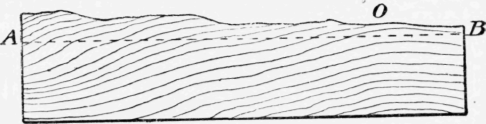
Fig.4.
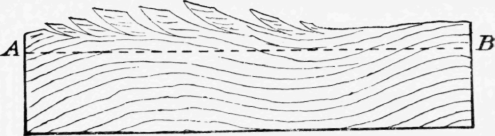
Fig. 5.
The operation of hewing, with hatchet or ax, is just the same as this. The stick must be turned with alternately one and the other end up, according to the grain, and when much wood is to be taken off, it must be scored and split as in the last exercise. The operation may be tried on one of the sticks of fire-wood used in Exercise 2. Holding the stick upright on the block with the left hand, turn one of the faces towards the right. Score obliquely into the more prominent parts, and then split them off. When the face has been made pretty nearly plane, smooth it off with light strokes of the hatchet, turning up now one end and now the other, so as to cut with the grain. Examine your work critically to see whether the face you have been working on is straight and smooth.
Continue to:


My Books

