


Lesson III. Strength Of Wood
Description
This section is from the book "Manual Training: First Lessons In Wood-Working", by Alfred G. Compton. Also available from Amazon: First Lessons In Wood-Working.
Lesson III. Strength Of Wood
WE have seen, in our previous exercises, that it is much easier to cut and split wood lengthwise than crosswise. We will now look into this matter more closely.
Exercise 6. Hewing With Hatchet
If we examine with a microscope the structure of the trunk of a tree, we find that the wood consists of fibers or threads running lengthwise of the trunk and adhering to each other more or less strongly. In many plants these fibers are longer and more easily separated than in trees, and they are used for twisting into ropes and into threads to be used in weaving. By examining specimens of hemp and of flax, you will learn something of the length and strength of such fibers. In some kinds of wood these fibers adhere so loosely that they can be separated by heat, moisture, and bruising. The fibers of bass-wood and some others are thus separated, to Wood-Working, be used in making paper. Fig. 6 shows the appearance of the fibers of Scotch Fir, a species of Pine, under the microscope. Now, while these threads have singly considerable strength, and still more, of course, when a number of them are taken together, their adhesion to each other is not so great. On the next page is shown a round pine stick, six inches thick, with the bark on, just as it grows in the tree, and we will cut off some pieces to illustrate what has been said. The stick is cut square across at the ends, and you can see the rings which mark how much the trunk grows each year. First I cut off a cylindrical piece six inches long, Fig. 7. Next, from this, I split off with an ax or a draw-knife some pieces a quarter of an inch thick, beginning at the outside, and splitting wider and wider pieces, till I get one four or five inches wide, by splitting along the lines a b, a c. In the piece a b d c thus cut off you can see the edges of the layers of fibers of which the ends were seen in the cylindrical block, and, comparing carefully the end of the thin board with the face, you see that these edges constitute the "grain" of the wood, and can also see why they are closer together near the edge of the board and farther apart near the middle, or why the board is fine-grained near the edge and coarse-grained at the middle.

Fig. 6.

Fig. 7.
Page 16, Fig. 7. - The end of the block should show concentric rings, not a spiral. It is shown correctly in this figure.
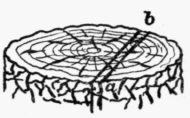
I will now cut off from a b d c a strip a b f g, half an inch wide, with a fine saw. In this strip, which I will mark A, the grain runs crosswise. Next, with a knife or hatchet, I will split off another strip, f d h i, also half an inch wide, in which the grain runs lengthwise, and which I will mark B. Now taking the first piece by the ends and pulling it, I can break it in two; but no pull that I can give is strong enough to break the other. (I am careful not to bend either of the sticks, because I want to consider now only the question of breaking by a direct pull; breaking by bending is something more complicated, and cannot be considered till later.) I hand you all now a number of such strips, of both kinds, and you readily satisfy yourselves that it is much easier to separate the fibers from each other than to break them.
After we have thus found out that wood is stronger lengthwise than crosswise, we may go a step further, and inquire how much stronger. We may put one of the pieces of each kind in a small "testing-machine," and apply an increasing force to it till it breaks. With such a machine we find that the piece A is broken by a pull of 65 pounds, while it takes 700 pounds to break B, and, as the two pieces are of the same size, we conclude that this kind of wood is about eleven times as strong lengthwise as it is crosswise. The operation of "testing," and the machine used for the purpose, are of the greatest importance. The architect and the engineer make use of powerful machines, in which large bars and columns can be strained till they break, and the breaking force measured. At the proper time you will find no difficulty in understanding these larger machines and operations, if you have understood the smaller ones. In the machine shown in Fig. 8, the piece to be broken is held by the clamps A and B. The wheel C being turned the screw D is drawn down, which raises the other end, E, of the lever, E F, and stretches the piece till it breaks. The index, G, on the spring-balance shows how great is the force applied at F; and the force applied at E is as many times greater than this as the length of H F is greater than that of E H. As the piece stretches before breaking, the pull is applied at first by means of the screw 7, and afterwards by C.

Fig.8.
Our experiments with these pieces of wood agree with our observations on the action of cutting-tools. The knife and the hatchet, when cutting square across the fibers, penetrate but a short distance, unless a very great force is applied, but when cutting between the fibers they are much more easily pressed forward. With such tools, therefore, we were obliged to cut lengthwise or obliquely, and found it nearly impossible to cut a thick piece square across. If we wish to do this we must use another tool. The tool specially designed for this work is the cross-cut-saw, which we will study in our next lesson.
Continue to:


My Books

