


The Simplest Kind of a Camera
Description
This section is from the "Handicraft For Boys" book, by A. Frederick Collins. Amazon: Handicraft for boys.
The Simplest Kind of a Camera
When you can buy a real camera for two or three dollars it seems of little use to make one, so just consider the camera I shall describe as a scientific curiosity rather than an apparatus of utility.
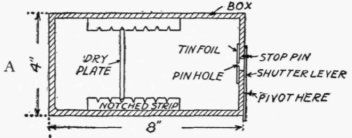
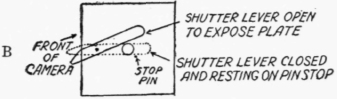
Fig. 56. An Easily Made Pin-Hole Camera
A. Cross section showing the notched strips.
B. The way the shutter works.
To make a pin-hole camera, so called because a pin hole takes the place of a lens, form a box of pasteboard or of thin wood 4 inches square and 8 inches long; cut a hole 3/8 of an inch in diameter in one end for the pin hole. Fit a strip of wood 1/2 an inch thick and 4 inches long, having notches cut into it to a depth of 1/8 inch, to the sides of the box as shown at A in Fig. 56. These notched strips are to hold a sensitized dry plate.45 Next make a shutter, that is, a little device to open and close the pin-hole; it is simply a bit of sheet brass 2 1/2 inches long, 1/4 inch wide at one end and 1/2 an inch wide at the other end as shown at B. Drill a hole 1/8 inch in diameter in the center of the strip of brass and pivot this to the front of the box so that it is on a horizontal line with the center of the hole.
Now to make the pin-hole, and certainly no pinhole was ever more important than this one. Glue a thick piece of nice smooth tinfoil over the hole on the inside of the box and with a fairly good-sized pin, or better a needle, prick a smooth hole in the center of it.
You are ready now to take a picture and to do so slip a sheet of ground glass46 into the grooves in the camera up close and then farther back until you can see the picture plain. This done take the camera into your dark-room,47 and load a dry plate into it, put the cover on the box and fasten a black cloth over it with a rubber-band as shown at C in Fig. 56.
Go out and point your camera at the object you want to photograph, be it a landscape, a seascape or a scapegoat, press down on the lever for a second, let go of it when it will drop back and cover the pin-hole again and the exposure is made.
45 A dry plate is a sheet of glass coated on one side with gelatin and bromide of silver which makes it sensitive to light.
46 You will find directions for making it in Chapter IX.
47 A dark room must be used because a ray of any kind of light except red will spoil a dry plate the instant it strikes it. A red-lamp can be bought for a quarter or you can make one and either use a sheet of red glass or red dark-room paper.
Continue to:


My Books

