


Floor Laying, Inside Finish. Part 4
Description
This section is from the book "Inside Finishing", by Charles A. King. Also available from Amazon: Inside Finishing (1912).
Floor Laying, Inside Finish. Part 4
The torus (/) (bead, round, or thumb molding) and the astragal (g) should appear to go around, as if to bind together. The scotia (h) and the fillet (i) are used as intermediates, to separate one member of a compound molding from another, and to give variety to a large cornice, or to form a break in a wide, flat surface.
The ovolo and the talon generally should be located above, and the scotia below, the eye.
The contour of moldings of the best periods of architecture is elliptical, not round, and in making and designing moldings, the workman should always strive for a graceful elliptical curve, instead of an arc of a circle.
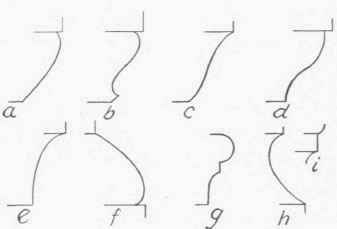
Fig. 14. - Classic Moldings.
A comparison of the two forms will show the difference in appearance.
In general, important moldings above the line of the eye extend upwards, and those below the eye extend downwards, from the vertical plane at an angle of about 45°, so that no important member of the molding will be out of the line of vision.
(E.) A baseboard is usually 8" wide, and should be well seasoned; it should not be put on until the plastering is thoroughly dry, or it will curl off, the moisture in the plastering swelling the back of the board, while the front remains dry.
When a single floor is laid, the baseboard is fitted upon the top of the floor boards, and a quarter round or shoe strip similar to n or w of Fig. 9 is nailed on to cover the joint, as at d, Fig. 7.
If the shoe strip is nailed to the baseboard, the shrinkage of the floor and baseboard will show a crack under the shoe strip, but if it is nailed to the floor, the shoe strip will follow the floor, and move with it, thus showing no joint.
If it is desired to dispense with the shoe strip, the baseboard should be nailed to the wall after the under floor is laid, and the wearing, or top floor, fitted to the baseboard, as at c, Fig. 7. Care should be used in fitting the ends of the flooring to the baseboard, for if one floor board is forced too much, it will push the base away from the one which was laid before it.
In cutting the baseboard down, the outside corners are mitered, and the inside corners cut square and butted upon common work; but upon the best class of work they should be housed, as shown at a, Fig. 15, to insure that the seasoning and settling of the building will not open the joint.
If it is necessary to splice moldings, the joint should be made in the least conspicuous place; to make the fewest possible splices, the long pieces should be fitted first. These splices may be made with either a butt or a miter joint, the latter of which is preferred by many workmen.
(F.) The quality of the work done with moldings depends to a great extent upon the condition of the moldings used, and the selection of the material from which they are made. The lumber should be straight and straight-grained, and kept lying straight. After the moldings are "stuck" that is, made, they must be handled with great care, or the corners and fillets will be bruised. One of the earmarks of a good workman is that he always leaves square corners; no rough, or "spalled" (rubbed), or broken edges should be permitted, but all corners and angles should be perfectly smooth and accurate.
15. Molding joints. - The curve of the joint between a straight and circling piece of molding may be found by the intersection method: place the moldings in their exact relation to each other, and mark the extreme points (a, b, Fig. 16). To ascertain c by another method than the "cut and try," lay out the moldings upon a board with a pencil, indicating a center line of each piece, and their intersection as c. The arc of a circle drawn through a, b, c, will give the sweep of the joint. Draw the chord of the arc of the joint as indicated by the dotted line, and measure the distance of its altitude at c; this must be transferred to each piece which is to form the joint. Upon a large molding, it may be easier to find the sweep by the well-known problem of constructing a circle from three given points.

Fig. 15. - Housing Corners of Baseboards.

Fig. 16. - Jointing a Straight and a Curved Molding.
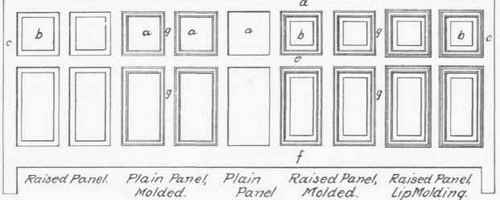
16. The dado. - (A.) Woodworking machinery has made the construction of panel work, similar to the types indicated in Fig. 17, a simple matter. A dado of matched or beaded ceiling may be easily and economically made, and is often used in places where a more expensive dado is unnecessary. A ceiling dado is made upon the work, but paneled dado is usually made in a shop which has all of the appliances necessary for doing the work economically and well.
The measurements for dado should be taken at the building after the partitions are set, and it is possible to locate accurately all the openings and angles.
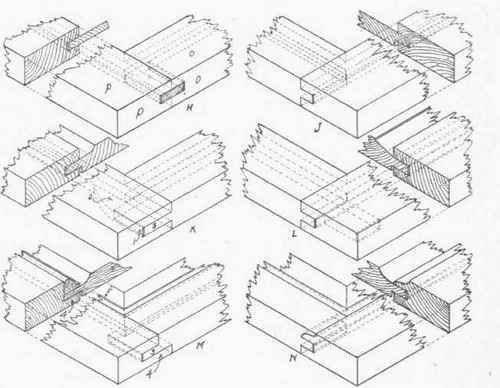
The different types of panel work, the names of their members, and the methods of construction in common use are illustrated in Fig. 17. At a is shown a plain panel, and at b a raised panel; either type may be used upon the cheapest or the best work, depending upon the effect desired. The grooves for the panels in the different members of the frame are usually 9/16" deep to accommodate \" of the panel and to allow for any possible swelling.
The stiles (c) should be grooved, usually upon one edge only, to receive the panels and the ends of the rails d, e,f.
Continue to:


My Books

