


Heating, Ventilation, Sanitation, Refrigerators. Part 4
Description
This section is from the book "Inside Finishing", by Charles A. King. Also available from Amazon: Inside Finishing (1912).
Heating, Ventilation, Sanitation, Refrigerators. Part 4
(B.) A refrigerator operates upon the principle that air of a low temperature will descend, and that of a high temperature will rise if both are confined in the same compartment.
To make an efficient refrigerator the walls should be airtight, and the doors fitted closely and forced tightly into their places. The walls should be made of two or more thicknesses of ceiling, with air spaces between in which the air is perfectly dead. In order to insure this, there must be studding every 18" or 24", as the stock will work to the best advantage. The ceiling in every case should be laid upon dressed studding of an even thickness, say 1 3/4" x 2 3/4", and a good grade of sheathing paper laid between the stud and the ceiling.
Figure 1 shows two methods of building the walls of a refrigerator. At a is shown the method of constructing the wall. Ceiling is laid upon the studding or framework of the refrigerator, with sheathing paper (b) between it and the studding, leaving a dead air space (c) between the two layers of sheathing paper; this is an efficient means of preventing the inside of a refrigerator from being affected by the outside temperature. The space c may be filled with shavings, which will settle vertically unless filled under pressure. This is often done, but it accomplishes little, or no more than does a dead air space.
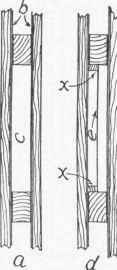
Fig. 1. - Refrigerator Walls.
At d, a piece of sheathing paper (e) is tacked tightly upon the small pieces of wood (x) which surround each space between the studs; this makes an extra air space to help make the walls impenetrable.
The walls of refrigerators are sometimes insulated with hair felting, or with mineral wool, which, if kept dry, will make an excellent wall to resist the passage of air from the inside or outside of the refrigerator.
For convenience, the ice door should open from the front of the refrigerator and be of a size to admit as large a piece of ice as possible; if the door is in the top, the ice will not melt so rapidly.
The doors and jambs should be made and fitted by some method similar to that shown in Fig. 2, by making as nearly an air-tight joint as possible at a by means of a felt or rubber weather strip, and by forcing the door into its place by a lever lock (b), placed upon the outside of the door. There are several kinds upon the market, but the one illustrated at b is efficient and economical.

Fig. 2. - Refrigerator Door and Lock.
Figure 3 shows the construction of an ice chamber, which should occupy from one fifth to one third of the cubical contents of the refrigerator. At b is seen the ice rack, the top of which should be set level. The floor of the ice chamber (c) should be set at a pitch so that the cold air will have plenty of room to find its way to the cold air duct (d) through which it is carried some distance below the bottom of the ice floor. As the air absorbs gases and heat from the foods, its temperature rises, and it passes through the warm air flue (e) and into the ice chamber (w) where the gases condense upon the ice and pass off in water form through the waste pipe (/) which has a trap at the end of it, to prevent the escape of cold air. The ice chamber should be lined with galvanized iron, which is very durable, but in the lower-priced refrigerators, zinc is much used.
This is, in substance, the method of the construction and operation of ice refrigerators. Other things being equal, the one which gives the freest circulation of air is the one which will give the best results, both in economy of ice and in the preservation of its contents.
In building a refrigerator, the workman cannot be too careful in making all joints as nearly air-tight as possible. It is the poorest economy to save on the price of the refrigerator by omitting anything which will tend to make it air proof, as the additional cost of the ice unnecessarily used will soon be more than the extra cost of building the refrigerator properly.
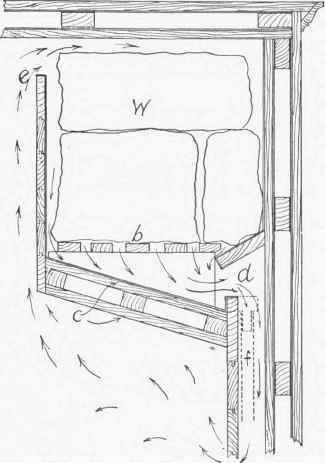
Fig. 3. - The Ice Chamber.
10. Construction of an ice house. - Figure 4 indicates the method by which an ice house may be constructed.

Fig. 4. - Ice House Construction.
The ground upon which the building is to stand should be well drained with a tile drain, as at c, not less than 12" below the surface, and in rows not more than 6' apart. The site should be so graded that no surface water will run over the floor after the building is completed. A slope in the ground upon which the house stands will assist in the drainage.
The house should be large enough to allow at least one foot of sawdust, shavings, or hay under and on each side of the desired quantity of ice, which should be packed in a solid mass, with nothing between the cakes. Hay is preferred for the outside packing, as it may be handled more easily than either sawdust or shavings.
It is the custom of many, after the ice house is filled, to deluge the mass of ice with water, thus making nearly a compact mass, and preventing the circulation of air as much as possible. After the house is filled, the ice should be covered with at least a foot of hay.
The building should be covered with a tight roof, and the gables boarded up, with a door (a) at each end for ventilation. These should never be entirely closed during warm weather. Doors for convenience in filling and emptying should be made at b, b, b. In large ice houses, the filling and emptying is done by machinery and inclined planes.
Suggestive Exercises
1. Is a fireplace satisfactory for heating a room? For what is it chiefly valuable? What are the objections to stoves as a method of heating?
2. What is the general tendency in installing a furnace? At what level should a furnace be set? How is this sometimes done? Why is this necessary? What is the least pitch or rise a conductor pipe should have? Which pipes generally have less pitch? At what point should a furnace be located in regard to the heating system of the house? How should the prevailing winds affect the location of the furnace? Why? What should be the capacity of a cold air duct? How is the supply of cold air regulated? How is the cool air often taken from the house and used again? Is this a perfectly hygienic arrangement? Why is it a satisfactory method for dwelling houses? How should the conductor pipes be treated to retain the heat? When should the pipes be put in
* the partitions? What provision is made to prevent the air from being too dry? What are the objections to very dry air?
3. What is meant by direct heating? Describe it. In what kinds of places is it used? For what places is it unfit? What is meant by indirect heating? Describe it. How is this method of heating used in connection with a ventilating system? What is the objection to conducting the partly heated air back to the heater? What is the advantage? How is it made less objectionable? What is meant by direct-indirect heating? Describe it. In what sort of places is this method of heating used? Which is considered the best of the three methods?
4. What is one advantage of a steam-heating system for an old house? In what sort of buildings is it generally used? Why is it undesirable for a small house? What methods of radiating may be used? What is generally the heating medium for the indirect method? What is the advantage of a steam-power plant as regards heating? What is the common pressure of a direct steam-heating system? What are the two systems of connecting radiators? What is the objection to sagging pipes?
5. Which is the more expensive system to install, steam or hot-water? Which is the more popular for dwellings? Why?
6. What are the requirements of a complete system of ventilation? Why should a room to contain a large number of people be high? Where is the heat of an indirect system usually conducted into a room? How are the poisonous gases removed from the room? In what part of the room do these gases gather? What are the two methods employed in removing vitiated air from the room? Describe the natural draft. Describe the forced draft. Compare them.
7. In what way is it customary for the carpenter to assist the plumber? When should the pipes in the walls be laid? What should the carpenter do in regard to the inspection of the plumbing? What is the most important part of the plumbing?
S. What cities have the best system of sewerage? What are the advantages to these cities? What is the objection to discharging sewage into a lake or river? Where should a privy be located? How may a privy be made inoffensive? How should chamber slops be disposed of? Describe the kind of house necessary for an efficient dry earth closet. Describe an earth closet receptacle. Describe a cesspool system of sewerage. What is the objection to this method of disposing of sewage? What kind of soil is best for a cesspool? Given an outline of the subsurface drainage system. What should be the pitch of a sink drain? What should be its size? How should the drain tile be laid? Should the end of the drain rest upon the ground? Why?
9. What is the principle of the operation of a refrigerator? Describe the construction of the walls of a refrigerator. What is a necessary condition of the walls? How should the doors be fitted in order to be as nearly air-tight as possible? Describe the interior construction of a refrigerator. Describe the circulation of air in a refrigerator. Compare the different locations of the ice door. What is poor economy in building a refrigerator?
10. How should the ground under an ice house be treated? How should surface water be kept out? Describe the construction of an ice house. How much sawdust should surround the ice? How should ice be packed in an ice house? How should an ice house be ventilated?
Continue to:


My Books

