


Stair Building. Part 6
Description
This section is from the book "Inside Finishing", by Charles A. King. Also available from Amazon: Inside Finishing (1912).
Stair Building. Part 6
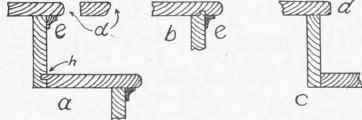
Fig. 70. - Construction of Treads and Risers.
A single piece of molding consisting of the nosing and scotia is sometimes used upon cheap work, as the end finish of the treads. In this case the ends of the treads are cut off flush with the face stringer, the front corner being mitered to receive the nosing of the end molding; the scotia under the front edge of the tread is then mitered in the usual way.
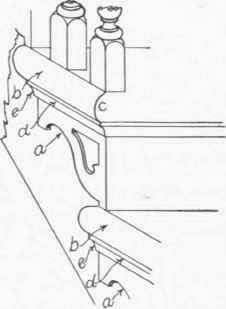
Fig. 71. - A Method of Finishing the Ends of Treads, and of Mitering a Riser and Face Scroll.
52. Circular stair risers. - A circular stair riser, illustrated in Fig. 72, is frequently needed, and one method by which it may be made is illustrated by Fig. 21. After the saw kerfs have been made, the riser is bent around a form and glued permanently, as at a, b, Fig. 72, and held in place by hand screws, as at c, c until the glue sets. The tread is fastened by nailing into the solid block (a, b).
A circling riser is sometimes built as shown at b, Fig. 72, the board being sawed, or planed thin enough to bend around the block (e, f). It is then glued there, being held in place by a piece of sheet iron (g) which is fastened to blocks (h), and held in place by hand screws, as at c, c, until the glue is set.

Fig. 72. - Methods of Making a Curved Riser.
Another method is shown at c, Fig. 72, in which the riser is resawed, as shown at j, and pieces of paper, pasteboard, or wood veneer (k), the thickness of the saw cuts placed in the cuts, and the joints filled with glue. The whole is then bent around a form, being held in place by some method similar to that illustrated at b. After the glue has set, the riser may be treated as straight. This method may be used to make circular work of any kind, soffits, bases, etc., it being an application of the method explained in Topic 18, B. A curved board, made of thin pieces glued around a form, is the strongest kind.
53. Handrails. - There are many different designs of handrail, or stair rail, a few of which are shown in Fig. 73; only expense and individual taste can decide which is to be preferred, one of the principal considerations being the ease with which the rail fits the hand.

Fig. 73. - Forms of Handrails.
Figure 74 shows the usual methods of fastening rails to the posts, - a being suitable for use only upon the cheapest work and b indicating the best method for making a permanent job.

Fig. 74. - Methods of Fastening Handrails to Posts.
Sometimes it is necessary to splice a rail, though this should be done only as a last resort. If the long splice method, shown at a, Fig. 75, is used, the point of the splice on the top of the rail should be pointed downstairs, and care should be taken to see that the rail is straight. If the rail bolt method is used, as illustrated at b, Fig. 75, the rail should be handled carefully until it is in place, as a sudden twist or wrench may break the joint. The method shown at a is generally used on the best work. A splice always should be made as near the end as possible, and not in the middle of the rail.
The material from which handrails are made should be straight-grained and seasoned thoroughly, for if a rail springs after it is in place, the defect is difficult to remedy. A handrail that is so long that it is not stiff enough sideways is often strengthened in the middle by a cast-iron baluster of the same design as the others, to the bottom of which has been added an angle-iron or brace, so that its bottom end may be set rigidly; the braces are covered by the finish. This baluster may be painted to match the rest of the stairs; if well done, its presence can be detected only by an expert.
54. Balusters. - Balusters are of many designs, suited to different styles of stairs, those with squares being used for the more expensive work. The balusters which are turned their entire length commonly are used upon stairs where economy is an object, though upon the best designed stairs a square, straight, or tapered baluster is frequently used.
Balusters are fastened to stairs by methods illustrated in Fig. 76. At a is shown the method used in fastening square-ended balusters in the best open string work; they are mortised into the under side of the rail, as at b and section k, and dovetailed into the tread before the return or end nosing of the tread is put on. At c is shown the method by which the same style of baluster is fastened upon the cheaper grade of stairs; the top is cut at the pitch of the rail and nailed, and a hole bored into the tread to receive the pin (/) which is turned on the bottom end of the square. At d is indicated the method by which round balusters usually are set upon the best class of work, and at e is shown a cheaper method, the same as method c, applied to round balusters. In methods c, d, and e, the end finish of the treads (b, Fig. 71) should be in place before the hole is bored to receive the dowel (/).

Fig. 75. - Methods of Splicing Handrails.

Continue to:


My Books

