


Water Content. Continued
Description
This section is from the book "The Mechanical Properties Of Wood", by Samuel J. Record. Also available from Amazon: The Mechanical Properties Of Wood.
Water Content. Continued
Progress of drying throughout the length of a chestnut beam, the black spots indicating the presence of free water in the wood. The first section at the left was cut one-fourth inch from the end, the next one-half inch, the next one inch, and all the others one inch apart. The illustration shows case-hardening very clearly. Photo by U. S. Forest Service.
For a given surface area the loss of water from wood is always greater from the ends than from the sides, due to the fact that the vessels and other water-carriers are cut across, allowing ready entrance of drying air and outlet for the water vapor. Water does not flow out of boards and timbers of its own accord, but must be evaporated, though it may be forced out of very sappy specimens by heat. In drying a log or pole with the bark on, most of the water must be evaporated through the ends, but in the case of peeled timbers and sawn boards the loss is greatest from the surface because the area exposed is so much greater.
The more rapid drying of the ends causes local shrinkage, and were the material sufficiently plastic the ends would become bluntly tapering. The rigidity of the wood substance prevents this and the fibres are split apart. Later, as the remainder of the stick dries many of the checks will come together, though some of the largest will remain and even increase in size as the drying proceeds. (See Fig. 27.)
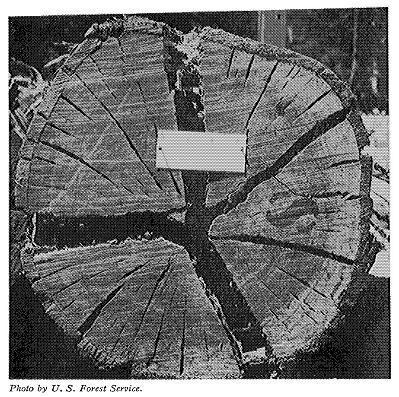
Figure 27
Excessive season checking. Photo by U.S. Forest Service.
A wood cell shrinks very little lengthwise. A dry wood cell is, therefore, practically of the same length as it was in a green or saturated condition, but is smaller in cross section, has thinner walls, and a larger cavity. It is at once evident that this fact makes shrinkage more irregular, for wherever cells cross each other at a decided angle they will tend to pull apart upon drying. This occurs wherever pith rays and wood fibres meet. A considerable portion of every wood is made up of these rays, which for the most part have their cells lying in a radial direction instead of longitudinally. (See Frontispiece.) In pine, over 15,000 of these occur on a square inch of a tangential section, and even in oak the very large rays which are readily visible to the eye as flakes on quarter-sawed material represent scarcely one per cent of the number which the microscope reveals.
A pith ray shrinks in height and width, that is, vertically and tangentially as applied to the position in a standing tree, but very little in length or radially. The other elements of the wood shrink radially and tangentially, but almost none lengthwise or vertically as applied to the tree. Here, then, we find the shrinkage of the rays tending to shorten a stick of wood, while the other cells resist it, and the tendency of a stick to get smaller in circumference is resisted by the endwise reaction or thrust of the rays. Only in a tangential direction, or around the stick in direction of the annual rings of growth, do the two forces coincide. Another factor to the same end is that the denser bands of late wood are continuous in a tangential direction, while radially they are separated by alternate zones of less dense early wood. Consequently the shrinkage along the rings (tangential) is fully twice as much as toward the centre (radial). (See Table XIV.) This explains why some cracks open more and more as drying advances. (See Fig. 27.)
Although actual shrinkage in length is small, nevertheless the tendency of the rays to shorten a stick produces strains which are responsible for some of the splitting open of ties, posts, and sawed timbers with box heart. At the very centre of a tree the wood is light and weak, while farther out it becomes denser and stronger. Longitudinal shrinkage is accordingly least at the centre and greater toward the outside, tending to become greatest in the sapwood. When a round or a box-heart timber dries fast it splits radially, and as drying continues the cleft widens partly on account of the greater tangential shrinkage and also because the greater contraction of the outer fibres warps the sections apart. If a small hardwood stem is split while green for a short distance at the end and placed where it can dry out rapidly, the sections will become bow-shaped with the concave sides out. These various facts, taken together, explain why, for example, an oak tie, pole, or log may split open its entire length if drying proceeds rapidly and far enough. Initial stresses in the living trees produce a similar effect when the log is sawn into boards. This is especially so in Eucalyptus globulus and to a less extent with any rapidly grown wood.
The use of S-shaped thin steel clamps to prevent large checks and splits is now a common practice in this country with crossties and poles as it has been for a long time in European countries. These devices are driven into the butts of the timbers so as to cross incipient checks and prevent their widening. In place of the regular S-hook another of crimped iron has been devised. (See Fig. 28.) Thin straps of iron with one tapered edge are run between intermeshing cogs and crimped, after which they may be cut off any length desired. The time for driving S-irons of either form is when the cracks first appear.
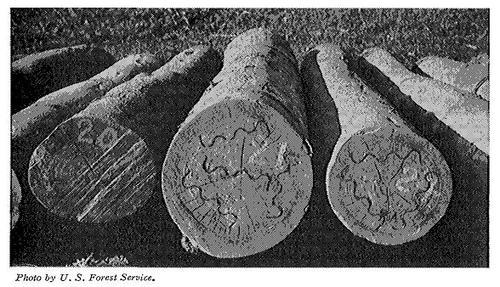
Figure 28
Control of season checking by the use of S-irons. Photo by U. S. Forest Service.
The tendency of logs to split emphasizes the importance of converting them into planks or timbers while in a green condition. Otherwise the presence of large checks may render much lumber worthless which might have been cut out in good condition. The loss would not be so great if logs were perfectly straight-grained, but this is seldom the case, most trees growing more or less spirally or irregularly. Large pieces crack more than smaller ones, quartered lumber less than that sawed through and through, thin pieces, especially veneers, less than thicker boards.
In order to prevent cracks at the ends of boards, small straps of wood may be nailed on them or they may be painted. This method is usually considered too expensive, except in the case of valuable material. Squares used for shuttles, furniture, gun-stocks, and tool handles should always be protected at the ends. One of the best means is to dip them into melted paraffine, which seals the ends and prevents loss of moisture there. Another method is to glue paper on the ends. In some cases abroad paper is glued on to all the surfaces of valuable exotic balks. Other substances sometimes employed for the purpose of sealing the wood are grease, carbolineum, wax, clay, petroleum, linseed oil, tar, and soluble glass. In place of solid beams, built-up material is often preferable, as the disastrous results of season checks are thereby largely overcome or minimized.
Continue to:


My Books

