


Mortising And Tenoning. Part 3
Description
This section is from the book "Our Workshop", by Anonymous. Also available from Amazon: Our Workshop.
Mortising And Tenoning. Part 3
The necessity for true and careful workmanship will be fully admitted when the four members of the frame are attached. If either a tenon or a mortise be, even in the slightest degree, out of square, the frame will be crooked, and the fault can be rectified only by paring a little off the opposite sides of the faulty tenon, close to the shoulder on one side, and near the extremity on the other. If the parts be much out of truth, this treatment will fail to effect a cure, as the tenon would be made so loose in the mortise that the joint would be practically worthless.
If the work prove satisfactory, the wedges for fixing the tenons may now be cut out and temporarily fitted. The wedges must be bevilled on one side only, and to the same angle as the outer ends of the mortises.
The frame must be taken to pieces to enable us to insert the panel and apply glue to the joints. The glue, which should be thin and thoroughly hot, must, with a chip or thin strip of wood, be smeared over the sides and ends of the mortises in one of the styles. The two corresponding tenons must be brushed over with glue, inserted in their respective mortises, and forced home to the shoulders. The wedges are next covered with a thin coat of glue, introduced, one on each side of the projecting tenons, and driven in moderately tight. We must caution our readers against using violence when putting their work together, as a few impatient blows may seriously injure, or perhaps totally destroy, the labour of several days. The wedges must be driven equally, or the tenons will be subjected to a severe side strain. If the external wedges (w' w', fig. 79) be even slightly overdriven, the end of the mortises will probably give way when the extremities of the styles are trimmed off.
Having successfully glued and wedged up both the rails into the first style, the panel which has been previously prepared must be inserted or planted by sliding it along the groove in the rails. The mortises in the second style and their corresponding tenons must be coated with glue; the style is then driven home by a mallet and wedged up. The mallet must be applied just within the mortises, and the blows should be distributed evenly to both ends, in order to drive the style straight. If the material of which the frame is constructed be soft and easily bruised, a small piece of wood should be interposed, to shield it from the strokes of the mallet. The ordinary hammer may then be used without fear of damaging the work.
When the glue has become thoroughly hard, the extremities of the tenons and styles must be trimmed off, as shown at C D, fig. 79. This should be done by one of the back saws, care being taken not to cut either the style or rails, which would be thereby much disfigured.
In joinery, the panel P, fig. 82, fits into grooves in the styles and rails, as shown at S; but in cabinet-making a rebate is generally made, as seen at S', and the panel is secured by slips of wood which are glued on to the frame after it is finished. In joinery, a moulding (m) is glued to the inner edges of the frame, to impart a finished appearance to the work. The moulding must not be glued to the panel, as the shrinking of the latter will separate the former from the frame.
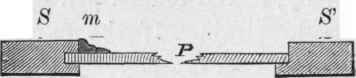
Fig. 82.
Sometimes it is necessary to make the panel flush with one side of the frame, as in fig. 83. The styles and rails are grooved in the usual manner; but the panel P is made thicker, and a rebate is formed around its edges, in order to make a tongue to fit into the groove.

Fig. 83.
Occasionally, neither grooves nor rebates are employed; and the panel is retained by the slip on one side, and by a light moulding on the other. In this case the moulding must be rebated on one edge, so that it may rest partly on the surface of the styles and rails and partly against their inner edges. This plan is generally adopted only in cabinet work when the inner edges of the rails are curved instead of straight. The curved mouldings cannot be wrought by a plane, therefore they must be carved by hand.
Sometimes in cabinet-making and light joinery, the mortises do not extend quite through the styles, and as the tenons cannot then be wedged up, the strength of the work in a great measure depends upon the accuracy and close-fitting of the parts.
When the rails are so wide that the width of the tenons would exceed four times their thickness, it is advisable to divide the tenons into two or more parts, as shown in fig. 84, which represents a wide rail having two tenons with three shoulders, which latter enter the groove in the styles. This kind of rail is unsuitable for the ends of a frame, the tenons being too near its edges; but it is used intermediately when the styles are long, and require additional support, or when several panels are to be introduced.

Fig. 84.
As a general rule, the space C D between the tenons should not be less than one-third the width of the original single tenon A B, and the shoulders, S, S, vary from one-third to one-half the width of one of the tenons.
In fig. 85 is shown the formation of the tenons and mortises for a wide external rail. The construction is very similar to that represented in fig. 80, and the only important difference is the subdivision of the tenon into two parts the object being to strengthen the style by leaving a central division in the mortise.
Another method of mortising and tenoning is represented in fig. 86. A single tenon, about two-thirds the width of the rail, is formed at the extremity of the latter, and two feather-slips (f, f) are let into the shoulders of the tenon. Corresponding grooves (g, g), to receive the feathers are ploughed in the styles on each side of the mortise.

Fig. 85.
Before using the plough, the inner ends (i, i) of the grooves must be cut with a small mortise-chisel of the same width as the plough-iron, to enable the chips to detach themselves. A hole of the same diameter as the width of the intended groove may be first made; the chisel can then be used with greater facility.

Fig. 86.
The feathers are useful, inasmuch as they impart greater steadiness to the frame by checking any tendency of the shoulders to rock on the style.
Continue to:


My Books

