


Summer-Houses. Part 2
Description
This section is from the book "Rustic Carpentry", by Paul N. Hasluck. Also available from Amazon: Rustic Carpentry: Woodworking with Natural Timber.
Summer-Houses. Part 2
Fig-. 161. - Section through Centre of Lean-to Summer-house.
Down the "valleys" at the juncture of the main roof and the entrance gable a strip of zinc will, of course, be nailed before the shingles are put on, whilst along the ridges a strip of zinc will be nailed upon the shingles; and this latter will need painting to match the colour of the wood.
Various suggestions may be given for finishing the inside of the roof. Supposing that round or half-round larch stuff has been used for the rafters (the latter is to be preferred for shingles, as giving a level surface to board upon), the space between the rafters may be covered with bark- virgin cork or otherwise - the chinks being stuffed with moss. But if this is done it will be well to fix the bark with screws, as the vibration caused by driving nails would displace or loosen the shingles.
A second plan under the like circumstances would be before nailing the boards upon the rafters to stretch matting across the latter - either ordinary garden bast matting or, better, the more substantial rush matting, both of which are very inexpensive. These have a pleasant natural colour (the last-named especially, of a greenish hue), and are so unartificial in their structure as to appear in no way out of place among rustic work.
Or it may so happen that suitable larch stuff is not to hand, and that ordinary sawn scantling has to be used for the rafters. If so, the whole roof may be hung with ling; or the rush matting may be stretched across the lower side of the rafters and tacked there, being afterwards more completely secured and finished by nailing a split hazel or other rod down the middle of each rafter. This last plan makes a neat and pleasing roof.
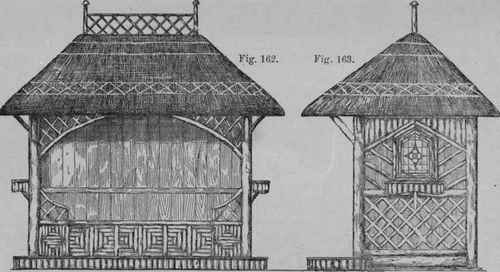
Figs. 162 and 163. - Front and Side Elevations of Shelter for Tennis Lawn.
It scarcely needs to be said that to make such a summer-house look its best the wall on each side ought to be covered with ivy or other creepers; and it will also be obvious that, if the height of the wall permits the floor of the summer-house to be raised a step or two above the surrounding level, the structure will gain thereby both in effectiveness of appearance and in plea santness as a place in which to sit.

Fig. 164. - Part Roof, Seat, and Floor Plans for Tennis Lawn Shelter.
The rustic summer-house or tennis lawn shelter illustrated in front and side elevations by Figs. 162 and 163 is constructed from straight saplings and twigs that have had their bark removed, and have been subjected to a reasonable period of seasoning. A new feature in the design is the accommodation under the seats for the reception of the croquet or tennis gear, and also the extended eaves and floor (see Fig. 164) and the open front, giving at once an uninterrupted view of the game and shelter-from the direct rays of the sun.

Fig. 165. - Connecting- Plates to Corner Post. Fig. 166. - Fixing Sleeper to Posts. Fig 167. - Section of Flooring Fig. 168. - Finial. Fig. 169. - Detail of Garden Shelter at Front Eaves. Fig 170. - Section of Seat.
The shelter is 10 ft. long by 5 ft. 6 in. wide, the height from the floor to the eaves being 6 ft. 3 in., and from the floor to the ridge 9 ft. The four posts are 6 ft. 9 in. long by 6 in. in diameter. The middle and lower end and the back rails are tenoned to the posts, a flat being formed on the post by the mortise and a corresponding shoulder on the rails. The remaining portion is worked to fit roughly the contour of the post.
The plates are o in. by 5 in. in section, and are secured to the posts with long galvanised bolts and nuts and a 3 1/2-in. square washer under the heads of the bolts. When halving the front plate, allow it to house into the side plates 1 1/2 in. ; by this method it will have a bearing on both posts. In Fig. 165 the left-hand plate represents the front. The front posts are connected at the floor line by a scantling, 4 in. by 3 in., which also forms a sleeper for the floor joists; see Figs. 166 and 167.
The structure rests on a low plinth of bricks, spaces being left for the circulation of air under the floor.
The extended floor also rests on bricks placed immediately below the joists; see Fig. 167, which is a section on c d (Fig. 164). The twig plinth nailed around the front will effectually conceal the sleeper and brick foundation.
The rafters are 2 1/2 in. by 3 in., and the ridge and hip rafters 2 in. by 5 in., the finials (see Fig. 168) being nailed between the angles of the hips. The eaves in front project 2 ft. beyond the posts, and Fig. 169 shows the method by which the additional width is obtained.
The sides are filled with 5/8-in. vee-grooved and tongued boarding, to which is attached the rustic work.
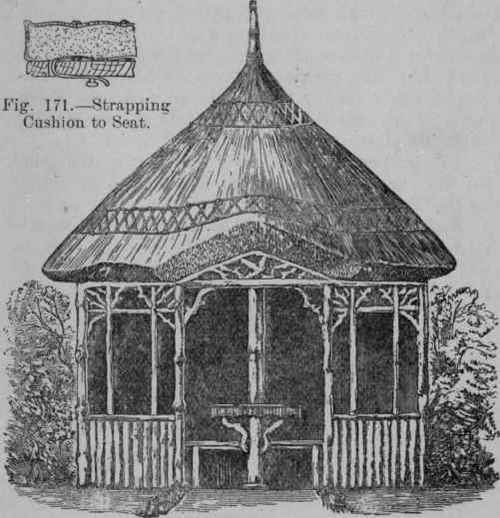
Fig. 172. - Front Elevation of Octagonal Summer-house.
The stained glass windows are fixed, and on the outer side of the back are diagonal braces made from split saplings, while in the centre a vertical post runs from sill to plate.
The braces and post are shown in the plan (Fig. 164).
The seats are constructed to form lockers (see Fig. 170, which is a section at a b, Fig. 164), their height being 1 ft. 3 in., which, with the addition of a 3-in. cushion, will form comfortable sitting accommodation.
Continue to:


My Books

