


Diagonal Chinese Cross
Description
This section is from the book "Woodwork Joints", by William Fairham. Also available from Amazon: Woodwork joints.
Diagonal Chinese Cross
At Fig. 395 is given a sketch of a completed Chinese block or cross puzzle in which the various pieces of wood go together diagonally. Plane up a piece of hardwood (which may be about 14 ins. or 15 ins. long) so that it measures on its end 1⁄2 in. square. Cut the wood into six pieces which measure about 21⁄4 ins. long, and then proceed to mark out, saw and pare up with the chisel two pieces likesketch A, three pieces like B, and one key piece as C. Now fit these together to make the completed cross. The solution is left to the reader.
 Fig. 395. - Diagonal Chinese Cross Puzzle. (Two Pieces required of A, Three of B and One of C.)
Fig. 396 shows a combination of six pieces which, when fitted together, will make the Chinese cross similar to Fig. 392 . Plane up the strip of hardwood (birch preferred) so that it measures 1⁄2 in. square at the end and proceed to mark out and make two pieceslike D, two like E, one like F, and one piece like G. Put the pieces together to form the Chinese cross. Again the reader is left to solve the problem of fitting.
 Fig. 396. - Another Chinese Cross. (Two Pieces required of D, Two of E, and One each of F and G.)
Square Puzzlesare of endless variety. Four of these are shown, all simple to make, but not equally simple to solve. The only material required for each is a5-ins. square piece of 1⁄8-in. fretwood or plywood; or, if preferred, pieces of different colour may be used. The diagrams are given exactly half size, and the lines may be set out direct on the wood. It will be noticed that all four puzzles are strictly geometrical in character.

Fig. 397. - Six-piece Square Puzzle. (For Guidance in Setting Out, the Centre of Top Line is marked at A.)

Fig. 398. - Five-piece Square Puzzle. (In Setting Out, note that the Angles B B are Right Angles.)
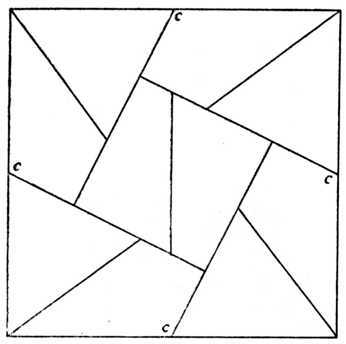
Fig. 399. - Ten-piece Square Puzzle. (For Guidance in Setting Out, the Centre of the Four Outlines are lettered at C, C, C, C.)

Fig. 400. - Six-piece Square Puzzle. (The Centres of the Four Outlines are lettered at D, D, D, D.)
Fig. 397 is made up of six pieces and is the simplest of the group to solve. Although containing only five pieces, Fig. 398 will be found to give more trouble.
Fig. 399 , with ten pieces, is undoubtedly the most trying puzzle, and will be found as baffling as many jig-saw pictures. Fig. 400 , again, presents only moderate difficulties.
If the reader prefers, he may cut the squares to the size illustrated instead of enlarging them.
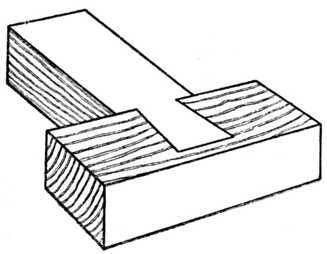 Fig. 401. - Blind Dovetail Puzzle Joint (see page 199).
Continue to:


My Books

