


Sawing For The Recess
Description
This section is from the book "Woodwork Joints", by William Fairham. Also available from Amazon: Woodwork joints.
Sawing For The Recess
After marking out for the hinge, as shown at Fig. 224 , take a fine-toothed saw (a dovetail saw is considered the best) and saw down as shown at Fig. 225 , care being taken not to cut beyond the gauge lines. In this sketch three intermediate saw kerfs are shown, but if the hinge is of great length, say 5 or 6 ins., the removal of the waste wood will begreatly facilitated by the addition of more intermediate saw kerfs. These cuts sever the cross fibres and allow the timber to be easily pared away in short lengths.

Fig. 224. - Marking for Recess.
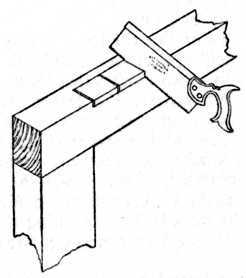
Fig. 225. - Sawing for the Recess.
 Fig. 226. - Tool Operation when Paring Out the Hinge Recess in the Door.
In Fig. 226 we see the tool operation when paring out the hinge recess. At the left of the drawing the recess is shown marked. Take a 3⁄4 in. chisel and, using it as a knife (see A), deepen the gauge lines. Then stab the chisel downwards, as at B, to deepen the end lines. Next, take the chisel and pare away the back of the recess as at C. The work may then be completed by paring neatly till the bottom of the recess is flat.
Continue to:


My Books

