


Tenon Saw
Description
This section is from the book "Manual Instruction: Woodwork. The English Sloyd", by S. Barter. Also available from Amazon: Manual Instruction: Woodwork.
Tenon Saw
This saw is for a similar purpose to the panel saw, but it is not intended to cut such thick pieces of wood as will necessitate passing the whole depth of the saw through the cut. The blade is made thinner, ensuring a finer cut, and has very great stability imparted to it by the strong stiffening rib of steel or brass down the back. This is called a spring back, for it is curved very slightly from end to end, exerting a slight pulling strain on the tooth edge directly from the back, and making the blade stiffer when in use.
The best quality of saws are finished by the makers with brass backs, the inferior ones with iron. The brass is not merely ornamental, as its increased weight is very valuable in this saw. Chiefly because of their better quality more pains are taken in their finish in every particular, making these brass-backed saws very much more expensive in first cost, but more economical, by reason of the great wear they will stand.
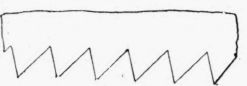
Fig 71.
The teeth of the tenon saw are small, about eight or ten to the linear inch, and have shallow throats. Their general shape is similar to the hand-saw teeth.
The closing of the brass back is almost invariably better done by hand than by machine. Machine-closed backs do not usually clasp the blade quite thoroughly, and gradually the saw will slip in the back, and very possibly the rivets in the handle will be cut partly through, rendering the saw unserviceable.

Fig. 72.
The usual dimensions of tenon saws in use by carpenters are 14 ins. to 16 ins. long, 21/2 ins. to 3 1/2 ins. deep, with ten teeth to the inch.
The Dovetail Saw is really a small kind of tenon saw, with very fine teeth for executing small work.
For all manual training purposes, however, the saw in fig. 72 will be found sufficient to fill the place of tenon saw and dovetail saw, with a corresponding saving of expense. The handle is similar to that of the dovetail saw, but the blade is longer and deeper.
The most convenient size is that shown by the dimensions in the illustration.
Continue to:


My Books

