


An Improved Dowel Plate
Description
This section is from the book "Handy Man's Workshop And Laboratory", by A. Russell Bond. Also available from Amazon: Handy Man's Workshop And Laboratory.
An Improved Dowel Plate
The chief fault with the ordinary dowel plate is the naturally obtuse cutting angle, formed by the edges of a hole bored in a flat steel plate. The dowel plate here illustrated presents to the wood an acute cutting angle, and also admits of being sharpened. Obtain a leaf of a buggy spring which has on its convex side surrounding the two holes a raised portion or boss. Soften the spring, and cut out the part required, leaving enough metal on either side of the hole to admit of its being drilled for screw holes. Run a twist drill through the hole with the raised lip, to make it of a standard size, and smooth the interior. After drilling, file the edges of the lip until quite sharp, screw the plate down to a suitable block of hard wood, and bore through it with the same twist drill. The plate is then complete. A mallet must be used for driving the dowels through the plate, so as not to injure the cutting edges.
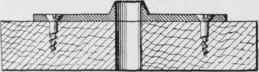
Fig. 124 - An improved dowel plate.
Continue to:


My Books

