


Chapter VI. The Handy Man's Electrical Laboratory. An Unbreakable Leyden Jar
Description
This section is from the book "Handy Man's Workshop And Laboratory", by A. Russell Bond. Also available from Amazon: Handy Man's Workshop And Laboratory.
Chapter VI. The Handy Man's Electrical Laboratory. An Unbreakable Leyden Jar
Two ordinary tin cans may be used to make a serviceable Leyden jar, which has the advantage of being unbreakable.
Select two tin cans such that the diameter of the one exceeds that of the other by about one-half inch. Cover the bottom of the larger can (inside) with a disk of rubber or varnished cardboard. To the bottom of the smaller can (on the outside) solder a piece of iron or copper wire, bent into a hook at the tip, or else ending in a ball. Around the smaller can wind an old rubber plate or several layers of silk rags or well-varnished parehment, folding this insulating layer down into the can over the edge, an inch or more. Place the smaller can, thus insulated, with the edge down, in the larger can, and the Leyden jar is completed, ready to be charged from a frictional machine or an electrophorus.
The inner can should stand out an inch or so above the outer can, to prevent sparks from passing over.
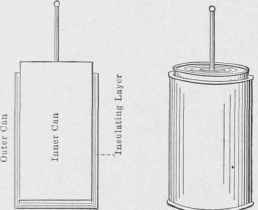
Fig. 195 - An unbreakable Leyden jar.
A Substitute For Tinfoil In Leyden Jars
The deposit of silver from a mirror solution is a convenient and effective substitute for the tinfoil on the inside of Leyden jars. It lies close, and presents no points or sharp edges to invite a puncture of the glass. It very much enlarges one's choice of bottles, as one is not obliged to sacrifice a flask of good dielectric properties because it has too narrow a mouth for convenient manipulation of the tinfoil. The suggestion may have other applications; for instance, a pair of thin glass test tubes, silvered in this way, serve very well in the construction of Regnault's hygrometer.
The easiest way to get proper silvering solution is to go down to the mirror maker's with the flasks that need the coating. The solution can be purchased for a trifle. The following formula will do very well. A. Rochelle salt 10 grammes in 1 liter of water. B. Silver nitrate 5 grammes dissolved in a little water. Add 3 grammes of strong ammonia gradually, so that the precipitate at first formed is dissolved. Add water enough to make 1 liter. Mix equal parts of A and B. The glass ought to be perfectly clean and at a temperature of 25 deg. or 30 deg. C. In about half an hour the deposit is complete.
Continue to:


My Books

