


Chapter VII. The Handy Man About The House. A Novel Music Stand Or Book Rest
Description
This section is from the book "Handy Man's Workshop And Laboratory", by A. Russell Bond. Also available from Amazon: Handy Man's Workshop And Laboratory.
Chapter VII. The Handy Man About The House. A Novel Music Stand Or Book Rest
To make a music stand or book rest, such as shown in Fig. 254, out of one and the same piece of wood, without joining or the use of pins, seems almost impossible. Nevertheless, a novice, so far as the use of woodworking tools is concerned, will be able to make one by following the instructions here laid down.
The size of the stand will depend upon the use to which it is intended to be put. If for a music stand or a large book rest, eighteen inches wide by three feet long will be a nice size. If intended for the table, for smaller size books, the length would better be only eighteen inches, the same as the width.
The board should be one and one-eighth inches thick, free from knots, cracks, and oilier defects. Either walnut, oak. or mahogany will do. It would be well for a novice, in fact it would save time in any case, to have the saw cuts shown in Fig. 255 done at a mill or carpenter's shop. As seen by the dotted lines and in the end elevation, these cuts do not extend the full length of the board, but to within two inches of each other, at the center of the timber.
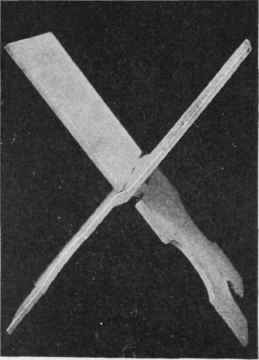
Fig. 254 - A music stand made, without joining, of two intermeshing pieces.
The board being cut, the next step is to mark five equally-spaced divisions, as shown in Fig. 257. The four short vertical lines are to be cut straight through the board, but the horizontal lines, joining them at the top and bottom, must only be cut half way through, or to the saw cut. The parts shown shaded are cut with a flat chisel, at an angle of forty-five degrees from the center, down to the vertical cut of the horizontal lines, as clearly shown in the side elevation. The board is now turned over and the same cutting done, but alternately, as clearly shown in Fig. 254.
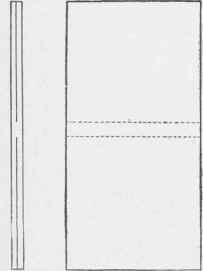
Fig. 255 - The board is cut to within 2 inches of the center.
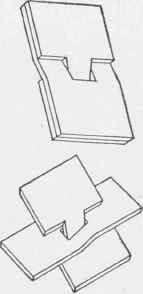
Fig. 256 - A puzzling bit of woodwork.
The lower part of the stand may be ornamented as may be desired, but the upper half should be kept perfectly plain. The whole must be sandpapered down, first with rough and then with fine paper, and afterward varnished or stained.
To hold the stand in a certain position, according to the use to which it is being put, an ornamental brass chain is connected across the bottom by means of a screw eye at one end and a hook at the other. The stand can be folded and leaned against the wall when not doing service.
A small model of the stand makes a very interesting puzzle. If made as shown in Fig. 256, the two pieces of wood can be separated and twisted around at right angles to each other. The device can then be given to a friend with a request that he get the two pieces apart, without breaking them. If the wood is sandpapered, and robbed of all traces of saw cuts, etc., the "puzzle" will deceive the most wary.
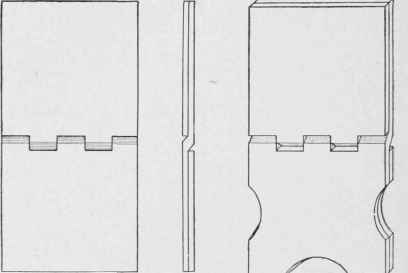
Fig. 257 - How the joint is cut.
Continue to:


My Books

