


How To Coast Skates
Description
This section is from the book "Handy Man's Workshop And Laboratory", by A. Russell Bond. Also available from Amazon: Handy Man's Workshop And Laboratory.
How To Coast Skates
There are more ways than one of enjoying an icy hill. The accompanying illustrations show a pair of coasting skates. These skates can be well made by any amateur at little or no expense.
The base 1 is of hard wood and is 20 inches long. It is 3 inches wide at the middle, and tapers to 1 inch at either end. It is 1 1/4 inch thick and dressed off on the under side, as clearly shown at 2a, leaving a flat section 5/8 inch wide along the center line. The front end is curved upward, and a strap of iron or thin steel 2 is fitted to the flat section and serves as a runner. The ends of the runner are turned over upon the top of the base and held by screws. No screws are necessary in the bottom. In use the ball of the foot rests at a point approximately midway in the length of the skate. A stiff strap, 3, preferably of metal and designed to fit over the toe of the shoe, is screwed or otherwise secured to the base at this point. This strap may be wrapped with padding if desired, but if properly shaped the padding is not necessary. A U-shaped iron as 4 is fixed to the base as shown, so as to prevent sidewise movement of the heel.
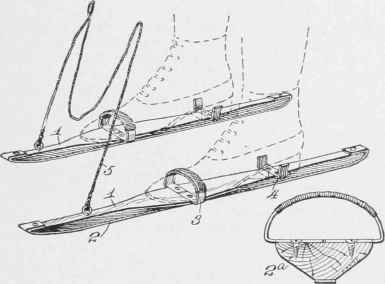
Fig. 354 - Coasting skates.
It will be appreciated that these skates may be readily removed from the feet after a coast down hill, and as readily readjusted at the top of the hill. To facilitate the use of the skates, a guide rope 5 is used. The opposite ends of this rope are secured to eyes, one in each of the skates at the forward end. When coasting, the rope is grasped in one or both hands, and held taut from the eyes.
Continue to:


My Books

