


Milk Testing Without Apparatus
Description
This section is from the book "Handy Man's Workshop And Laboratory", by A. Russell Bond. Also available from Amazon: Handy Man's Workshop And Laboratory.
Milk Testing Without Apparatus
The following process for the detection of added water or of skimmed milk in ordinary milk is more accurate than the simple use of the lactodensimeter without the creamometer check.
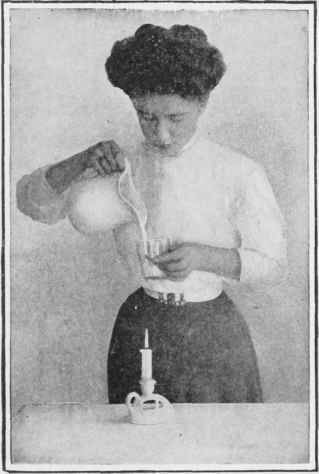
Fig. 292 - Simple method of testing milk.
The whole test can be made in five minutes. The result does not show whether the adulteration consists in the addition of water or in the subtraction of cream, but as a rule this matters little to the consumer. What he wants to know is whether or not he has what he has paid for.
The suspected milk is stirred with a spoon, in order to disseminate into the whole liquid the cream which may have come to the surface. Then one volume of milk is poured into fifty volumes of water. (One fluid ounce to two and a half pints.) A candle is lighted in a dark room. The experimenter takes an ordinary drinking glass with a tolerably flat and even bottom, and holds it right above the candle, at a distance of about one foot from it, so as to be able to see the flame of the candle through the bottom of the glass. He then pours slowly the diluted milk into the glass. (See the accompanying figure.)
The flame becomes less and less bright as the level of the liquid rises into the glass. The flame is soon reduced to a dull white spot. A little more liquid, slowly added so as to avoid pouring an excess, and the flame becomes absolutely invisible. All that remains to be done is to measure the height of the liquid in the glass, this being most conveniently ascertained by dipping into it a strip of pasteboard and then measuring the wet part. It should measure not over one inch if the milk is pure. With good quality milk, diluted and tested as stated, the depth will be about 7/8 of an inch before the flame is lost to view. A mixture of one volume of milk and a half a volume of water should show a depth of 1 1/2 inches. A depth of 2 inches indicates either partially skimmed milk or a mixture of one volume of good milk with one of water, and so on.
The reader has already understood that the process is based upon the close relation between the opacity of milk and the number of fatty corpuscles contained in it. Both skimming and the ridding of water work in the same direction, namely, to decrease the opacity of milk. The same cannot be said of the density. Skimming increases it, adding water decreases it: and the common test, which consists in the mere introduction of the lactodensimeter in milk, is worthless, as a skimmed milk may have a normal density if care has been taken to pour into it a certain amount of water. Density should he taken before and after skimming, and the percentage of cream should be determined with' the ereamometer. Thus applied, the density test requires a lacto-densimeter, a thermometer, and a ereamometer, and the test requires twenty-four hours, while the result is not much more accurate than the opacity test just described.
Continue to:


My Books

