


How To Make A German "Thur-Zither"
Description
This section is from the book "The Boy's Book Of Mechanical Models", by William Bushnell Stout. Also available from Amazon: The Boy's Book Of Mechanical Models.
How To Make A German "Thur-Zither"
SEVERAL summers ago I stopped for a few days at the home of an American dentist in Germany. My host was a pleasant and entertaining gentleman, and his home was full of knickknacks and curios picked up in various parts of the continent, which he always enjoyed exhibiting.
On the first day of my visit, on entering the living room from the main hall, I noticed a faint yet beautiful strain of music, whose source puzzled me. It seemed to come from far off, faint at best, but easier to be heard from the side of the room toward the hall - yet I had heard no music when coming through the hall on the way to the living room.
The music was made by strings, as one could tell from the tone, and after a moment's listening I could see that there were only five notes in all, striking irregularly and making a beautiful minor chord, loud and soft, soft and loud, - ghost music, intangible but sweet, - like the strains of an AEolian harp in a soft wind.
My host was still standing by the door as 1 stopped, turned, and listened, and his body hid what I should have seen. With his back to the door and his hands behind him, he was swinging it from time to time a few inches each way. As I looked up at him finally, with a puzzled expression, he burst out laughing.
"What is it?" I asked. "Where does it come from?"
For answer he stepped aside, and there on the back of the door was the machine shown in the drawings, - a thur-zither (pronounced "toor-zitter"), as he explained afterwards.
It was composed of a little box part, or sounding-board below, over which were stretched five steel strings. Supported a little above the box was a rod from which little lead balls were suspended on threads, a ball opposite each string, so that when the door was opened, the ball at the ends of the threads would tap against the" strings.

With my host's consent, I made a sketch of the zither on the spot, and will tell you how to make one.
First, cut a piece of thin, straight-grained wood planed on both sides and a little less than a quarter of an inch thick. This, - the front piece of the zither, - is shown in the separate pattern drawing Figure j, and at A in the picture, Figure 4.
Enlarge this pattern on paper and lay it on the piece of board (the grain running up and down); at the right of a center line drawn up its middle, trace the pattern. Then turn the pattern over, sliding it also over to the other side of the center line, and trace the other half of the zither front, which will then surely be the same on both sides.
Cut this piece out with a keyhole, or fret saw. One with a wire frame for small blades can be purchased at a hardware, store for something like fifteen cents. The blades cost ten cents a dozen.

Fig. 2. A Thur-Zither.
If you can't get a saw, it isn't a very hard job to cut the thin wood with a knife, if you are careful and keep your blade sharp. The hole e in the center should be marked with a compass before cutting in order to get it as true as possible.
The back piece in the sketch of the sound box, Figure j, is cut of the same kind of wood and is the same shape as the front, except that there is no top part above the dot-and-dash line d in the pattern Figure 1, and no hole in the center at e. The grain runs crosswise.
These two pieces are separated by a box part shown at the "sound box," Figure 3.
This consists of two end pieces E of wood a quarter or three-eighths of an inch thick, connected at top and bottom by strips C and D. Make this cart as carefully as possible so that the front and back pieces we have cut will fit on without a crack, in order to give a good tone.
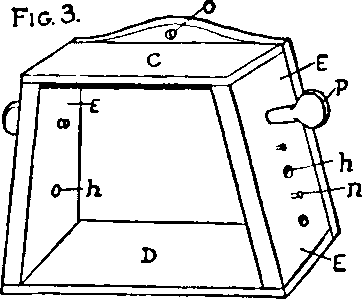
The pieces E, D, and C are fastened together with nails or brads, and the front and back pieces are fastened on with brads and glue, if you have it, as in Figure d.
The dotted lines a on the pattern show where the bridges go, and these are just three-cornered strips of hard wood with small notches cut at equal distances (say every half inch) for the strings to fit into.
The pegs, Figure 5, are of medium hard wood, about a quarter of an inch in diameter at the small end and three-eighths at the large end of the round part V, where they flare out into thumb pieces so they can be more easily turned. The holes for them in E are bored with the handle end of a file.

Instead of having all the pegs on one end of the box, we arrange three on one end and two on the other so there will be room to turn them. The ends of the strings opposite the pegs are fastened to brads or nails n.
The strings - steel banjo strings - may now be strung up as shown, and tuned to some minor chord that may suit your fancy.
Now get five large lead sinkers - large split shot - and fasten them to five separate.pieces of preferably silk thread.
Above, between the arms of the front piece, run a stout wire from the holes b or fasten a wooden rod across; anything that is neat will do, so long as you have something to which you can tie the upper ends of the threads so the balls will hang down and touch the strings.
The threads are now tied on in such a way that there is a lead ball opposite and touching each string below.

Fasten the back of the zither to the hall door by a little strap of tin with a hole in it, that hooks to a nail. Or you can make a little hole in the middle of the top of the sound box at the back to hang it on.
When the door is opened, the strings will be set to swinging and the balls will tap against the wires. The music that results will surprise you.
Before putting on the strings and balls and the steel wires, if you want to give the zither some finish, sandpaper it off carefully and apply shellac varnish. It will need at least four coats, sandpapering the gloss off each coat before adding the next. This will much improve the zither and at the same time help out the tone.
Figure 4 shows a zither with piano pegs at K instead of wooden pegs, and having a back shaped to allow a hole 0 by which to hang it up.
Figures 2 and 6 show a cigar-box construction which is simpler than this. Here you cut two end pieces E, shaped as shown, and nail them to either end of a cigar box, with a cross piece A at the top. The hole in the cigar box, the bridges, the pegs, and tuning are the same while the balls are supported in the same places by strings fastened from nails along the front edge of the upper piece A. This is a much easier thur-zither to make than the first one and will have just as good a tone, but is not quite so handsome in appearance.

Continue to:


My Books

