


How To Make A Wooden Elephant
Description
This section is from the book "The Boy's Book Of Mechanical Models", by William Bushnell Stout. Also available from Amazon: The Boy's Book Of Mechanical Models.
How To Make A Wooden Elephant
BOB EVANS was up against quite a proposition. He had only ten cents and the next day was his little brother's birthday. He wanted to give his little brother a present, but he didn't feel that ten cents would get very much, so his first move was to look up the author in his workshop and tell him his troubles.
"I think," said I, "that we can fix up something which will be great fun, and you can save your ten cents as well. I used to make a whole lot of cut-out toys from wood for some of the younger children, and there is no reason why you can't make some of these yourself.
"Wait till I get my scrapbook, and I think you will find something there that will please the youngster."
From the shelf in the corner of my shop, I took down one of my scrapbooks and, thumbing over the pages, came finally to the set of drawings shown in this chapter.
"Now here is an elephant that wabbles his head and trunk when you wheel him along the floor, and it is a very lifelike toy at that.

It can be made any size for which you have wood."
Bob was interested at once, and looked the drawings over very carefully.
"I think I can see right away," said he, "just how this works; but I don't think I could draw the elephant good enough."
"That's easy," I told him, "for I can show you how to copy this drawing. You see from Figure 1 just how this toy is made and just what kind of work you will have to do in making it.

"In the first place it runs on wheels on a base, a great deal like the toys you buy at the stores, only this is simpler to make. The main body parts are cut out of inch wood, while the legs and ears are cut out of thin cracker-box wood and nailed on. "Figure 2 gives you a pattern of all the parts, which can be traced off separately after the elephant has been drawn to scale. Any one can copy this pattern, even if he is a very poor artist, for all you have to do is to make up a set of i-inch squares like Figure 2 and copy one square at a time, being sure that each line is in the proper square and runs to the proper point in that square.
"For instance, the eye is in third square to the right and the second square down, and is a little to the left of the center of that square. The lower part of the trunk is on the upper edge of the fourth bottom square to the right. Starting at this point, you can follow along, one square at a time, entering and leaving each square at the proper place until the whole elephant is complete.
"Then it is very easy to trace off each part separately, as shown,-the body, the trunk, the legs, the ears, and the tusks.
"There is but one pattern each for the body and trunk. Two ears are made, however, and two each of the front and hind legs. Also two tusks are made of very thin wood. Pieces for the front and hind legs can be cut out of inch stuff, and then sawed down the middle and planed off, which will make both of these patterns exactly the same.
"These parts should be carefully smoothed off and sandpapered before they are put together, but they will look better if the corners are left square instead of being rounded off.
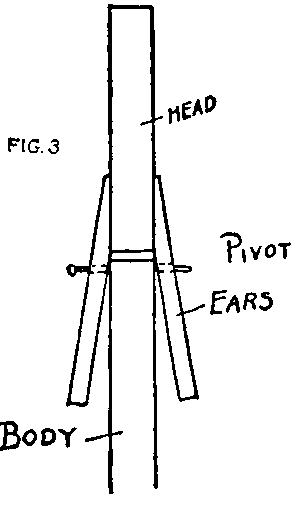
"The ears fasten to the trunk and the trunk part is pivoted to the body through the ears, as shown by the dotted lines in Figure 2.
"The body part slips between these ears, and a nail through holes in the proper places shown in Figure j, pivots the trunk at this point. The trunk does not balance to this center, but will hang off to one side until a rubber band R, in Figure 2, is fitted between nails on the head and trunk to hold this in proper position and act as a string for its action.
"This is a little ahead of my description, however, for we have not yet put together the trunk and head of the animal. These are nailed in place as shown, and if glue is also added, the toy will be so much stronger.
After the elephant is put together entirely, a strip of wood S is slipped between the feet lengthwise, and nailed in place, and this strip is nailed to a baseboard B made of inch stuff fitted with wheels as shown, which forms the standard for the toy. By this means the elephant can be drawn around by a string, his head bobbing this way and that through the jerking of the motion, making a very lifelike imitation of Barnum and Bailey's big creature.
"That's great," said Bob, "for now I can fix up my little brother, have some fun myself making this toy, and still have my ten cents left."
"That may be," I told him, "but don't forget to give the toy a coat of gray house-paint when it is done, and take care that the paint does not get into the joints too much. After this is dry you can put in the eye with black paint and add the few wrinkles which an elephant needs to look natural.
"Also you can tack a piece of rope on for a tail, and screw a screw eye into the front end of the base block for the string which will draw the toy across the floor.
"When this is done, your brother will have a toy as good as any he can buy."
Continue to:


My Books

