


How To Make Ocean Fun Ashore
Description
This section is from the book "The Boy's Book Of Mechanical Models", by William Bushnell Stout. Also available from Amazon: The Boy's Book Of Mechanical Models.
How To Make Ocean Fun Ashore
Note. This toy was invented by the author while watching a crowd playing the game of " Shovel board " on board the S. S. Adriatic.
ASTEAMSHIP at sea is not the most quiet place in the world for a person to work in, and this boat is no exception. She's a monster, and the waves affect her as little as any boat afloat, I suppose, and yet, especially in the "Lounge," one can't forget, even while he is absorbed in his work, that just below him is working away at so many revolutions a minute power enough to drive all the street cars of a great city and more besides. If he should forget it for a minute, he will remember it again when his ink bottle starts a war dance on the writing table.
However, I want to tell how you can make a miniature game of " shovelboard" to play at home.
We play it on the ship way up on the boat deck, where the sailors have marked out, about sixty feet apart, two diagrams in chalk like the sketch labeled "marking the board."
Each of the players or sides has four "men," disks of inch wood about five inches in diameter, and a "shovel" stick with which to push them along the deck.
Now, standing at one end of the deck behind the chalked diagram, the first player shoves or slides his first man at the farther diagram across the deck, trying to make it stop on the largest figure on the diagram, which is, as you see, "10 on." If he goes too far into that last section, it is " 10 off " and that much is taken from his score.
Any "man" stopping on a line of any kind does not count; to count, they must be well within the end circles or squares. These squares measured about ten inches each way.
The player who scored a hundred first was the winner, and it was great sport.
Maybe you can mark this board on the asphalt somewhere and play the game, but it is hard to find a place large and smooth enough. Here's a way to make one on a small scale, only you must make a toy man to shove the shovel for you.
Here he is in Figure i, mounted on a small base C. The body part A is fast to C by the feet, and the arm a is pivoted on a small nail to turn at the shoulders at 0.

Fastened to the arm just back of 0 at r is a wire I which ends in a loop into which the index finger is to fit, the thumb and middle finger grasping the body. Then by working the index finger up and down, the arm a will swing forward and back.
To the hand below at n, Figure 2, the "shovel" is fastened, and by shoving down on I as shown, the shovel H will be thrust sharply forward and slide the checker men - used in place of the disks for the large game - across our toy board.
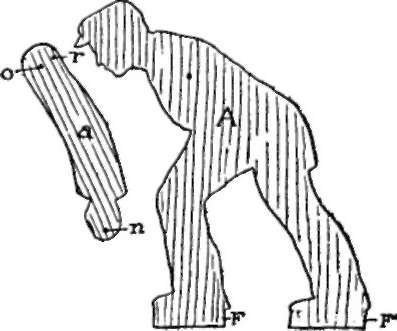
Fig. 2. ARM AND BODY PATTERN.
For a "board" use a flat board of any kind, and the diagram need be marked off only at one end. The squares should be about twice as big as your checker men, and the length of the board will depend on how far your toy shooter-man can shove. You can tell by trying him a few times.
The shooter-man himself is cut out of thin wood by a pattern enlarged from the one shown. The lugs F on the man's feet fit into holes in the base C and are fastened there. The base C is left free to be set in any position on the board where the player may wish to put it.
The "shovel" H is just a straight, thin stick formed in a sort of head to fit the curve of the men it shoves. The other end is cut " crotched " to pivot to the hand by a pin at n. Be sure that all the joints work easily, but are not too loose.

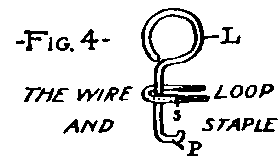

If you want to use a different method of working the arm and one which is perhaps a little simpler, drive a small nail into the arm at r instead of using the wire L. Then from this run a string down through a staple K in the base below and back.
Then by holding C down with the left hand and jerking the string D with the right, the hand will be shoved forward with more power.
If you use Z,, a staple should be driven into A as shown in Figure 4, to keep it loosely in place.
Continue to:


My Books

