


Web Stress. Part 3
Description
This section is from the "Plate Girder Construction" book, by Isami Hiroi, C.E.. Also see Amazon: Plate Girder Construction.
Web Stress. Part 3
Now comes in the question how the web should be proportioned to resist such stresses. There are almost as many methods advanced as there have been authorities on the subject. Perhaps the rational, and, at the same time, the most practical way of proportioning the web is to make its section sufficient merely to resist the entire shearing stress, without, however, passing the limit below which the oxida-dation by the moisture of the air, and the excessive increase of pressure on the rivets become unfavorable elements; and wherever in the web thus proportioned a section is found that is not strong enough to resist as a column in the line of maximum compression the intensity of the same, to rivet stiffeners composed of angles, T's or plates. In America the thickness of the web plate is hardly ever made less than ⅜ inch, and on the continent of Europe rarely less than one centimeter.
Although, as we have already seen, the shearing stress at any section is not uniformly distributed, yet when we solve eq. (7) for different points in a vertical section of a flanged beam with a very thin web, we find that the values of t vary from the extreme fiber toward the neutral axis, as shown by the shaded area (Fig. 5).
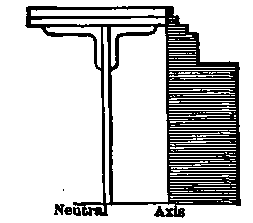
Fig. 5.
The increase throughout the web is almost inconsiderable, and we can on that account consider the shearing stress to be entirely borne by the web, and to be uniformly distributed over its section, i. e.,
Sx/A = t----------------------(9)
In which A is the area of the cross section of the web plate. Or, since it is by the virtue of the bending moment that the unequal distribution of stress takes place in the section, if we now, under the supposition that flanges alone resist the entire bending moment, and the web only the shearing action, solve eq. (7), confining the summation to flanges only, we obtain:
Sx/b hx=t.
In which hx is the distance between the centers of gravity of top and bottom flanges, and b the thickness of the web, or what is practically the same as eq. (9). Consequently at any point of the web, by dividing the shearing force at that point by the distance between the centers of gravity of flanges we obtain the amount of shearing stress per unit of length in its direction, which we will designate by s, and we have:
s=t b=Sx/hx-------------------(10)
The significance of these formulas will appear in the following pages.
In order, therefore, to determine the thickness of a web plate, we first obtain the maximum shearing force, which, of course, will be found always at the end of the beam, then divide this by the shearing strength of iron per unit area, and the quotient is approximately the necessary section. But, as has already been explained, the action of the shearing stresses at the neutral axis is equivalent to compression and tension at right angles to each other and of equal intensity, making an angle of 45° with the axis, the web is still in danger of failing by flexure under this compressive stress. Consequently the web with its thickness as already proportioned for shearing, must now be examined for its strength as a column inclined at 45°, and of the length, therefore, of A' sec. 450 and fixed at both ends, h' being the vertical distance between the upper and lower rows of' rivets in the web. For this pur pose Gordon's column formula may be used, which is c = 8000 1+(r/3000 b2) in which c is the allowable compressive stress per square inch; b the thickness of the web, and l=h' sec. 45°. It may be here remarked that the value of 8000 for the numerator of the second term of this equation may be in some cases found to be taken too low, but to avoid the tedious operation of conforming to its ever changing values (see p. 49), we have taken it as constant, and thus we are so much on the safe side. In order to save the further trouble of working out the formula for every case, the following table is given, from which, knowing the values of h' and 5, we can at once obtain the value of c.

Fig. 6.
Now if we know the amount of shear at any point where we wish to determine the strength of the web, we divide that shear by the cross sectional area of the latter, and then compare this shearing stress per square inch thus obtained with the value of c in the table, against the corresponding value of h'/b If the shear per square inch is less than c, it shows that the web is stiff enough by itself, but if, on the contrary, c is less than the shear, then the web must be stiffened.
h'/b | c |
40 | 3870 |
42 | 3680 |
44 | 3500 |
46 | 3320 |
48 | 3150 |
50 | 3000 |
52 | 2860 |
54 | 2700 |
56 | 2590 |
58 | 2470 |
60 | 2350 |
65 | 2100 |
h'/b | c |
70 | 1880 |
75 | 1690 |
80 | 1520 |
85 | 1380 |
90 | 1250 |
95 | 1140 |
100 | 1040 |
110 | 880 |
120 | 760 |
130 | 650 |
140 | 570 |
So far as this resistance against compressive stress alone is concerned, stiffen-ers inclined at 45° may be more effective in strengthening the web than the vertical ones, but on account of the difficulty of construction attending the former, and also on account of the direct action from the flange upon the latter when the load lies on the top of the girder, the stiffeners are always made vertical.
Continue to:


My Books

