


Enlarging On Bromide Papers
Description
This section is from the book "Workshop Receipts For Manufacturers And Scientific Amateurs. Supplement Aluminium To Wireless", by The Chemical Publishing Co.. Also available from Amazon: Workshop Receipts For Manufacturers And Scientific Amateurs.
Enlarging On Bromide Papers
When Bromide papers are used, a darkroom illuminated by a safe orange or ruby light will be necessary for the insertion of the paper in the Enlarger, and for developing ; and the Actinometer exposure test, used when enlarging on " Velox " will not serve, because of the much higher sensitiveness of the Bromide paper. For the illumination of the dark room under these circumstances we recommend a Wratten Junior Lamp.
Having placed the negative and the paper in position in your dark room, cover up the glass end of the Enlarger with a black card or cloth to keep out white light, and take the Enlarger to a window ; direct the negative to the sky, avoiding the sun ; remove the card or cloth for the necessary time, which is dependent upon the character of the negative and the strength of the light. It is impossible to give the exact time-experience alone can indicate the proper exposure- but the following should be a guide.
For this reason it will be well to make a test exposure on a strip of paper one inch wide and long enough to extend under the slides on the paper carrier. Put this strip of paper where it will receive the most important part of the picture. For the first test exposure you will have little to guide you, but if the light be good and the negative be of ordinary density try 40 seconds. If this exposure is right, or nearly so, the image will develop gradually, reaching full strength in about one minute. If the test exposure is much over or under exposed, another test strip should be made, more or less time being given according to the error in the first case. The exposure may be anything from 20 seconds to five or ten minutes according to the density of the negative and the strength of the light. When you have ascertained the proper time you can insert a full size sheet of paper or a post card in the carrier and make a correct exposure.
When the ascertained exposure has been given, cover the negative up again, return to the darkroom, remove the exposed paper and develop it, following the directions given with each packet of paper.
Directions for Setting up and Using the " Kodak" Auto-Focus Enlarger.-The " Kodak " Auto-Focus Enlarger consists of the following parts, Fig. 155 :
The Standard A, with Bellows K, and Negative Carrier J.
The Reflector or Lamp House D with Collar E, Lamp Holder F, Switch and flex.
One " Kodak " Anastigmat Lens 130 mm. focus, and one Diffusing Disk.
One sheet of flashed opal glass. Two sheets of clear glass for use with the Negative Carrier. One set of Masks. Two steel bars.
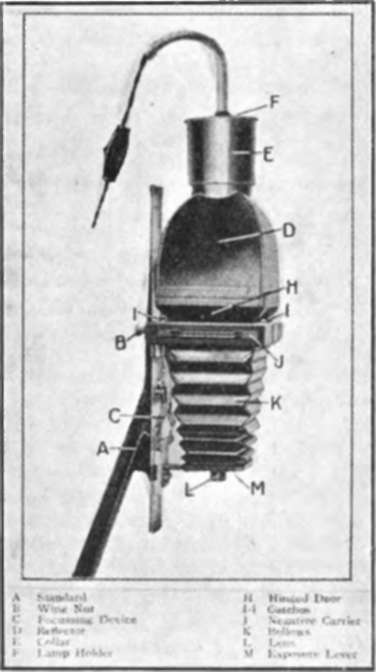
Fig. 155.
Screw the lens into the opening in the narrow end of the bellows, L, Fig. 155. Set up the Standard A, on the edge of some steady, firm support, such as a table or shelf, and fasten it by means of the clamping jaw at the bottom. This makes the Enlarger absolutely rigid. The inside of the clamping jaw is lined with felt in order not to damage the table top, and to prevent the standard from slipping.
Place the sheet of flashed opal glass in the recess on the top of the* frame-work, O, Fig. 155, from which the bellows hangs.
The Auto-Focus Enlarger is supplied with a bayonet Plug adapter, flex and a bayonet Lamp Holder, F, Fig. 155, to accommodate a 60 or 100 watt gas-filled electric lamp.
The 100-watt gas-filled lamp is the most suitable for all round work.
Gas-filled lamps of 150 and 200 watt can also be used, but as they are only made with screw fittings a screw lamp holder is needed ; this can be supplied instead of the bayonet lamp holder, if specified when the Enlarger is ordered.
Fit the electric light bulb into the lamp holder F, and fix the lamp house, hood, or reflector D, Fig. 155, on the top of the opal glass. Make sure that it is securely fastened by turning back the three metal catches I.
The collar E slides up and down ; this should be placed so that the centre of the filament of the electric lamp will be a little below the lower edge of the tube on which the collar slides.
Fit the plug on the end of the connecting flex into the electric light socket, and turn on the current.
This Enlarger must be used in a dark room ; otherwise the Bromide paper will be fogged. A dark room means a room in which no ray of white light penetrates. Such a room is more easily obtainable at night than in the daytime. In any case, it is advisable to secure the door ; otherwise someone may open it, and, in ignorance, admit white light. A large room is preferable to a small one, since, if all means by which white light can enter are blocked, there may be little or no fresh air available.
For general illumination of the Dark Room a Wratten Safelight Lamp with No. 0 Safelight is recommended.
Continue to:


My Books

