


Grease Guns
Description
This section is from the book "Workshop Receipts For Manufacturers And Scientific Amateurs. Supplement Aluminium To Wireless", by The Chemical Publishing Co.. Also available from Amazon: Workshop Receipts For Manufacturers And Scientific Amateurs.
Grease Guns
Tin: ordinary type of grease gun consists of a cylinder filled with grease, which grease is forced out-through a nozzle at one end, when a piston is forced down the cylinder by hand pressure. These are simple in construction and cheap to make, but they suffer from the disadvantage that the grease cannot be forced out at any greater pressure per square inch than that put upon the piston in the cylinder, and this is not enough to force grease into many desired places. An improvement consists in providing a handled screw, by means of which the piston may be forced down; the trouble here is that to give a great increase in the grease pressure a fine-thread screw must be used, this puts up the cost of making, and such a screw thread will not stand much wear, and there are practical limits to its degree of fineness; in practice therefore the screw thread used is not really fine, on account of the above objections, and while it is an improvement on the push-in type, it still does not give us a great increase in the grease pressure. The Tecalemit grease gun is a distinct advance in the required direction; in the description given below it will be seen that a reasonable size diameter grease cylinder is used, but at the time of forcing out the grease the total hand pressure is exerted upon a very small diameter piston, and therefore the grease pressure is increased to many times per square inch above that of the iiand pressure only. This results in being able with this grease gun to force grease into the tightest bearing or any desired position.
The Tecalemit 3b Gun is composed of a tubular barrel G438a, for the lubricant, fitted with a piston sliding in this barrel and attached to the handle, 6479a, of the gun by a piston rod, 0435a.
The function of this piston, which is called il the low pressure piston," is to force lubricant from the barrel into the high pressure cylinder, 6430a, when pressure is exerted by pushing the gun on to the nipple.
The high pressure cylinder, 6430a, is placed in the nose-piece, 6427a, of the gun and consists of a tubular brass cylinder which slides in the nose-piece, 6427a, and to the end of which is fitted the steel nozzle, 6440a, which makes contact with the lubricating plug.
In the other end of the sliding high pressure cylinder, 6430a, is fitted the high pressure piston, 6431a, which is held in place by a dome-shaped piston stop, 6432a, screwed into the nose-piece, 6427a.
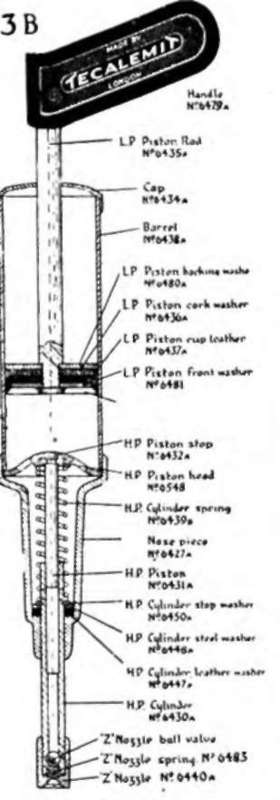
Fig. 79.
Slots are cut in the piston stop, 6432a, and the high pressure cylinder, 6430a, to enable the lubricant to enter the cylinder.
The action of the 3b Gun is as follows :-Pressure being applied by the handle, 6479, fitted to the rod, 6535a, of the low pressure piston, this piston forces the lubricant inside the nose-piece, 6427a, and through the slots into the high pressure cylinder, 6430a. At the same time the high pressure cylinder, 6430a, slides into the nose-piece against the recoil spring, 6439b, and forces the high pressure piston, 6431a, up the bore of the cylinder, thereby ejecting the lubricant through the ball valve into the lubricating plug, see Fig. 79.
When the pressure on the handle is released, the high pressure cylinder, 6430a, is returned to its normal position by means of the recoil spring, 6439b, the ball valve mena-while closing. This creates a vacuum in the cylinder into which a new charge of lubricant is drawn as soon as the high pressure piston uncovers the slots in the high pressure cylinder. The whole series of operations is, therefore, effected in one push by the pressure exerted at the handle of the gun.
Continue to:


My Books

