


Microscopes. Part 5
Description
This section is from the book "Workshop Receipts For Manufacturers And Scientific Amateurs. Supplement Aluminium To Wireless", by The Chemical Publishing Co.. Also available from Amazon: Workshop Receipts For Manufacturers And Scientific Amateurs.
Microscopes. Part 5
With lower powers-1 in., 1/2in., 2/3in., etc., and those of less magnification, flatness of field can be secured over nearly the entire surface, but under no circumstances can flatness of field be produced in a lens of large aperture and fine quality or high power-it is an optical impossibility.
Resolving Power
The power to define fine detail in an object is dependent on the angle of the bundle of rays which it is capable of receiving from the object. This quality is expressed by the term " Numerical aperture." The higher the numerical aperture, therefore, of the objective that is employed-subject to its being of good performance-the greater will be the power to resolve fine structure. It must be remembered, however, that with the increase of numerical aperture, the working distance of the lens is shortened ; in all our lenses the ratio of numerical aperture to the power has been very carefully considered and established.
The working distance depends not only on the focal power of the objective, but also on its numerical aperture. The greater its numerical aperture, the more closely it must approach to the object when working. Students and others who work in laboratories frequently use a variety of cover glasses of varying thicknesses and we recommend, especially when a 1/6th in. objective is chosen, that the one in our list with a numerical aperture of .74 should be purchased in preference to the one of larger aperture for this very reason. The former will work through the cover glass of a 1 laemacytometer, while the latter will not.
Fig. 125 is a sectional view of the body of a microscope with eyepiece and objective in position, as shows the method of measuring the body length. The draw-tube is generally engraved to include the added length of a revolving nosepiece, when such is supplied.
Oil Immersion Objectives. With certain high-power lenses, a film of special immersion oil, which is supplied with the lens, is interposed between the cover glass of the object and the front lens of the objective, continuity being established thereby while observing. This oil is approximately of the same refractive index as the cover glass itself, and the practical effect of the oil is to admit light which could not possibly enter a dry objective, for the oil prevents the spreading out by refraction of the rays emanating from the object which would occur when passing from the cover glass-which has a high refractive index-to air, which has a lower refractive index. Such rays are, as the result of the oil film, utilized by the objective.
The immersion objective requires to be carefully treated. In cold weather it often happens that this oil, which normally is quite clear, becomes cloudy, and a milky deposit forms at the bottom of the bottle. This may generally be cleared by warming, but if it still persists, it is best to pour off the upper portion and throw away the residuum.
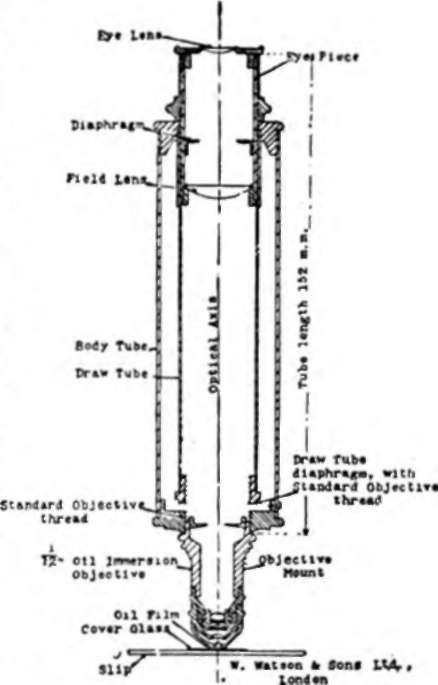
Fig. 125.
Immersion Oil
If such an Objective is used with an oil which is not of the refractive index or dispersion for which the lens has been corrected, the efficient working is seriously impaired. Many of these immersion oils are injurious to the Objectives themselves, and cause the displacement of the front lens, by acting as a solvent on the cement which holds them.
To get the best effects the immersion oil supplied by Watson's should be used with Watson's lenses.
The oil should be wiped from the front of the immersion lens immediately after use. If by any chance a small quantity of oil should become dried on the front lens, it should be treated very gently. The readiest and easiest method is to put a quantity of fresh oil upon it and let that act as a solvent on the dry deposit, then wipe the whole off together. If necessary repeat the process two or three times. A quicker method is to soak a piece of very soft cotton rag or clean silk with xylol and gently wipe the front with this.
It has been recommended that for the entire removal of oil immediately after use saliva should be used. This has proved very effective.
Thickness Of Cover Glass And Tube Length
These are important factors in obtaining the best results from objectives. If an objective is corrected for a definite tube length with a stated thickness of cover glass, it will work at its best when so used. If a greater or less tube length be employed, with the same thickness of cover glass, the effect will be marred to a greater or less extent.
If, however, the tube be set at the length for which the objective is corrected and the cover glass be of a different thickness from that which is prescribed, the resulting definition is not the best possible.
This can then be overcome by varying the length of the draw-tube, making the total length of body shorter if the cover glass is thicker, and the total length of body greater by extending the draw-tube if the cover glass is thinner than that for which the objective has been corrected. It requires a certain amount of experience and training to detect the subtle differences in definition, but when once acquired, the draw-tube is either extended or pushed inwards with unerring rapidity until the best definition that is possible is secured.
The mechanical draw-tube, actuated by rackwork and pinion, enables the correct length of draw-tube to be determined to a nicety, and is a valuable addition to a Research Microscope.
It should be mentioned that oil immersion lenses are not so susceptible to variations in thickness of cover glass as dry lenses, the oil film having the effect of making the front of the objective and the cover glass a continuous whole. It is, however, important that they be used with the tube length for which they are corrected.
Continue to:


My Books

