


Painting By Spraying. Continued
Description
This section is from the book "Workshop Receipts For Manufacturers And Scientific Amateurs. Supplement Aluminium To Wireless", by The Chemical Publishing Co.. Also available from Amazon: Workshop Receipts For Manufacturers And Scientific Amateurs.
Painting By Spraying. Continued
The air pressure for atomising the paint varies from 20, 35 and 401bs., according to the circumstances and the class of material used, likewise the pressure on the paint averages from 5-15Ibs., according to the viscosity of the material.
Cleaning
-It is necessary that careful attention should be paid to the cleanliness of the spraying equipment. At the end of the day the paint should be blown back into the container, and the paint tube disconnected and cleansed with a suitable cleaner. A low grade of white spirit is recommended for all Oil Paints.
When cleaning the handpiece and paint tube, first allow the air to escape from the top of the paint container by loosening the thumb screws, then by placing hand with a rag over the nozzle of the instrument and pulling back finger lever; this turns the air back through the paint tube, thereby blowing the paint back into the container; while the air is still turned back to the paint tube, turn off the tap at the bottom of the paint pot detaching the tube from the paint container and placing this in a suitable receptacle with cleaning fluid and again turning on the air at the handpiece-this will suck the cleaner into the tube ; it can then be blown out at the nozzle, detach the tube from handpiece and hang up to drain. The Aerograph Spray Painter should then be immersed in a bath of cleaner and wiped dry; this prevents any working parts from becoming congealed with paint, which will harden and prevent the instrument from working satisfactorily.
Careful attention to these details will maintain the spraying unit in perfect working condition. The same care should be given to a Spraying Plant as is given to the condition of ordinary paint brushes. The Aerograph Co., Ltd.
Fig. 142 shows the Aerostyle Pistol Sprayer in section, the various part names are :-1, Body. 2, Colour Bowl ; 2a, Colour Bowl Cover; 3, Fibre Head Washer ; 4, Hexagon Head ; 5, Needle : 6, Stuffing Box ; 7. Leather Gland for ditto ; 8, Nozzle ; 8a, Lockring for ditto; 9, Tip; 10, Cam ; 11, Cam Axle; 11a, Cam Axle Bush; 12, Trigger ; 13, Crosshead ; 14, Cross-head Clamping Screw ; 15, Needle Tension Spring ; 16, Needle Tension Spring Box; 17, Back Cover; 18, Valve Spring; 19, Valve Spindle ; 20, Fibre Valve Washer (now obsolete, metal valve seating being fitted); 21, Valve Stuffing Box ; 22, Leather Gland for ditto ; 23, Valve Body ; 23a, Valve Seating ; 24, Wooden Handle ; 25, Milled Nut; 26, Set Screw to Trigger ; 27, Slides ; 28, Adjusting Screw and Lockring ; 28a, Trigger Stop-Screw ; 29, Nipple for Air Hose connection ; 30, Cock and Union for Paint Hose Connection ; 30a, Leather Washer; 31, Brass Sleeve.
It will be noted that parts 2 and 30 are alternative, depending upon whether the paint is fed in at atmospheric pressure from the colour bowl 2, or under air pressure through cock 30.
The new model Aerostyle Paint Sprayer Unit is about 2ft. 7in. in height by 101/2in. in width, weighing about 60 lbs. It includes a paint filter, and a paint agitator. The reducing valves admit of it being used with any compressed air supply at any pressure between 50 lbs. to 150 lbs. per sq. inch. The consumption of air when painting continuously is 8 to 10 cubic feet per minute. The sets are provided with a paint capacity of either one or two gallons. The adjustment to the portable paint sprayer, and to the pistol sprayer are very simple. Should any paint spluttering occur, there is a leakage of air past the fibre washer 3, tighten up. Should colour leak through the tip when not spraying, then increase the tension on the needle by screwing in needle tension spring box 16, unless it is caused by some foreign matter lodging in the tip in which case remove it at 4, or wash it out with a solvent. Fig. 143 shows the whole apparatus ready for working.
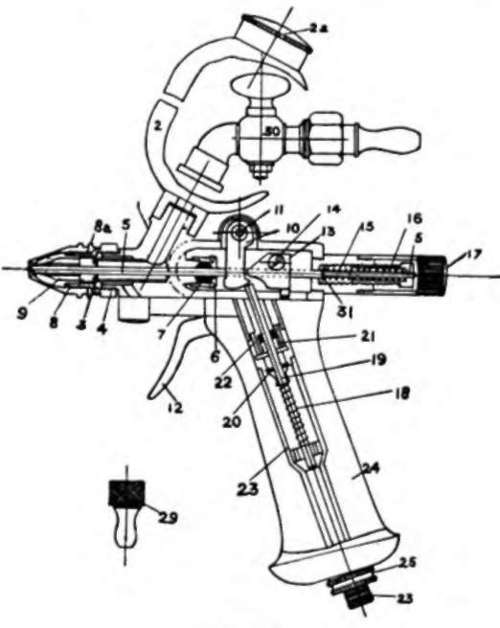
Fig. 142.
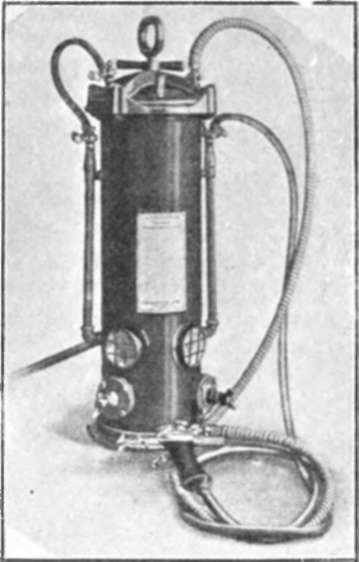
Fig. 143.
Continue to:


My Books

