


Portraits And Groups
Description
This section is from the book "Workshop Receipts For Manufacturers And Scientific Amateurs. Supplement Aluminium To Wireless", by The Chemical Publishing Co.. Also available from Amazon: Workshop Receipts For Manufacturers And Scientific Amateurs.
Portraits And Groups
As everyone knows snapshot portraits are nearly always more pleasing and truer to life than the studio type, and much can be done by the enterprising amateur in obtaining striking likenesses. Any attempt at posing is to be avoided : a little patience, discrimination as regards the best moment, and study of the lighting conditions prevailing, will generally repay the photographer with the admiration the resulting portrait receives.
(Messrs. Houghton-Butcher, Ltd.)
If glass plates be used, these should be loaded into the plate holders in the dark room using a ruby light, care being taken that the sensitive side of the plates be outwards. If film rolls be used, these can be loaded into the camera in daylight, full instructions being given with each roll. Whether plates or films be used, make sure that everything is in working order before proceeding to either focus the view or inspect through the view finder. If no actual focussing on a screen is done with the camera in use, then it is generally necessary to extend the bellows to correspond on a marked scale with the estimated average distance of the object. A very little experience will quickly enable the operator to quite accurately fix upon this distance.
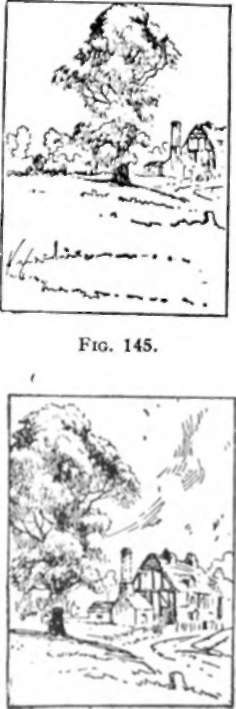
Fig. 146.
Exposure Time
It is important to give the correct exposure time and the beginner cannot do better than invest in some form of Exposure Meter. The Wellcome Exposure Calculator contained in their handbook is excellent and inexpensive. Fig. 147 gives an illustration of this calculator. A single turn of the disc indicates the correct exposure for any ordinary subject with any plate or film, under any condition of light, stop, or lens. Exceptional subjects are dealt with by an ingenious and simple arrangement which only calls for a second turn of the same disc.
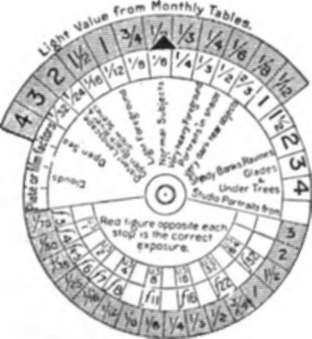
Fig. 147.
The white disc revolves. Supposing you want to take a photograph of a street scene at 3 o'clock in the afternoon in April. The sun is obscured by light clouds, but is strong enough to cast a slight shadow, and the film in the camera is " speed " film. The light tables facing the Calculator give 3/4 as the light value for diffused sunlight at 3 o'clock on an April afternoon, in latitude 52° N. : the speed table gives 1/8 as the factor for the plate you are using. Therefore, you turn the little white disc until the plate factor 1/8 is opposite the light value 3/4 in the upper sector. Then, opposite each stop below, you get the correct exposure in fractions of a second-one-twelfth of a second at f8 (U.S. 4) ; one-twenty-fifth of a second at f6 (U.S. 2) ; and so on.
Every other problem in exposure is settled with equal ease.
If your camera has only one speed, or if the stops are only marked 1, 2, 3, etc., the book still gives the necessary information. There are two standard rules for correct development :-
1. ;Correct exposures should be developed for a definite period of time in a standard developer of constant activity. This time varies according to the temperature, the plate or film, and the printing process to be employed.
2. ;Incorrect exposures must be developed for the same time as correct exposures, the other conditions being the same.
The rules are the outcome of much research devoted to the establishment of scientific methods by means of which development is made safe for the photographer.
Continue to:


My Books

