


Rivets
Description
This section is from the book "Workshop Receipts For Manufacturers And Scientific Amateurs. Supplement Aluminium To Wireless", by The Chemical Publishing Co.. Also available from Amazon: Workshop Receipts For Manufacturers And Scientific Amateurs.
Rivets
Bifurcated rivets are made with many different shaped heads, and in many different diameters and lengths. The body diameters are generally either ;1/16, 3/32,1/8,5/32 or 3/16 ins., while the lengths range from 1/8in. to 11/2in., depending upon the diameter, and the use for which the rivet is intended. A hammer is the only tool necessary in many cases to drive the rivet through the materials, this of course depends upon the material. If the rivets are being used on leather then they can be driven in, and if the leather be laid upon a metal plate the ends of the rivet (if the correct length is used) will turn over outwards and securely fasten the rivet. If desired a boss cap can be used, the rivet ends placed through it, and turned over with a hammer. These rivets may be used on metal plates or sheets, etc., but then it is probable that holes must be punched or drilled ready for them. Tubular rivets are also made in a wide range of diameters and lengths, ranging from Jin. up to -3/16 in. diameter, and from up to Jin. long, depending upon the diameter. An additional tool, beside a hammer, is required to turn outwards the hollow end of these rivets. These bifurcated and tubular rivets will be found extremely useful for many jobs, and easy to use. the former requiring the use of a hammer only in most cases.
Rivet Heating By Electricity
The process of electrically heating rivets was first introduced some ten or fifteen years ago.
Simplicity of Method-The method of heating rivets by electrical means is extremely simple, and is based on the fact that when a conductor is carrying current heat is generated, the amount being proportional to C2R (where C = Current and R = Resistance of the conductor). If an iron rivet forms the conductor it will quickly rise in temperature, and by using a suitable current value white heat can be attained in a fraction of a minute.
As a rule, heaters are designed to deal with two or more rivets simultaneously, and any desired output can be obtained by selecting a heater with a sufficient number of jaws, or heads, as they are termed. The table on page 311 gives the time required to heat 100 rivets of various sizes in an A-L Pontelcc heater, type R 15/2, having two heads. The figures are not laboratory results, but represent average commercial practice, and even higher speeds can be obtained if desired. When using small rivets, the output is limited by the ability of the operator to insert and remove the rivets quickly, as the machine is capable of heating them faster than they can be handled.
Average power consumption, 15 units per 100 lbs. of rivets.
Low Voltage
The electric rivet heater has many of the characteristic features of a spot welding machine, both machines providing means for conveying large currents at extremely low voltage direct to the place where heat is required. The voltage is so low that it is most convenient to use a source of A.C.. power, reducing the pressure by means of a static transformer which forms an integral part of the heater. This is the arrangement generally adopted, nearly all standard heaters being fitted with a single-phase transformer. When working off a polyphase supply each heater may be connected to one leg of the system or, if preferred, separate two/single or three single-phase transformers may be installed to give a single phase supply to the heaters. If desired, however, heaters can be built at slightly increased cost, with a separate transformer for each head. When only direct current is available it is first converted to A.C. by a rotary converter or motor generator, the heaters being wound to suit the pressure given by the converting plant.
Diameter | ; | Length of Rivet. | ; | ; |
of Rivet. | 2 in. | 3 in. 3 in. | 5 in. | ; |
5/8 in. | 24 | 35 44 | 50 | Time in |
3/4 in. | 31 | 40 50 | - | minutes |
1 in. | - | 92 150 | - | per 100 rivets. |
Method of Operation (see Fig. 178)
The operator inserts the plug in the regulator box and depresses a pedal against the pressure of the adjustable spiral spring, causing one pair of jaws to open. He then places a rivet endwise between the electrodes and releases the pedal, allowing the spring to raise the bottom jaw and hold the rivet in position. The rivet is held firmly in place under the spring pressure, and a current flows through it immediately contact is made. In a few moments the end of the shank begins to show colour, which quickly spreads over the whole surface, and as soon as the right colour is observed the rivet may be removed.
It should be noted that there is no need for soaking. This is due to the fact that the rivets heat from the centre outwards and, therefore, the core is always hotter than the exterior, whereas the reverse is the case with rivets heated from the outside, and it will be found that less effort is required to put the head on an electrically heated rivet than on one heated by other means. Further, there is no burning and a minimum of scale is formed.
After the first rivet has been placed in the machine, and while it is heating, the operator may depress the other pedals in turn and insert two more rivets, so that by the time the third one has commenced to heat the first is ready for the riveting machine. By varying the position of the heating plug, and the number of heads in use. the supply of hot rivets can be adjusted to the needs of the work enabling maximum output to be obtained.
Heating Rivets In Position
It is often desirable, particularly when small sizes are used, to heat the rivets after they have been placed in position. Such cases occur in the building up of motorcar chassis, etc., and for this work a modified design of heater is employed. The machine is usually mounted on flanged wheels so that it can be run along the erecting shops on rails. The electrodes are carried on the ends of flexible connections and brought into contact with the rivets, which are heated and then closed by hammer in the usual way.(Messrs. Allen-Liversidge Ltd.)
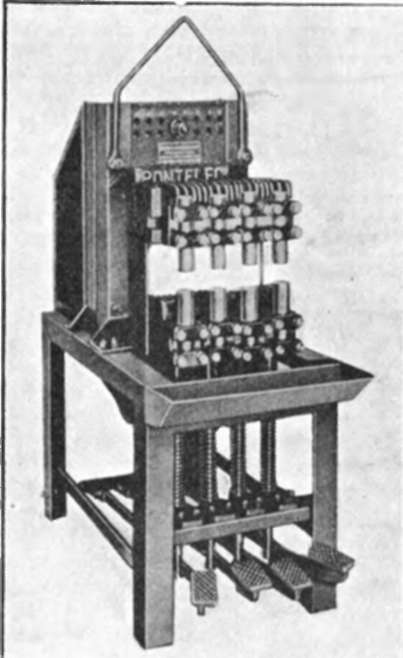
Fig. 178.
Continue to:


My Books

