


Rubber And Engineering. Part 4
Description
This section is from the book "Workshop Receipts For Manufacturers And Scientific Amateurs. Supplement Aluminium To Wireless", by The Chemical Publishing Co.. Also available from Amazon: Workshop Receipts For Manufacturers And Scientific Amateurs.
Rubber And Engineering. Part 4
The stress-strain curves of a rubber compounded with 7-5-10 per cent, of sulphur are usually taken as criteria for the evaluation of a specimen of raw rubber. As different specimens vulcanise at different rates it is not recommended to compare specimens vulcanised under constant conditions. Usually the time of heating is adjusted and the specimens compared on one of three bases : (1) identical vulcanisation co efficients; (2) a standard curve; or (3) maximal tensile figures. The last method is difficult of application as a large number of tests are required to average the experimental error in determining maximal figures ; (2) is usually adopted, the standard curve representing approximately the maximal tensile figures and gives results similar to (3) as maximal figures do not vary much in the neighbourhood of the standard curve, if correctly chosen. Method (1) enables comparison to be made between specimens vulcanised to a degree approximately corresponding with manufacturing practice, as the maximal figures by methods (2) and (3) are only obtainable by vulcanising to a greater degree than is consistent with keeping qualities of the vulcanised rubber.
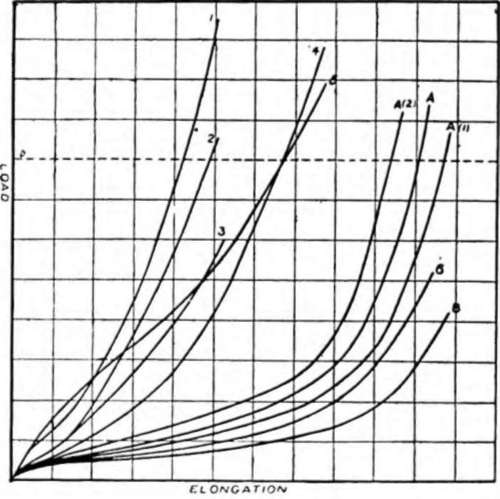
Fig. 179.
The lie of the curves (Fig. 179 is dependent on the degree or state of vulcanisation ; thus, taking the curve for specimen A, a less vulcanised specimen of the same rubber mixture will give a curve such as A (1), a more vulcanised specimen a curve such as A (2). The curve, however, preserves its characteristic shape. When, however, we introduce " pigments," or compounding ingredients, the character of the curve may undergo some modification. This is illustrated by curves 1 to 6. The rubber mixture contains five per cent, of sulphur by weight calculated on the rubber. The minerai constituents were added in such proportions as to occupy the same volume as compared with the rubber, as follows :-
1. ;Carbonaceous black.
2. ;Carbonaceous black (another specimen).
3. ;China clay-very finely divided.
4. ;Zinc oxide.
5. ;Magnesium carbonate (light).
6. ;Barytes (ground and levi-ga ted).
All these mineral ingredients are regarded as inert although, as a matter of fact, zinc oxide and the carbonaceous black have some slight surface action. The curves given by the mineralised specimens show the same general characteristics as curve A (rubber compounded with sulphur only), but with modification. As already stated, curve A may be regarded as made up of three portions. The curves 1-4 (5 is abnormal) resemble curve A with the greater part of the initial flat portion missing. This is particularly noticeable with curve 1 (tor carbonaceous black), in which the added particles are smaller than in the other cases. Or put it another way : curve 1 resembles that of a simple rubber-sulphur mixing, such as A, but regarded as already under tension. It has been demonstrated that for certain technical purposes where the rubber is required to take up a sudden load, it is necessary to keep the rubber permanently under tension if the rubber is not mineralised.
The graphs may be compared by the elongation produced by a given load, as, for instance, the distance between the points where the curves cut the dotted line drawn from the point b, 1 and 2 are carbonaceous blacks and show the least elongation, i.e., the greatest resistance to the load applied ; 3, 4 and 5 resemble 1 and 2 to a lesser degree, but 6, which is the graph given by the rubber incorporated with the relatively coarse particles of barytes, resembles that given by an unminernlised " mixing" that is to say, the barytes acts as a filler or diluent. Curves 1-6 are not strictly comparable with curves A, as the latter were vulcanised with a large proportion of sulphur to bring out the maximal physical effects. To complete the series curve B has been included. This was obtained from a mixing of rubber and 5 per cent, of sulphur vulcanised under the same conditions as 1-6. Too much importance must not be laid on the length of the curves in the diagram. The end position gives the breaking load and strain at this load, but owing to the unavoidable irregular strains set up in the test pieces under stress, the relative breaking load and strain can only be arrived at by making a number of determinations and taking the mean. It will be remembered that all the vulcanised rubber specimens 1-6 contain the same proportion of mineral by volume and not by weight. It is obvious that the physical properties of a vulcanised rubber may be appreciably modified by the incorporation of fine particles, although composed of material chemicallv inert. When vulcanised rubber suffers distortion, no appreciable change in volume takes place except in the case of mineralised rubber. The change (increase) in volume is then of a similar order to the size of the particles-thus a barytes compounded rubber shows an appreciable increase in volume over 13 per cent, at 200 per cent, elongation, while lamp black shows only a small increase (1-76 per cent.). It is suggested that the rubber when stretched is separated from the coarse mineral particles forming a vacuum at each pole, thus accounting for the increase in volume. The effect of the incorporation of fine mineral particles in a vulcanised rubber is probably an entirely physical phenomenon and distinct from the vulcanisation process, as mixtures of plastic materials and finely divided mineral particles show a similar behaviour. Putty consists of chalk incorporated with linseed oil. If this be well rolled out the mass shows slightly elastic properties, and can easily be stretched for a short distance ; it then becomes much harder and the appearance of the surface changes from a smooth oily character to a dull granular one. This may be explained by assuming the mineral particles to be surrounded and separated from each other by a layer of oil of a definite thickness. Stretching causes the particles to separate longitudinally but to close up laterally. The mass stretches easily as long as the lateral approach of the particles merely causes a flow of the oil separating them, but when the particles come into closer " contact " other forces come into play and further deformation can onlv be effected by applying a considerably greater load. The change of the surface from an oily to a dry condition is evidence of the fluid sucked from between the particles laterally to allow for the increased distance between the particles longitudinally. Changes in the surface appearance of mineralised rubber under stress may be similarly noted. When vulcanised rubber is stretched it becomes less transparent or even opaque, giving the effect of a paler colour, and there is often a peculiar silky appearance at the point of tension when a piece of rubber is torn. This is more noticeable when the rubber is incorporated with pigments of poor covering power, such as china clay or magnesium carbonate. The effect is masked with pigments of good covering power such as zinc oxide and carbonaceous black. The same effect may be seen to some extent in an unmineralised rubber, probably owing to uncombined Sulphur present.
Continue to:


My Books

