


The Herbert Pendulum Hardness Tester
Description
This section is from the book "Workshop Receipts For Manufacturers And Scientific Amateurs. Supplement Aluminium To Wireless", by The Chemical Publishing Co.. Also available from Amazon: Workshop Receipts For Manufacturers And Scientific Amateurs.
The Herbert Pendulum Hardness Tester
This is an instrument (Fig. 84) for testing the hardness of substances ranging from lead to sapphire. It is especially applicable to hardened steels, and by a simple adaptation is rendered suitable for testing rubber, ebonite, mica and many other materials.
It dispenses with all microscopic measurements and all difficult readings, and, as it does not depend on impact, the readings are in no way affected by the mass or inertia of the specimen. Heavy loads are not used, and the test may be applied to thin and fragile articles without risk of breakage or defacement of finished surfaces.
Description Of The Pendulum
The instrument is extremely simple. It consists of a weight of 4 kilograms, pivoted on a ball 1 m/m. diameter and constituting a pendulum. The ball is held in a chuck in the centre of the instrument, and six screwed weights are provided whereby the position of the centre of gravity of the whole instrument may be adjusted to coincide with the centre of the millimetre ball, which is of steel or ruby. Hall-pointed diamonds can also be supplied for inspection testing.
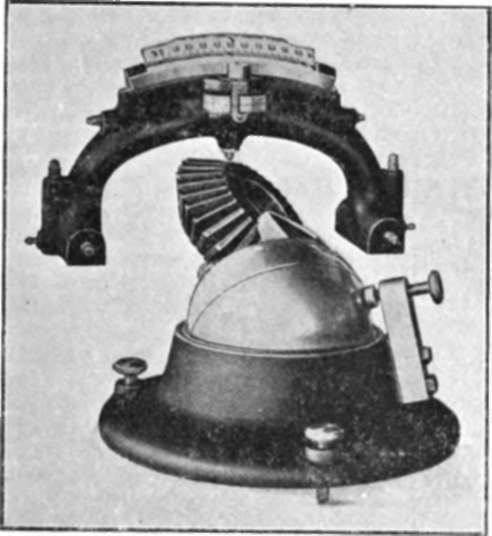
Fig. 84.
Immediately above the ball is a graduated weight mounted on a screw. By raising or lowering this weight, the centre of gravity of the instrument can be brought to a predetermined distance above or below the centre of the ball. For standard tests this distance is one-tenth of a millimetre below the centre, and the time of a single swing on a very hard surface is 10 seconds.
The Pendulum Hardness Tester provides two entirely independent tests of hardness, called "Time Tests " and "Scale Tests," which depend on different principles and measure different kinds of hardness. It also provides a means of measuring the work-hardening capacity of metals.
Time Tests
The time period of oscillation of the pendulum is a very reliable measure of the hardness of the surface on which it rests, and the time in seconds taken in making ten single swings on any substance is the " time hardness number " of that substance.
The pendulum is placed gently on the specimen with the bubble at or near 50, and is caused to oscillate through a small arc. The time is taken with a stop watch.
The Pendulum Time Test, like the Brinell Test, measures resistance to indentation or " Indentation Hardness." The Pendulum l ime Hardness Scale corresponds with and is convertible into the Brinell Scale of Hardness Numbers, though it extends into regions of hardness where the Brinell Test is no longer applicable, and it can be used to test thin and fragile articles that could not be tested by the Brinell or anv other method. It is specially useful for case-hardened parts. It is much quicker and easier to carry out than the Brinell Test.
Typically time hardness numbers (seconds for ten swings), using millimetre steel ball, are as follows :-
Glass ............ ;100
Very hard carbon steel .... ;75
Hard carbon steel .... ;65
Tempered high speed steel ;52
Annealed high speed steel ;26
Annealed carbon steel .... ;22
Rolled brass .... .... ;15
Cast brass (soft)........ ;11
Lead ............ ;3

Fig. 85.
In testing hardened steel the Brinell Hardness number can be read direct from the Pendulum a few seconds after it has been placed on the specimen. The number of seconds of a single swing of the pendulum multiplied by 100 is the Brinell Hardness number.
In testing soft metals and un-hardened steels with a Brinell Hardness Number of 330 or less a different formula is used. The Pendulum Operating Stand (Tig.
85) enables time tests to be made very rapidly by mechanical means.
Scale Tests
The pendulum is placed gently on the specimen in an upright position and then tilted to 0 and released. The weight of the instrument causes the ball to indent the surface, and the effect of tilting to 0 is to elongate the indentation. When the pendulum is released the ball rolls back along the groove so formed, pushing a little wave of material in front of it. The energy absorbed in thus displacing the metal is taken from the potential energy of the pendulum, and is shown by a shortening of its first swing. The position of the bubble on the scale at the end of the first swing shows the work done by the ball on the specimen and measures its hardness. The ball is in effect a tool working the material, and the Scale Heading measures the resistance which the material offers to working, i.e., Work Hardness.
In the case of a very soft specimen the indentation will be relatively deep and the pendulum will come to rest after a very short swing, or, as in the case of lead, will not swing at all but remain at 0.
Typical 11 scale hardness numbers," using 1 millimetre steel ball, * are as follows :-
Glass ............ ;97
Very hard carbon steel .... ;93
Hard carbon steel .... ;88
Tempered high speed steel ;75
| Annealed high speed steel ;54 j Annealed carbon steel .... ;41
Rolled brass .... .... ;14
Cast brass (soft)........ ;4
Lead .... .... .... ;0
The Pendulum " Time " and " Scale " Hardness Tests. Their Mutual Relationship.-The Scale Test Reading measures work hardness, a composite quality consisting of resistance to penetration or indentation hardness, and resistance to flow or flow hardness. Dividing the scale hardness number (work hardness) by the time hardness number (indentation hardness), we obtain the scale/time ratio which measures flow hardness.
The extreme importance of the properties work hardness and flow hardness (which have never before been isolated or measured), can be readily appreciated.
On the hard steels the work hardness generally follows the indentation hardness, but an exception is hard-drawn piano wire, which has j a lower indentation hardness than hard steel, but a higher work hardness owing to its higher flow hardness,
The Herbert Pendulum readily distinguishes between hardness due to cold working and hardness due to heat treatment.
Manganese Steel has indentation hardness equal to that of soft cast-iron, but owing to its exceptionally high flow hardness, its work hardness approaches that of hardened die steel.
Mild Steel combines low indentation hardness with low flow hardness, while, in aluminium and tin, flow hardness approaches zero.
Pendulum Operating Stand
This stand (Fig. 85) is specially adapted for Inspection testing where a large number of tests must be effected rapidly. It also enables " time tests " to be made without previous practice. The standard pendulum is used, and the operation is entirely mechanical. Slight movements of one handle serve :-(1) To release the table and allow it to rise until the pendulum swings gently on the work. (2) To operate the stop watch. (3) To lower the table and replace the pendulum on its 3-point support.
The arm supporting the pendulum can be raised to admit specimens up to 6in. deep. . ;, . I
A ball pointed diamond can be supplied for inspection testing on hardened steels.
The table is mounted on a plate which rests on three levelling screws. It can be replaced by special fixtures for testing irregularly shaped work.
The standard pendulum can be used to make time tests on this stand and also to make " Scale," " Work-hardening " and Temperature Tests by hand operation.
Continue to:


My Books

