


Typewriters
Description
This section is from the book "Workshop Receipts For Manufacturers And Scientific Amateurs. Supplement Aluminium To Wireless", by The Chemical Publishing Co.. Also available from Amazon: Workshop Receipts For Manufacturers And Scientific Amateurs.
Typewriters
These machines are now made by many different makers, and are of very different construction and appearance. It is therefore quite impossible in the limits available here to treat of the different devices, etc., in each make; space does not permit. The duty of a typewriter is to cause a required mark to appear at a given place on the paper, all according to the wishes of the typist. It is understood that this mark is to be obtained with the minimum of noise and labour, and with the maximum of speed and good appearance.
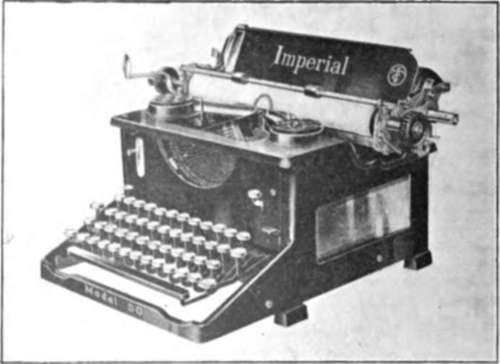
Fig. 211.
Fig. 211 illustrates the latest model Imperial typewriter, which is British made, and has several outstanding features It can in stantly be separated into three main units, i.e., the Carriage, the Keyboard, and the Frame. By this the keyboard can be changed for another in any other type or language, also a carriage of another length can be substituted quickly and easily. A centrifugal brake is fitted on the Tabulator mechanism.
In common with many other makes a two colour ribbon can be used so that, if desired, the writing can be all in one or two colours, or words or figures here and there can be picked out in a different colour to the rest of the typing, this being effected by moving a small switch as required.
On most typewriters capital letters are obtained by depressing a key while the correct letter key is struck, the same action on another key is generally used to obtain the figures. The space bar, used to obtain the space between words, etc., is general on all machines, a bar is used to give rather more space to be struck than an ordinary key.
The action of striking the keys causes the ribbon to move from one ribbon reel to the other automatically, and when one reel is full, a lever is moved to cause the ribbon to reverse its direction, and so wind back again, it is necessary therefore to move this lever at the right time, but ribbons now being very long, this action is not required very often in a day's work. Practically all machines ring a small bell at or near the end of the line, to warn the typist, etc. It is then required that the typist pushes back the paper carrier to start a new line, and this action causes the platen or roller carrying the paper to turn round a predetermined amount, so that the next line to be typed leaves a space between it and the last one typed.
Typewriters have what is termed a paper release, generally a small lever, on pressing which the paper which has been pressed between the platen and a small rubber roller is released by the small roller being moved slightly away from the paper, thereby making it possible to adjust the position of the paper against the platen exactly as may be required.
Pointers are provided to show where the letter, etc.,. will appear when the correct key is struck.
Means are also provided so that a new line always starts at a predetermined place in line with other lines. In many machines a tabulating device is supplied, on pressing which the paper carriage runs to a certain vertical line or col., this being determined beforehand by adjusting a stop to the required position, this action is especially useful in writing vertical lines of figures. For cutting waxed paper stencils, means are provided for moving the ribbon out of the way of the letters, which then strike the stencil, etc., direct.
It is really necessary for rapid work that the writing be visible to the operator as the work progresses, and by visible is meant visible without having to turn over the carrier, etc., in order to see the writing.
The platen or paper carrier after each impression is made on the paper is automatically released and pulled back a distance equal to the space of one letter, and then held again, the pull is generally obtained by means of a cord attached to a coiled spring.
Fig. 212 shows the Key Lever and Type Bar Action of a Typewriter, and Fig. 213 shows the position of the levers, etc.. when the type has just reached the paper to make an impression ; this palented mechanism ensures that the impression is uniform throughout, and it will be noted lhat the movement of all levers except the Key Lever is but slight, resulting in a light easy touch, with a minimum of noise and wear. In the Imperial typewriter the various type-bars are guided between two steel horns or plates at the time of making the impression, this making for absolute permanence of alignment. A very distinctive feature of the Imperial machine is that by a simple movement the complete keyboard and type can be removed, and another in a different language, or in different type substituted. If you change the language, you may have to change the keyboard to suit.
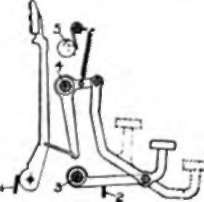
Fig. 212.
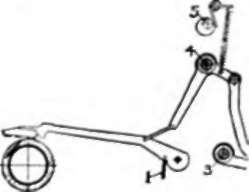
Fig. 213.
The following points are applicable to all makes of typewriters :-
General Care And Attention
1. ;Carry out the maker's instructions as to oiling, etc.
2. ;Cover the machine up when it »s out of use.
3. ;Clean the face of the type with a brush frequently.
4. ;Never pick out the type laces except with, say a brass pin.
5. ;Keep all dust and dirt, etc., out of the working parts.
6. Handle the machine with as little roughness as possible.
7. Let a competent workman overhaul it now and then.
Continue to:


My Books

