


11. Expressing More Than One Attribute In A Sentence
Description
This section is from the book "Lessons In English", by Chestine Gowdy, Lora M. Dexheimer. Also available from Amazon: Lessons in English.
11. Expressing More Than One Attribute In A Sentence
We may both assert and assume attributes of a thing in one sentence.
In the sentence, The large blue book was on the table, the size and the color (qualities) of the book are assumed and the place is asserted. In the sentence, The large book on the table is blue, the size and the place are assumed and the color is asserted. In the sentence, The frightened child ran and screamed, a condition is assumed and two actions are asserted.
In each case, it is the assertion that makes the group of words a sentence. The expression, the large blue book on the table, shows three attributes of the book; but it is not a sentence, for each of the attributes is assumed.
Exercise 5. Composition
1. In the same sentence assume a quality and assert a condition of a dog.
2. Write a sentence in which you assert three qualities of a dog.
3. Make other sentences in which you do these things : a. Assume a quality and the place of some subject of thought and assert its condition.
b. Assert two classifications of Abraham Lincoln.
c. Assume the material and assert a quality of some subject of thought.
d. Assume a quality and assert an action of some thing.
e. Assume an action and assert a condition of some thing.
f. Assume three attributes and assert two of some subject of thought.
Topics For Short Talks And Written Paragraphs
Give a short talk to your class about one of the following topics. Express the attributes of your subject of thought clearly.
Write a paragraph of several sentences about another topic. Choose your words carefully, trying to say just what you mean.
1. Insect pests. (Follow the outline given below, or make one to fit better the facts that you know or can learn).
I. Classes: sucking and eating. II. Illustrations of each class. III. Means of destroying the different kinds.
2. A prize "plate" of apples or other fruit.
3. A horse that I should like to own.
4. The angel food cake, bread, jelly, some piece of fancy work, that will take the prize.
5. The kind of boy or girl I don't like.
6. The month I like best or least. (Describe the month and see if the class can tell what one you have in mind).
7. Some odd person that I saw on the street or car.
8. My choice for a national flower.
9. Selecting seed corn. (Bring stalks and ears if you can to illustrate your talk. Perhaps you can explain the score card used in your state).
10. A wayside scene, or a scene in a park.
One reason that we have not more to talk about is that we have not trained ourselves to look for the beautiful and interesting things that are all around us. The picture on this page is a photographer's "snapshot" of a wayside scene. The man who made it, as well as several other pictures in this book, saw scenes worth preserving whenever he loitered along a country road or walked down a village street.
If you choose topic 10 you will make a "snapshot" in words. Let the class decide who gives the best picture.
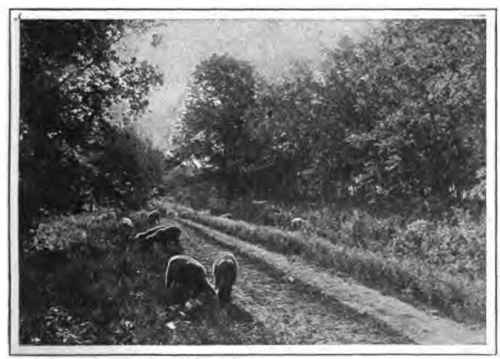
A Wayside Scene. A. J. Swanson.
Continue to:


My Books

