


Tenth Day. Second Day. New York, N. Y., Nov. 6, 1845
Description
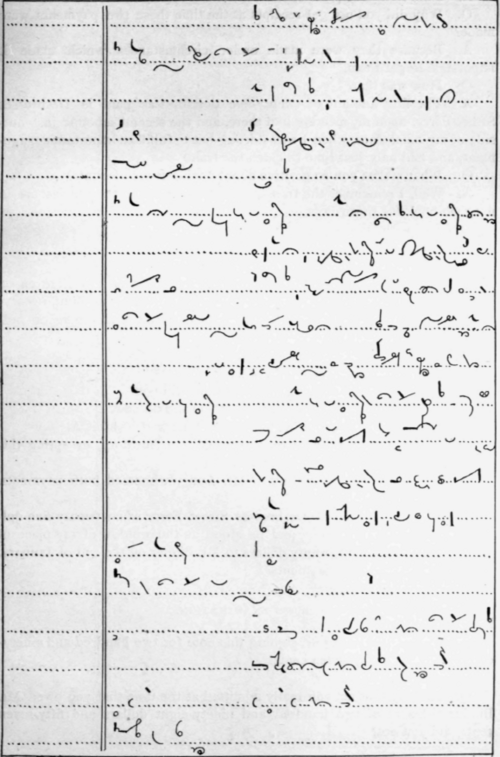
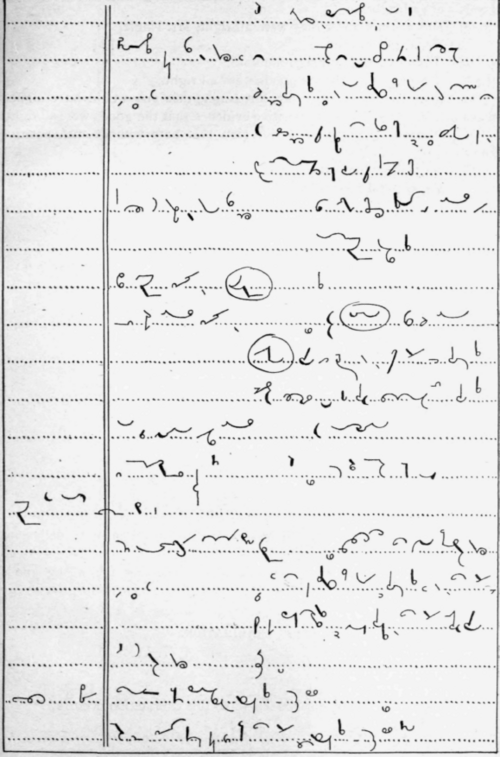
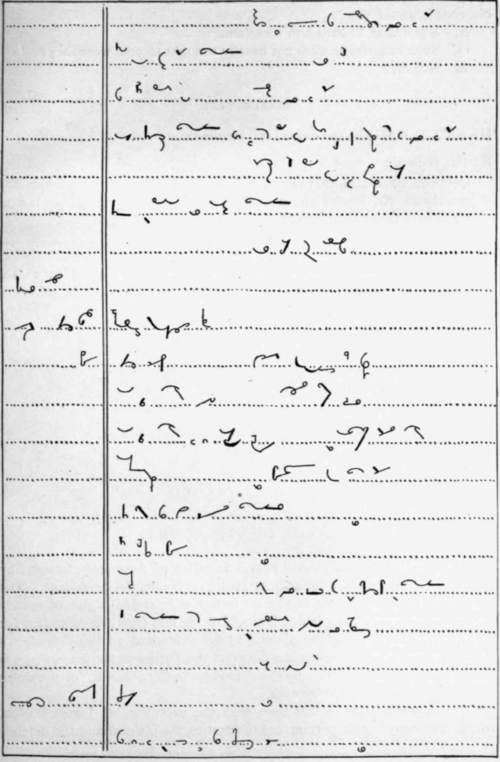
This section is from the book "Haven's Complete Manual Of Practical Phonography", by Curtis Haven.
Tenth Day. Second Day. New York, N. Y., Nov. 6, 1845
Testimony For The Defense. Henry T. Nagle, the defendant, sworn in his own behalf.
Direct Examination
By Mr. Willard:
Q. This promissory note, for two hundred and ninety-eight dollars and fifty-seven cents, which you gave Mr. George Binder, for goods purchased, did you pay it when it became due?
A. I did not.
Q. Why not?
A. Because I found out, after giving the note, that Mr. Binder had not sent me the kind of goods ordered, and the goods were inferior to the ones I had previously bought at same price.
Q. Did you ever speak to Mr. Binder of this?
A. Yes, sir, repeatedly, and sent the goods back to him, but he would not receive them.
Q. Did he give you any reason for not taking the goods back?
A. Only that he would not receive them.
Q. You are positive that he never gave any reason?
A. I am positive he never did to me.
Q. When did you first complain personally to Mr. Binder, in relation to the goods bought of him, January 29, 1843?
A. It was either the first or second or third day of February, 1843. I received the goods a day or two after the note was given, and I called on Mr. Binder the very day I received the goods, but he was out, so I left word for him to call on me, which he did on either the first, second, or third of February, 1843, and I then complained personally about them. He then said he would not receive them back.
Q. You asked him to take them back, did you?
A. I did.
Q. And he positively refused, you say?
A. Yes, sir; positively.
Q. Giving what reason?
A. No reason, only that he would not take them back.
Q. And you say, because the goods were not as represented you refused to pay this note of two hundred and ninety-eight dollars and fifty-seven cents?
A. Yes, sir.
Q. Did you ever offer to pay Mr. Binder what you claim you rightly owed him?
A. Yes, sir; if he would, from the amount of the note, deduct twenty dollars, the price of the instruments I desired to return, I was willing to pay the balance.

Q. Did you offer this money personally to Mr. Binder on or before the day the note became due?
A. I offered it several times before, and on the day the note became due, also.
Q. Did he accept?
A. He did not; he positively refused to accept the money.
Q. Giving you no reason?
A. None whatever.
Q. Did you offer him the money at any time after the note was protested?
A. I offered him, some days after the note was protested, the same amount as I had offered him before, but I refused to pay the protest on the note, and also refused to pay for the goods I didn't want.
Q. And you tried to return the goods?
A. I did, several times, before and afterward, and am willing to return them yet, as I have them in the same condition as when bought.
Q. Has Mr. Binder, at any' time, received any money from you on account of your indebtedness to him?
A. Twice on account; and he was willing to receive the amount I offered him before the note was due, but he would only receive that money as an account payment. He declined to receive it with the instruments, as a full payment.
Q. You say you offered to pay that note after it was protested?
A. I offered, after the note was protested. to pay Mr. Binder two hundred and seventy-eight dollars and fifty-seven cents cash, and return the goods not ordered, if he would give me the note. But I would not pay the protest, and, of course, I refused to pay for goods that were not the ones ordered. I made this offer before the note came due, and the day the note was due, but only once after it was due.
Q. Was your offer accepted?
A. It was not.
Q. Did you ever pay Mr. Binder any money on account of this note?
A. I did.
Q. When?
A. On one occasion-it was January of this year-I paid him-Mr. Binder - twenty-five dollars, and again, on the 23d of same month, I paid him twenty dollars, both amounts on account of the bill.
Q. Was that all?
A. That was all that I paid him on account of the bill.
Q. Did you get receipts for these amounts?
A. I did not. He promised to send me receipts, but never did.
Q. Why did you not get receipts at the time these two payments were made?
A. Because they were made under circumstances which made it impossible to get them.
Q How was that?
A, The first amount of twenty-five dollars was paid in Desbrosses Street Ferry, upon my meeting him there, and the second amount just outside of my office door, when I was starting out to fulfill an important engagement, and had only just time to catch the train.
Q. What makes you so positive about paying these amounts?
A. Well, I remember the transactions distinctly, and the entries are in my cash-book for those days.
Q. Is this the cash-book you refer to? [Showing book.]
A. It is.
Q. Can you point out the entries you refer to?
A. Yes, sir; there they are. [Indicating.] This is the first entry. [Reading.] January 13, 1845, Paid to George Binder, on account, twenty-five dollars. And here is the other, in same words, under date of 23d, same month and year, twenty dollars.
Q. In whose handwriting are those entries?
A. They are in my own handwriting.
Q. You kept your own books at that time, did you?
A. I did-yes, sir; have always kept them and do now.
Cash-book offered in evidence and marked Exhibit A.
Q. Have you no other corroboration of your memory, excepting this book?
A. Yes, sir; a salesman of mine, Mr. Long, witnessed both payments.
Q. How was that?
A. He was with me at Desbrosses Street Ferry when twenty-five dollars were paid to Mr. Binder, and he stood at the window of my place of business when I handed twenty dollars to Mr. Binder on the 23d of January.
Q. Did he see both payments?
A. He says so-yes.
Cross Examination
By Mr. Stover:
Q. Mr. Nagle, you admit signing this note for two hundred and ninety-eight dollars and fifty-seven cents?
A. Yes, sir.
Q. And by that act you really admitted at the time that you owed Mr. Binder the sum of two hundred and ninety-eight dollars and fifty-seven tents, did you not?
A. I thought that amount was correct, then, because I presumed the goods were all right.
Q. Did you not know they were all right, Mr. Nagle?
A. No, sir; I did not.
Q. Then why did you sign the note?
A. Because I thought the goods were all right.
Q. Now, do you mean to say, Mr. Nagle, that you would have signed that note, if you had not had positive evidence that the goods were all right?
A. I mean to say that I did sign that note without such positive knowledge.
Q. Do you go about signing notes in that way, Mr. Nagle?
A. No, sir; not generally. Especially not since then.
Defense Rests. Rebuttal
James Wilson, a witness for the plaintiff, being duly sworn, testified : By Mr. Stover :
Q. James, where do you reside?
A. 1132 Franklin Street, this city.
Q. In whose employ are you?
A. Messrs. Bridge & Close.
Q.. In whose employ were you in January, 1843?
A. I was in Mr. George Binder's employ.
Q. In what capacity?
A. I was delivery clerk for Mr. Binder.
Q. Do you remember this last order of Mr. Nagle's?
A. Yes, sir.
Q. Did you attend to its delivery?
A. Yes, sir.
Q. In what way?
A. I packed the goods and gave them to the drayman to deliver to Mr. Nagle.
Q. Did Mr. Nagle ever complain about receiving the wrong goods on this occasion?
A. Not that I know of.
Cross Examination
By Mr. Willard :
Q. What is your age?
A. Nineteen.
Q. Then you were about sixteen when this transaction occurred?
A. Yes, sir.
Q. You would not have known if Mr. Nagle had complained about his goods, would you?
A. Not unless I heard him complain.
Q. Such complaints were not usually brought to you, were they?
A. No, sir.
surrebuttal. Henry T. Nagle, the defendant, recalled :
By Mr. Willard-:
Q. You have said, in your examination-in-chief, that you complained frequently to Mr. Binder about sending you the wrong telegraph instruments- were these complaints made verbally, or in writing?
A. Both.
Q. On what occasions were they made in writing ?
A. On the day I received the wrong goods. I stopped in to see Mr. Binder; and, as he was not in, I left a note on his desk in reference to the matter.
Cross Examination
By Mr. Stover :
Q. Who was present when you left that note?
A. I -think James Wilson was.
Q. You think ! Are you positive?
A. I am not positive; it might have been someone else.
Q. Did you call anyone's attention to it ?
A. I think not.
Evidence. Closed
Continue to:


My Books

