


Circle Ses, Sez, Zes, Zez
Description
This section is from the book "The Manual of Phonography", by Benn Pitman And Jerome B. Howard. Also available from Amazon: The Manual of Phonography.
Circle Ses, Sez, Zes, Zez
85. Representation Of Plurals
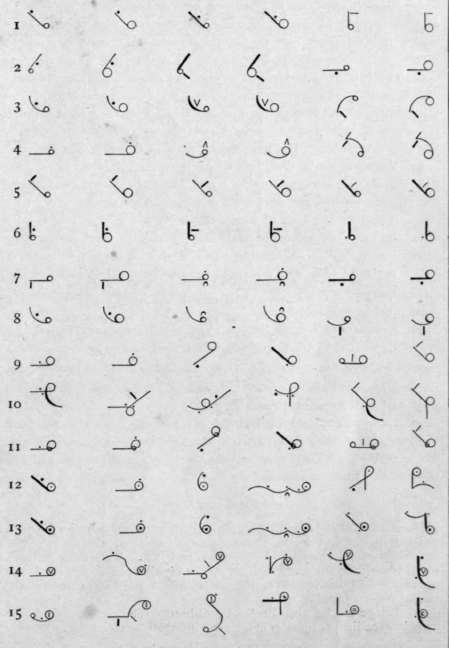
It will have been perceived that one of the most important uses of the circle s-z is the representation of the plural number of nouns. In cases where the singular already ends with a circle the plural is formed by enlarging the circle. See lines I to 8. When the singular ends with s the corresponding plural ending is sez. When the singular ends with 2 the corresponding plural ending is zez. Similarly, when the outline of the infinitive of a verb ends with a small circle, the circle is enlarged to form the third-person singular, indicative.
86. The Large Circle In Other Cases
The syllables sez and zez, as well as ses and zes, are also represented in other cases by the large circle. See lines 9 and 10.
87. Sez-Ez
When the singular ends with a large circle the plural is formed by adding a small circle-z, and the verb is treated similarly. See line 11.
88. Suggestive Vocalization Of The Large Circle
It will, be observed that, unlike any phonographic character heretofore given, the large circle has a syllabic and not an elementary value, and that the vowel in the syllable represented is normally e - the second-place light dot. To a limited extent, however, other vowels may be suggestively indicated, as follows: i (the first-place light dot) by a light dot within the large circle (see line 12); e (the first-place heavy dot) by a heavy dot within the circle (see line 13); i by the diphthong-sign within the circle (see line 14); u (second-place light dash) by a light dash within the circle (see line 15); aw (first-place heavy dash) by a heavy dash within the circle (see line 15); a (third-place light dot) by a small circle within the large circle (see end of line 15); any coales-cent by its sign turned in its proper direction (see end of line 15).
89. Zez, zes and sez, ses Circles Distinguished. - Zez, zes, may be represented by the shaded circle to distinguish them from sez, ses, (see lines 5 to 8) though such distinction is necessary only in critically accurate writing.
90. Manner Of Attachment To Strokes
All the rules for the attachment of the small circle to and between straight and curved strokes (see paragraph 80) apply equally to the large circle.
Exercise on the Large Circles.
Continue to:


My Books

