


Concurrent Vowels
Description
This section is from the book "The Manual of Phonography", by Benn Pitman And Jerome B. Howard. Also available from Amazon: The Manual of Phonography.
Concurrent Vowels
53. Consecutive Vowels Written Separately
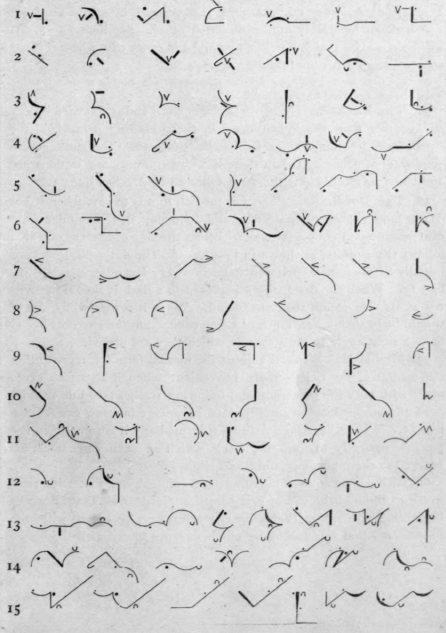
a. When a word begins with two consecutive vowels the first is written further away from and the second nearer to the following stroke. See line 1. b. When a word ends with two consecutive vowels the first is written nearer to and the second further away from the preceding stroke. See line 2. c. When two consecutive vowels occur in the middle of a word the first is written to the preceding stroke and the second to the following stroke (see lines 3 to 6) unless (d) the angle between the two strokes is so acute as to render it impracticable to write a third-place vowel within it, in which case both vowels may be written to one of the strokes, as at the end of line 6.
54. Dissyllabic Diphthongs
When the first of two concurrent vowels is long and the second is an unaccented short or obscure vowel they may be conveniently written with the following compound signs:

in which u stands for any short or obscure unaccented vowel. See lines 7 to 9. A little tick may in like manner be struck at an acute angle after a' diphthong or coalescent-sign to indicate a following unaccented short or obscure vowel. See lines 10 and II.
55. Approximate Representation Of Concurrent Vowels By Coalescent Vowel-Signs
When the first of two concurrent vowels is an unaccented
 or
or
 a coalescent-sign of the y series may be conveniently employed to represent the two vowels. See lines 12 to 15. This indicates a pronunciation which though not strictly accurate is sufficiently so for practical purposes and is, indeed, often employed by the poets. Thus, Shakespeare uses period sometimes as a word of two
 sometimes as one of three syllables
 (See Antony and
Cleopatra, act iv, for both uses).
Exercise on Concurrent Vowels.
Continue to:


My Books

