


The Aspirate
Description
This section is from the book "The Manual of Phonography", by Benn Pitman And Jerome B. Howard. Also available from Amazon: The Manual of Phonography.
The Aspirate
56. The Tick-H
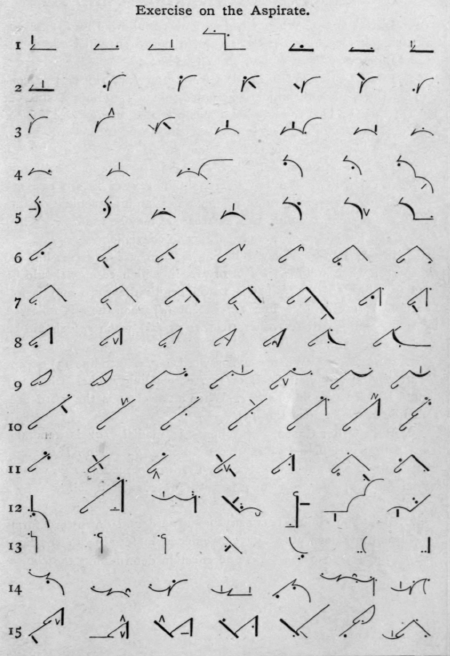
When h begins a word and is followed by k, g, s, z, lay, ar, m, mp or w, the aspirate is represented by a light short tick struck down invariably in the direction of ch. See lines I to 5. It will be observed that the tick is employed in every case where it forms an acute angle with the following stroke.
Note
In order to produce a distinct outline the tick may be made somewhat longer before lay than in other cases.
57. The Stroke-H
When h begins a word and is followed by any stroke other than those mentioned in the preceding paragraph, the stroke form
 should be used. See lines 6 to 10. The stroke is also employed, of necessity, when there is no other consonant in the word and when a vowel begins the word followed by h. See line II.
58. The Dot-H
a. When h is medial, that is to say, when it has one or more consonants preceding and following it, the regular form of representation is by a dot placed before the sign of the vowel which follows the aspirate, as shown in line 12. b. The dot aspirate is used initially before joined coalescents and in a very few other words. See line 13. When the dot aspirate is placed to a dash it should be written at its side rather than at the end. When it is placed to a dot it should be in such a position that a line connecting the two dots would be at a right angle to the stroke to which they are placed.
59. Medial H
While the dot is the normal form for representing the medial h, the tick is more convenient when it forms an acute angle with both the preceding and following strokes (see line 14) and even the stroke may be employed to advantage in a few cases. See line 15. When the stroke h is written medially it is sometimes impossible perfectly to form the hook which in such cases must be adapted to the preceding stroke as a slight offset.
60. Wh
The student may find some difficulty at first with such words as those at the end of line 5 until he has learned that all words beginning with wh in the ordinary spelling really begin with the sounds hw - that why would be much more properly spelled hwy.
Continue to:


My Books

