


The Small W-Hook
Description
This section is from the book "The Manual of Phonography", by Benn Pitman And Jerome B. Howard. Also available from Amazon: The Manual of Phonography.
The Small W-Hook
122. The Small W-Hook
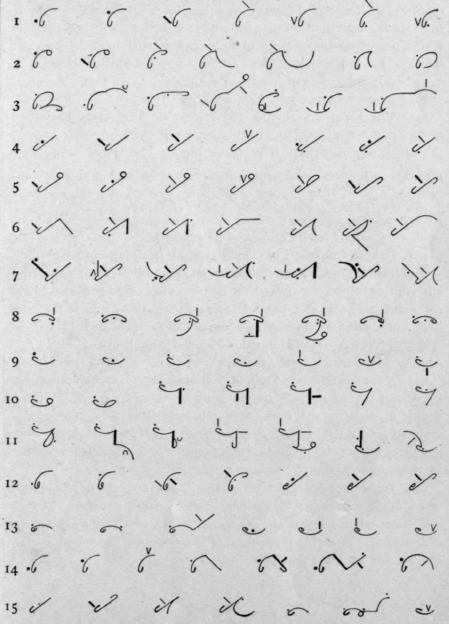
A small hook at the beginning of /, ray, m, and n represents w. See lines I to II.
123. Attachment To Curves
Like all other hooks the w-hook takes the motion of the curve; that is to say, it is written on the concave side of the curve.
124. Attachment To Ray
Attached to ray the w-hook is written with involute motion.
125. Vocalization Of Outlines Containing The W-Hook
The unvarying rule in vocalizing outlines containing the w-hook is to write and read the vowels with reference to the stroke and not with reference to the hook, to which a vowel can never be placed. In this respect the w-hook is like the circle-s. Compare paragraph 80.
126. Rules for Writing the Stroke and Hook Forms of W.a. When a word begins with w and the following consonant is /, ray, m or n, use the w-hook, except when the w is followed by two vowels, one of which is accented ; thus, write wear
 , weigher
 b. When a word begins with a vowel followed by w use the stroke; thus, ware
 , aware

127. Medial Use Of Small W-Hook
While the small w-hook is most useful at the beginning of words it may occasionally appear in middle, as in line 7.
128. Combined Circle-S And W-Hook
S preceding w may be expressed by placing the circle within the hook. See lines 12 and 13.
129. Hw
When h precedes w it may be indicated by shading the hook. See lines 14 and 15, and compare paragraph 60.
Exercise on the Small W-hook.
Continue to:


My Books

