


Double Consonants
Description
This section is from the book "The Manual of Phonography", by Benn Pitman And Jerome B. Howard. Also available from Amazon: The Manual of Phonography.
Double Consonants
130. The Liquids
The peculiar quality of / and r, which causes them to be classed as " liquids," is their power of combining with or, so to speak, flowing into other consonants. Either lor rmay combine with a preceding consonant and unite closely with it in the same syllable. The combinations thus formed may be aptly spoken of as double consonants. These combined sounds are heard at the beginning of such words as play, pray, blew, brew, fly, fry.
131. The L-Hook
Double consonants of the / series are represented in phonography by attaching a small initial involute hook to the stroke consonant which precedes the /. The / hook is regularly attached to the following strokes only:

 Shl is always written upward and never stands alone, but must be joined to some other stroke, as it would otherwise be read shn. See pars. 22 and 101.
132. Double Consonants Considered As Indivisible Compounds
The learner must accustom himself to thinking of a double-consonant sign as representing an indivisible compound, and should not consider the hook as separately representing the /. It is therefore best, in speaking of the double consonants, to name each by a single syllable ; thus
 is pl, as heard in the last syllable of the word apple, and not pee-el, which would indicate

133. Vocalization Of Double Consonants
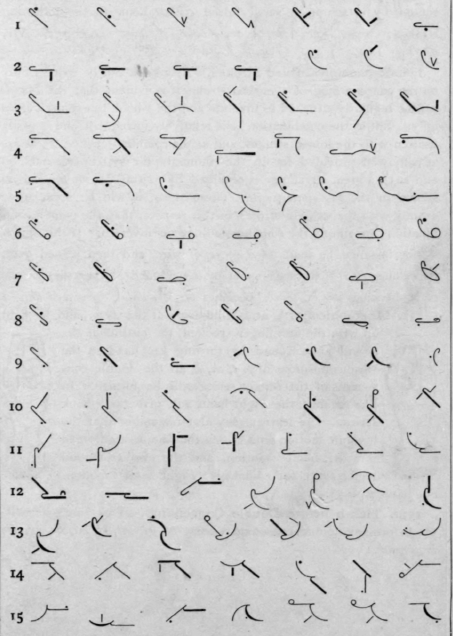
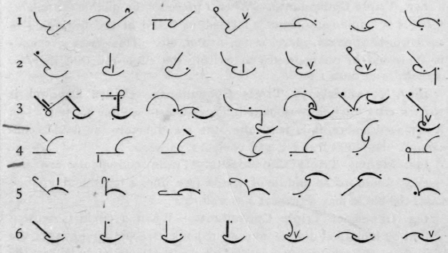
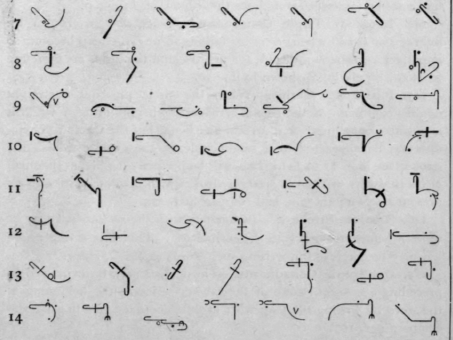
Double consonants are vocalized exactly like simple consonants. If a vowel follows a double consonant, both consonants represented by the combined sign are read before the vowel. See lines 1 to 8. If a vowel precedes the double consonant it is read before either of the consonants represented by the combined sign. See lines 9 to 15.
134. Imperfect Hooks
When the l-hook appears in the middle of an outline it cannot always be made perfect in form, but must sometimes adapt itself to the preceding stroke as a slight offset, more or less closely resembling the form of the perfect hook. See lines 14 and 15, and compare par. 59.
Exercise on the L-Hook.
Double Consonants
Continued.
135. The R-Hook
Double consonants of the r series are represented by attaching a small initial evolute hook to the following strokes:


136. R-Hook On Curved Strokes
As a hook can be written only on the concave side of a curved stroke, it is evident that the l-hook can be regularly attached to involute and the r-hook to evolute curves only. But as the combination rr is relatively infrequent and is easily written with the joined strokes, and as the combinations wr, sr, zr are already well provided for in the phonographic system (see pars. 79 and 123), a great advantage is obtained by writing fr, vr, thr, dhr as shown in the last paragraph. These signs, it will be seen, agree exactly with the straight strokes in this respect, that the r-hook combinations are simply the l-hook combinations inverted. If the sign p/
 for instance, be made of a piece of wire, and then turned over, it becomes pr
 ; in like manner by inversion fl
 becomes fr
 , vl
, vl
 becomes vr
 thl
thl
 becomes thr
 , dhl
, dhl
 becomes dhr

137. Mnemonics For L And R-Hooks
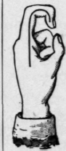
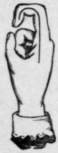
If the Left hand be held up with the first finger crooked, the outline of the tl will appear, and by turning the hand in the various positions of p, t, ch, k, all the double consonants of the l-hook series will be formed. In like manner, the .Right hand will give the r-hook series. The learner may also remember that the involute motion with which the l-hooks are formed is "Left-hand" motion, and the evolute motion which forms the r-hooks is ".Right-hand " motion.
See paragraph 78.
I37a. Tick-h before Double Consonants.- Tick-h may be written before any double consonant except kl, gl, shl, rl, ml, kr, gr, fr, vr, lr, mr.
Exercise on the R-hook.

Double Consonants
Concluded.
138. Irregular Double Consonants
Since the small initial hook attached to
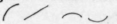 represents w (see paragraph 123) it is evident that l and r-hooks cannot be regularly attached to these strokes. The combinations rl, ml, nl, ngl and Ir are therefore distinguished by making the hook large (see lines 1 to 4), and the combinations mr and nr by shading the strokes (see lines 5 and 6). These signs are termed irregular, ml and nr being especially so.
139. Use Of The Double Consonant-Signs
In general, the double consonant-signs should not be used when a distinct long vowel, a diphthong or an accented short vowel occurs between the two consonants, as in the words pole
 ; but should be used when no vowel occurs between the letters (see page 65, lines 1 to 8; page 67, lines I to 8) or when the vowel is an unaccented short or obscure vowel (see page 65, lines 9 to 15; page 67, lines 9 to 15).
140. Intervocalization Of Double Consonants
Strict adherence to the rule given in paragraph 139 would occasionally cause long and awkward outlines for words which might be written with convenient forms could a vowel be expressed as between the two consonants of a double consonant. Intervocalization may therefore be indicated in such cases by writing, in the same position as for the regular sign, a small circle before the double consonant stroke to represent the heavy dot vowels, and after the stroke to represent the light dot vowels (see lines 7 to 9). The dash vowels, diphthongs and coales-cent-signs, both light and heavy, are struck through the double con-nant stroke (see lines 10 to 14). If the first or third-place dash interferes with an initial or final hook or circle, place it just before the beginning or just after the end of the stroke. The beginner should use intervocalization with caution, employing it chiefly in outlines of considerable length.
Note
When a word begins with rand l is the next consonant the intervocal-ized rl-hook is generally employed, in order to avoid the inconvenient forms which result from the use of ray-el and ray-lay; thus write with the rl-hook the words rail, roll, rule, relative, relation, realm, relish, and the like.
Exercise on the Irregular Double Consonants.
Exercise on Intervocalization.
Continue to:


My Books

