


The F-V Hook
Description
This section is from the book "The Manual of Phonography", by Benn Pitman And Jerome B. Howard. Also available from Amazon: The Manual of Phonography.
The F-V Hook
108. Manner Of Attachment
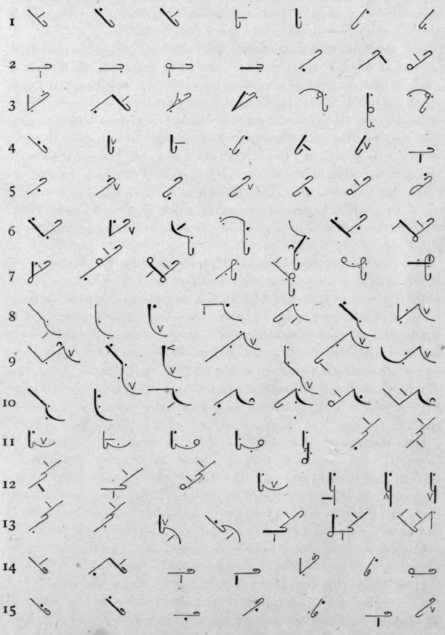
A small final hook may be attached to any straight stroke with involute motion to represent f or v.
109. F And V Distinguished
When critical accuracy is required the f-hook is made light (see lines 1 to 3) and the v-hook is shaded (see lines 4 to 7). In ordinary writing this distinction is wholly unnecessary (compare paragraph 84).
no. Rules for Stroke and Hook Forms of F and V. - a. When f or v is the last sound in a word and is preceded by an explodent, ray or stroke-h, use the hook. See lines I to 7. b. When a word ends with a vowel preceded by/or v use the stroke. See lines 8 to 10.
III. Medial Use of F-V Hook. - The f-v hook is most frequently used at the end of words, but it may sometimes be employed in the middle of an outline when a more convenient form is thereby obtained. See lines 11 to 13.
112. Combined F-V Hook And Circle-S
The circle s-z may be written within the f-hook and the combination thus obtained is read fs or vz. See lines 14 and 15. This combination is chiefly useful in writing the plurals of nouns the singulars of which are written with outlines ending with the f-v hook, but it is also used in other cases. The large circle and the loops do not combine with the f-v hook.
112a. Compound Strokes in Relation to the Base-line. - The attachment of an appendage - circle, hook or loop - to a stroke does not in any way affect the relation of such stroke to the base-line. Thus, kf and kn are so written that the stroke shall precisely coincide with the base-line.

Exercise on the F-V Hook
Continue to:


My Books

