


Signals And Systems Of Writing: Ancient And Modern. Continued
Description
This section is from the book "The Reporter's Companion", by Benn Pitman. Also available from Amazon: The Phonographic Reporter or Reporter's Companion.
Signals And Systems Of Writing: Ancient And Modern. Continued
5. First of all, written language was undoubtedly hieroglyphic - that is, it consisted of a series of pictures of thought: specimens of which occur on all the architectural and sculptural remains of ancient Egypt. This was the earliest dispensation under the written law. The system required a sign, or picture, for every idea, and, therefore, only adapted to a period when ideas were comparatively few in number, or to a people stationary in civilization. As ideas increased in number and variety, the symbols became too numerous for the memory to retain, and consequently any considerable accession of knowledge became impossible with so faulty an instrument for its expression and conservation.

6. Then some happy mortal - or immortal, as tradition avouches, - conceived the idea of transferring the symbol, or picture, from the thought to the sound, which represented it in speech. This is a fine, but yet complicated process, and so obviously out of the way of self-suggestion, that there can be no doubt that it arose subsequently to the other. Yet it is impossible to give its date; it certainly, however, belongs to a period of the remotest antiquity. We learn from a passage in Diodorus Siculus, that both the hieroglyphic and the alphabetic systems of writing were known to the Egyp-tian priests: he informs us further, that they kept the secrets of their caste and creed in the former, on account of the great difficulty of acquiring and retaining it in the memory. This substitution of phono - graphy, or sound-writing, for idea - graphy, or thought-writing, was the grandest revolution ever introduced into the arena of human effort. The latter system was unquestionably prevalent throughout the east, before the former came into use: in the mighty regions of Eastern Asia, China, and its dependencies, it flourishes - or should we not rather say, it stagnates - at the present hour. The intellectual contrast between Europe and China - the progressive civilization and conquering science of the one, and the stationary intellect and political insignificance of the other,- is not an unfair measure of the relative power of the two instruments for furthering the lofty ends and equitable aims of society.
7. Thought has infinite aspects. Each thought, too, is elementary; and no analysis can ever reduce it to a more primitive system of roots. Bishop Wilkins in modern time3 endeavoured to make such an analysis; but his attempt was a signal failure. His roots were too numerous for common use, and yet not accurate enough for science. Other analyzers have met with similar ill success. But the same remark does not apply to sound, for although it admits of almost infinite combination, its radical elements are very few indeed. These elements would alone require representatives; and their combinations would yet express every variety of vocal utterance of which the human organs are capable. The basis of the system was therefore eminently simple. This the inventor of the alphabet comprehended; and. having obtained the best analysis of sound that he could, contrived forms - probably from the ancient collection of thought-pictures - to represent each radical element. The alphabet, or phonetic system, was then complete. Probably no attempt was then made to obtain the simplest and most easily formed signs for the representation of these sounds: their want could not at first be felt; and when it was afterwards experienced, the system, although defective, was generally accepted, and a change, even for the better, became difficult. Indeed little has been done from that day to this towards establishing a scientific symbolization of language. The Greeks adopted their alphabet from the Phoenicians; the Latins borrowed theirs from the Greeks; the northern conquerors of Rome seized upon the letters of the vanquished, as a part of the spoil; and with little alteration, adapted them to the expression of their barbarous tongues. The original defects were thus transmitted from one age and nation to another; and to these were added faults of omission and commission innumerable. The result is before us. Modern English in its representation, is considerably less scientific, - less true to the alphabetic theory on which it professes to be based, than the ancient Greek was; and every year its tendency to return to the hieroglyphic type, becomes more and more apparent. This is a matter of profound interest to the progressionist; the arrestation of this backward tendency is a work which challenges his prompt attention and commands his most earnest efforts.
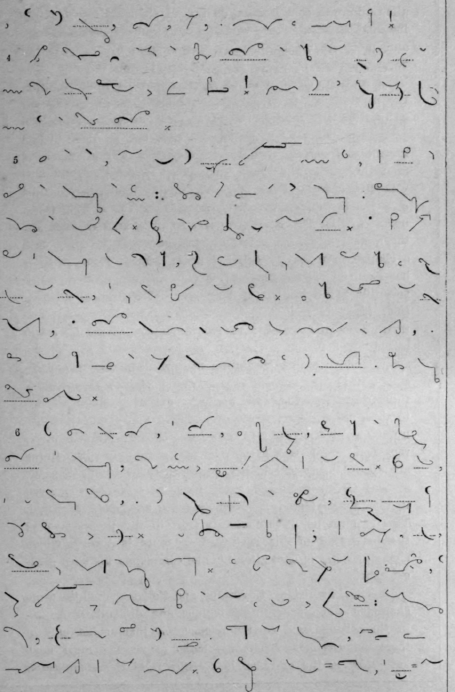
8. The Phoenicians, Egyptians, and Hellenes, used the same character - one exceedingly tedious and difficult to form -in their books and correspondence, on their coins, and in their manuscripts. That this mode of writing must have been slow in the extreme, is obvious from the complicated
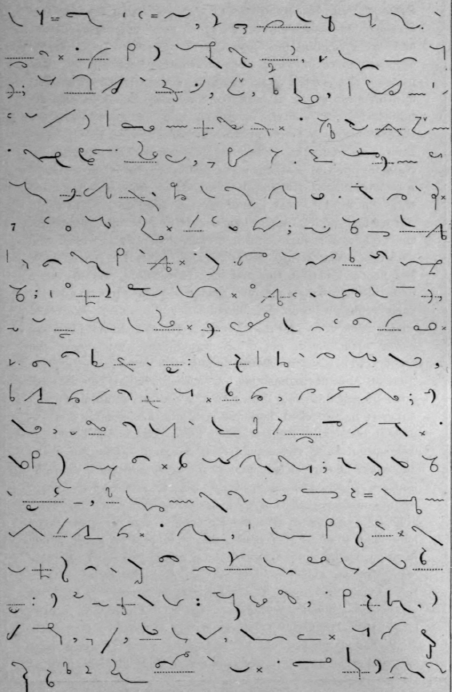
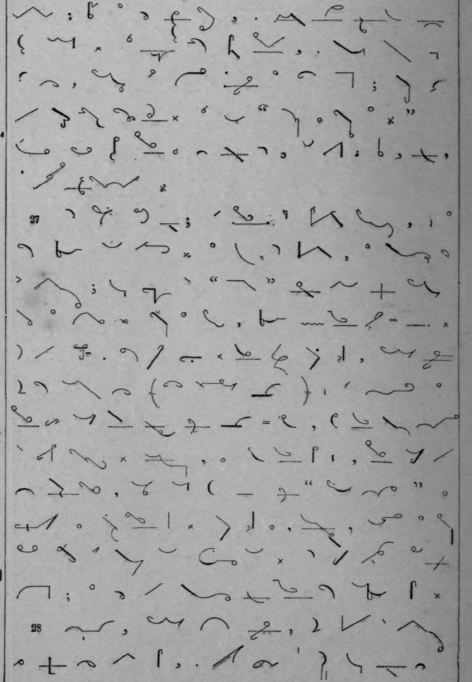
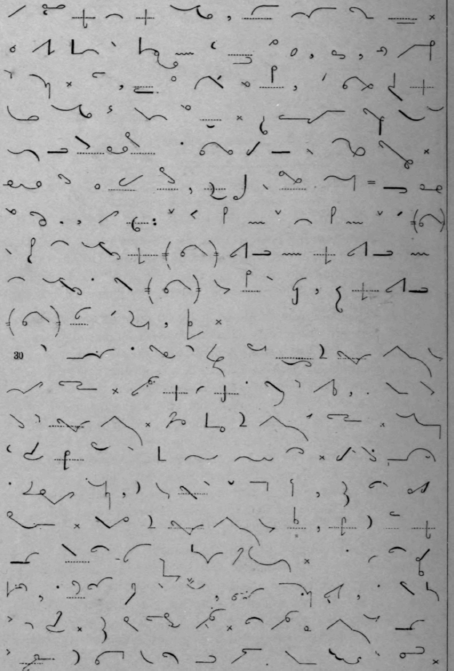
forms of their letters: from this difficulty arose the practice of using abbreviations - common on coins and in old manuscripts. Yet even this method was cumbrous. The hand, especially in composition, feels an instinctive impulse to keep pace with the thoughts. Various systems have been proposed. by which the ordinary disparity betwixt the powers of exp res-sion sion and its symbolization, might be lessened. These have been expressively termed "short hand," or rapid hand. TLe oldest system is that invented by Tyro, a freedman of Cicero's, who taught it to his amanuenses: and such was the skill which they acquired by constant practice, that it is Asserted they could make verbatim reports of speeches. They were often employed by Cicero to report speeches of eminent plead-ers, or of politicians, for his private use. The fine oration which Cato delivered on the subject of the Catiline conspiracy is said, by Plutarch, to have been reported in this way, and so handed down to posterity. Valerius Martial refers to these notaries in a well known verse. Ausonius speaks of a boy who could write down a speech by a few simple marks, while in process of delivery. But this art was lost for a great length of time. In the beginning of the sixteenth century, an ancient manuscript by Hygenus, was discovered in Dacia, written in the abbreviated style. It was beautifully written; but, of course, unintelligible to the learning of that period. At length the celebrated Pietro Bembo succeeded in deciphering it. His letter to Pope Julius II. announcing the discovery, is still extant, and it contains some curious particulars respecting the art. Since that time, a great number of systems have been offered to the world; but the same fault has characterized them all: they have been, like the method of Tyro that suggested them, purely arbitrary. They have been eminently inflexible and unscientific: too difficult for daily use, and too little systematic to satisfy the Phonetic reformer. In fact the invention of a satisfactory method of symbolization was one of incalculable difficulty, and it was only natural that many failures should precede it.
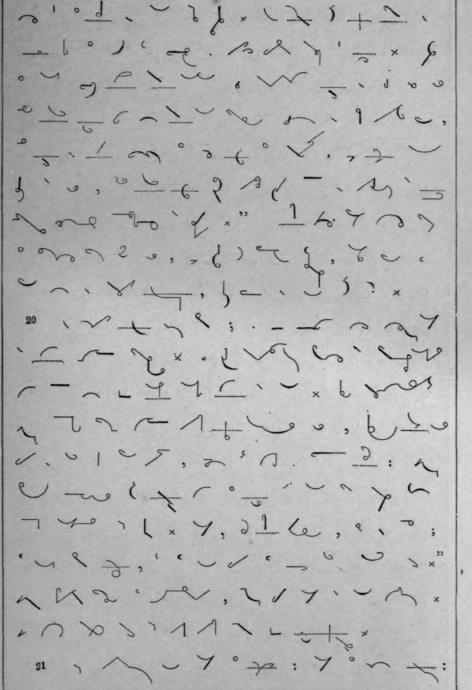
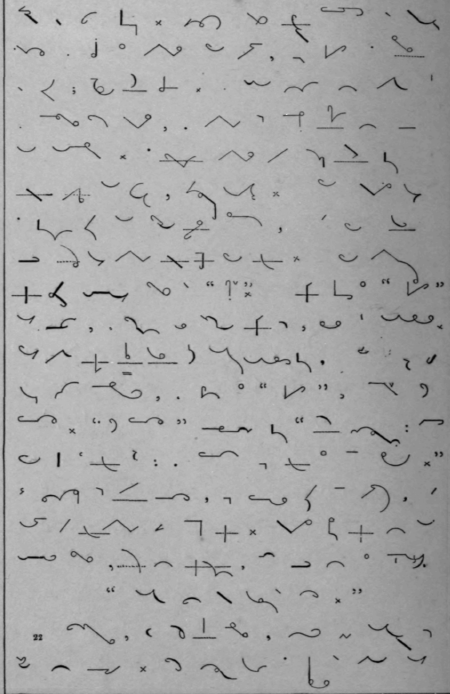
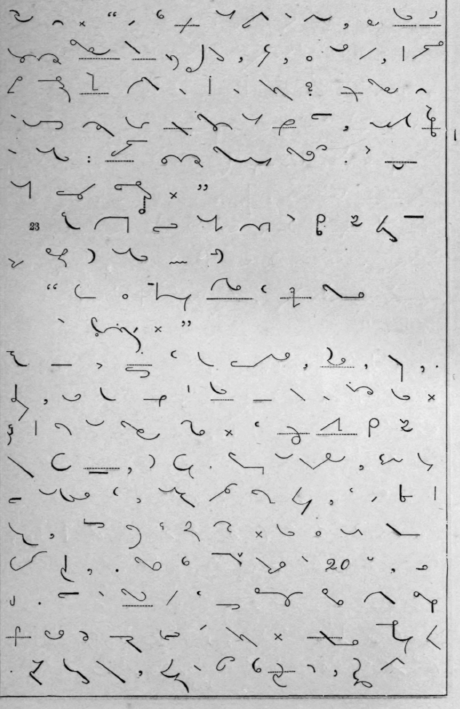
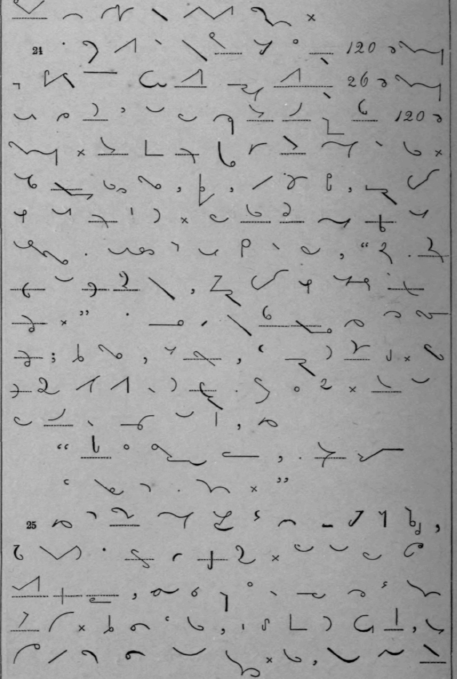
9. The great problem to be resolved in the construction of a philosophic system of writing, was this: to discover the

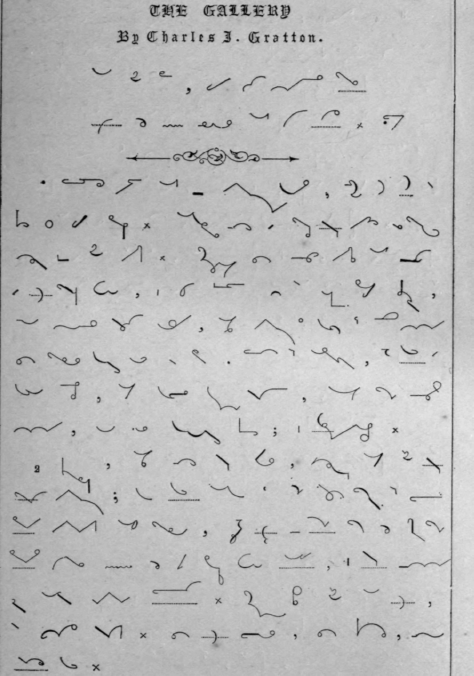
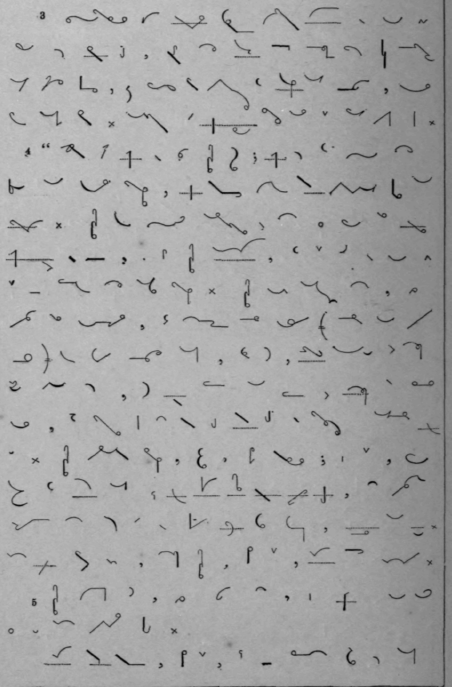
elementary sounds of which our current language is composed, to arrange those elementary sounds in their natural order, and, from the elementary geometric forms, to extract such simple lines, points and curves, as, while they bore a suggestive resemblance to the sounds they were intended to represent, should, when combined, constitute a system of notation, rigidly scientific in principle, unerring in expression, brief and facile in manipulation, and yet indefinitely expansible and improvable in character. This problem has been apparently resolved by Mr. Isaac Pitman. A happy inspiration led him to reject the Roman alphabet as inadequate to represent the sounds occurring in the pronunciation of the English language, and to revert to the idea of the first inventor of the alphabet - the discovery of the elementary sounds, and the selection of an appropriate sign for each.
10. The economical element which distinguishes Mr. Pit-man's art, however important it may be, is not the one that has the greatest attraction for the disciples of progress. Its more valuable attribute is, that it at once checks the before noted tendency of the language towards the hieroglyphic type - establishes on acoustics, geometry, and anatomy, the firm basis of a philosophical alphabet of nature, adapted to all the world: and therefore, the centre of a universal language - that grand desideratum, to which the attention of mankind should ever be directed. This is the great contribution which it makes to the cause of human progression.






Continue to:


My Books

