


What is Astrology or Horoscopy? Part 2
Description
This section is from the book "The Brihat Jataka Of Varaha Mihira", by N. Chidambaram Aiyar. Also available from Amazon: Brihat Jataka of Varahamihira.
What is Astrology or Horoscopy? Part 2
Most of the eminent astronomers of the Hast and West believed in a double Sun, a double Moon, Mars and other planets - the one is the Sthula or the physical one and the other is the Sukshma or the astral one. The difficulty in conceiving active agency as possessed by the planets when viewed in the light of huge inert balls, will be removed when we suppose that each planet possesses a soul. Besides, there is nothing repugnant to our mind in the idea that the planets together form a body of executive officers charged with the duty of rewarding and punishing humanity for their past karma by the command of the Most High, who at the same time allows each man the chance to improve his own condition by making him a free agent in many matters. A man is whipped for theft by the order of the Magistrate. He suffers for his karma - the deed of theft. But the whipping officer is an active agent. Take another instance: A man does a piece of valuable service to the state; the sovereign commands a local officer to invest the person with the order of knighthood; the officer obeys; the officer no doubt is an active agent though the honor was the immediate effect of the person's services. We therefore hold that planets not only indicate 2 human destinies, but bring about such destinies. The world is a mixed field of honor, of punishment and of probation. And the planets are the rewarding and chastising officers, and meddle in no way when man exercises his free will within its own sphere.
The same idea might be represented in another way: planetary activity is the total activity of a number of forces, some for good and some for evil, and while a man's karma leads him into the one force or the other, there are other forces by a knowledge of which man may benefit himself, though it may not be his lot to be drawn into any of them by his past karma. If this were not the correct view of the part played by the planets, a large portion of the science of astrology, in which man is advised to avail himself of such and such planetary positions for particular purposes, would become useless. The planets therefore can be made to do more than the work of jailors and rewarding officers. For instance, in the fourth chapter (Brihat Jataka) which treats of Nisheka (conception) a man is advised to avail himself of particular planetary positions if he desires an excellent issue: Parasara, who was a great astronomer and astrologer, finding that such an hour for Nisheka had approached, joined a boat-man's daughter in an island on the Jumna and the issue was the great Vedavyasa. A Brahmin astrologer under similar circumstances joined a potter's daughter, and the issue was the great Salivahana.
That man is not altogether a free agent is an idea caught by Shakespeare in one of his well known passages in "As You Like It."
" All the world is a stage,
And all the men and women merely players ;
They have their exits and their entrances,
And one man in his time plays many parts,
His acts being seven ages,"
Again, while the heavens form the macrocosm, man is the microcosm. In other words, each man is a little world exactly representing the Universe. While all seems quiet without, there is an active world within Such a world is visible to the inner sight of a Yogi. Occult science treating of this subject says:-
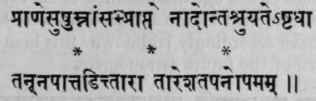
If the Pranavayu (vital air) can be taken to the Sushmnanadi, eight sorts of music will be heard, and fire, lightning, stars, the moon and the sun will become visi. ble. Again, in Chapter IV (On Nisheka Kala Or The Time Of Conception), already referred to, Varaha Mihira says that menstrual discharges occur in women when Mars and the Moon approach each other. In connection with this subject the author of Saravali says as follows: -

"The Moon is water and Mars is fire; bile is the result of a mixture of fire and water, and when bile mixes with the blood, menses appear in women."
So that with the change that is going on without, there is a change going on within, and every element or bit of man's physical body has its representative in the heavens. Such being the case, there is a subtle connection, imperceptible because subtle, between the conditions of the planets and the stars above and those of man below.
We shall now say a few words touching the causes of failure of astrological predictions; the most important of these we will take up first.
Astrology rests on astronomy. The latter science was probably in a good condition at the time of Vikramarka. The tables for the calculation of the places of the planets which were then framed or then in use, were all suited to the time. Owing probably to the wear and tear of the several working parts of the whole machinery of the Solar system, the tables of one age are unsuited to another age. To this truth the ancient Hindu astronomers were keenly alive. They have accordingly laid down this broad rule for the guidance of the future astronomers.

Since error in calculation is as sinful as the murder of a Brahmin, the correct places of the planets shall be ascertained by daily meridian observations.
And this cannot be done without an Observatory. Observatories of some sort did exist in this land; but owing to foreign invasions and the want of encouragement on the part of rulers, the science has ceased to progress, and the former tables for want of corrections have become useless. The calendars therefore prepared by the native astrologers do not give the true places of the planets. The error has been going on for the last 1000 years.
Continue to:


My Books

