


What is Astrology or Horoscopy? Part 3
Description
This section is from the book "The Brihat Jataka Of Varaha Mihira", by N. Chidambaram Aiyar. Also available from Amazon: Brihat Jataka of Varahamihira.
What is Astrology or Horoscopy? Part 3
The nautical almanacs prepared in Europe and America give very correct positions of the planets; and Messrs. Bapu Deva Sastry of Benares, Lakshmana Chatrai of Poona, Ragunatha Chariar of Madras, and Vencateswara Deekshitar and Sundareswara Srouty of Combaconum have started almanacs basing their calculation on the correct modern tables. These tables enable us to ascertain correctly the places of the planets from the Vernal Equi-noxy one of the two points where the ecliptic cuts the quator. This point is the Western first point of Aries.
It has a retrograde motion at the rate of about 50" a year. But the Hindu first point of Aries is the fixed star Revati (the Yogatara of the group) which is stated to be on the ecliptic. This star is at present about 200 to the East of the Vernal Equinox. Planetary places from this star are known as the Nirayana Sphutam, and places from the Vernal Equinox are known as the Sayana Sphutam. The little bit of increasing space between the two points is known as Ayanamsa. Now Hindu astrology rests on the Nirayana Sphutam of the planets, and modern tables give us the correct Sayaua Sphutam; so that, if the length of the Ayanamsa is correctly known, it may be subtracted from the Sayana Sphutam, and the remainder will be the Nirayana Sphutam required. But the exact length of the Ayanamsa is not known, and it cannot be ascertained by direct observation, because the star Revati has disappeared: I have treated of this subject at some length in the April (1883) issue of the Theosophist. The several almanac publishers already referred to have arbitrarily assumed different lengths of the Ayanamsa, evidently to suit their own convenience. These lengths of the Ayanamsa on the 1st January 1883 are:-
0 | ' | " | |||
(1) Bombay | Almanac | • • • | 18 | 14 | 20 |
(2) Madras | | do | • • • | 22 | 2 | 39 |
(3) Combaconum | |||||
(4) Benares | do | • • • | 21 | 58 | 29 |
(5) Vakhya | do | • • • | 22 | 41 | 44 |
(6) Siddhanta | do | • •• | 20 | 46 | 15 |
I have discovered the true length to range between 20° 23' 8" and 200 25 22" on the 1st January 1883. By adopting the mean, namely, 20o 24' 15" the maximum amount of error will only be 1' 7". Now the difference between the correct Ayanamsa and the various Ayanamsas above given will be seen from the following:-
0 | ' | " | |||||
(1) | Bombay | • • • | __ | 2 | 9 | 55 | |
(2) | Madras | • • • | + | 1 | 38 | 24 | |
(3) | Combaconum | ||||||
(4) | Benares | • • • | + | 1 | 34 | 14 | |
(5) | Vakhya | • • • | + | 2 | 17 | 29 | |
(6) | Siddhanta | • • • | + | 0 | 22 | 0 | |
To express the same in other words. The Ayanamsa error as it affects the planetary positions in point of time in the first four almanacs will be found to be as follows:-
Planets. | Bombay (before) | Madras and Combaconum (after) | Benares (after) | |||||
day. | hour. | day. | hour. | day. | hour. | |||
Sun ... | • • • | • • • | 2 | 5 | 1 | 16 | 1 | 14 |
Moon ... | • • • | • • • | 0 | 4 | 0 | 3 | 0 | 3 |
Mars ... | • • • | • • • | 4 | 3 | 3 | 3 | 3 | 0 |
Mercury | • • • | • • • | 0 | 13 | 0 | 10 | 0 | 9 1/2 |
Jupiter | • • • | • • • | 26 | 0 | 19 | 17 | 18 | 21 |
Venus | • •• | • • • | 1 | 9 | 1 | 0 | 0 | 23 |
Saturn | • • • | • • • | 64 | 16 | 48 | 23 | 46 | 20 |
Moon's node | • • • • | • • • | 40 | 21 | 31 | 0 | 29 | 16 |
So that it is evident that horoscopes constructed on the planetary positions as found in the existing almanacs are wrong.
Again,in the construction of horoscopes, the following wrong tables showing the Rasimana or time of oblique ascension of the Zodiacal signs above the horizon is adopted nearly throughout the land by a great majority of ignorant astrologers:-
Ghatikas. | |||
Aries | ... | 4 1/4 | |
Taurus | ... | 4 3/4 | |
Gemini | ... | 5 1/4 | |
Cancer | ... | 5 1/2 | |
Leo | ... | 5 1/4 | |
Virgo | ... | 5 | |
Gbatika8. | ||
Libra | ... | 5 |
Scorpio | ... | 5 1/4 |
Sagittary | ... | 5 1/2 |
Capricorn | ... | 5 1/4 |
Aquarius | ... | 4 3/4 |
Pisces | ... | 4 1/4 |
The reader is referred to the Appendix for a correct table for all the places of India.
A third cause of failure is an ignorance of the local time. The present days are days of clocks and watches, and these are luxuries confined to our towns and do not extend to our villages. Besides, these clocks and watches are rarely made to show the local time. In most of the places of Southern India, the clock shows the Madras time, and where there are no clocks the time is ascertained by a rough calculation applied to the length of a man's shadow. The corrections due to the latitude of the place and to the position of the sun on the ecliptic are omitted. At night, if the sky should happen to be clear, the transist of particular constellations over the meridian is observed, and by the application of a rough table beginning with.
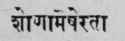
"When Sravana crosses the meridian, Aries has risen by 2 3/4 Ghatikas," an attempt is made to ascertain the local time. In the first place the table is a rough one, and in the second place it applies to the time when the Yogatara or chief star of the group crosses the meridian. The table therefore becomes useless for times lying between the transit of the Yogatra of one group and that of the Yogatra of the next group. Besides, most men are ignorant not only of the Yogatara but of the exact position of the meridian ; and turning towards the star which might be to east or west of the meridian, they fancy that it is just about to make the transit. If the night happens to be a cloudy one, the time is purely one of guess work. So many errors must, of necessity, lead often to an error in the Lagna; and when this occurs, it upsets the whole thing. Add to this the errors of the calendar relating to the places of the planets. Cent per cent. of the horoscopes of the present day are therefore wrong. It is a horoscope of this type that is put into the hands of a person who calls himself an astrologer. In a great number of cases, Indian astrologers are poor men who have betaken themselves to the study of the science as a means of livelihood. The public would pay them only if they would predict some good fortune ; if he correctly predicts an evil, he is not only not paid anything, but is set down for a sorcerer, whom it would not be safe to approach. Thus the astrologer is induced to conceal any unpleasant truths which he might happen to know, and after this the complaint is that the predictions of such and such astrologers have failed! For want of encouragement, the astrologer pays little attention to the study of his subject and often has recourse to the help of the black art as already described.
We shall now say la few words regarding a particular branch of the science, known as Prasna or Arudha Shastra, horary astrology. This differs from horoscopy or nativities in this respect, viz., while the latter rests on the motions of the visible planets round the Sun, the former rests mainly on the motions of certain invisible planets which are supposed to move round the horizon. Their laws of motion are exceedingly simple. These planets, which are 8 in number, move in the following order: the Sun, Mars, Jupiter, Mercury, Venus, Saturn, the Moon and Rahu, at the distance of a sign and a half, or 450 from one another and take one full day or 24 hours to go round the horizon - the Sun being at the first point of Aries every day at sunrise, the horizon being their ecliptic and divided into 12 equal parts, each part being known as a sign, and Taurus, Leo, Scorpio and Aqarius being respectively the due eastern, southern, western and northern heavens above. The astrologer forms as it were the sun, round whom the planets revolve. The direction of (sign occupied by) the querent is noted down, as well as the position of the invisible planets at the time. We cannot enter into the details of the process of calculation here. The astrologer proceeds to discover the matter of question and then makes his predictions with the help of his books. In this, he is assisted by another department of astrology known as Angavidya or Cheshta Sastra which rests on the motions of human limbs, casual words and the like. Angavidya rests on the theory that an All-pervading Intelligence is pointing out to the astrologer (who is otherwise unable to know them) the minute events of life in a hundred ways. (Vide Chapter 51 of Varaha Mihira's Brihat Samhita.)
Continue to:


My Books

