


How To Build A Pyramid. Part 2
Description
This section is from the book "The Pyramid: How To Build It, How To Use It", by Les Brown. Also available from Amazon: The Pyramid.
How To Build A Pyramid. Part 2
Now let's return to Les Brown's narrative, which he wrote in 1974.
Height is measured from the [topmost point of the--ED] apex straight down to the center of the base. The side measurement is the slowing line running from the [top point of the] apex down to the base corner [at the very centerpoint of juncture with the ground or with a solid foundation--ED]. The base measurement is of one side of the base, measured from one centerpoint of the lower corner beam to the next.
Many people are bothered about having read that the base angle must be precisely 51 degrees, 51 minutes, 14 seconds at each base junction, not knowing how to make such miniscule measurements of angles. Don't worry about that!! If you use the above measurements and fasten correctly when you build, these angels will be automatically built in.
For a four-foot pyramid I would advise using steel rods, angle irons, copper pipe, iron pipe or wood. The smaller pyramids can be fabricated easily from good, strong wire such as is used to make coat hangers, or with fairly strong cardboard. Naturally, the wire ones would be open and the cardboard ones closed.
You can make energizers from a number of such cardboard pyramids placed side- by-side. Remember, energy from the points of an energizer is more concentrated than that produced by a single pyramid. The energizer is especially good for experiments in general, or for use as an energized surface on which to stand plants. Once the energizer is constructed, place over the top of it, in contact with the points, a sheet of heavy foil or light-gauge aluminum plate. The energizer is then ready for use. [See Fig. 4].
A pyramid energizer has multiple uses. The one pictured consists of 72 small cardboard pyramids and a top plate of cardboard covered with foil. By placing the top plate on top of the pyramids and orienting the entire energizer to true north, you can use the energy generated for such purposes as mummification, energizing water, or as a beneficial surface on which to place growing plants for outstanding growth.
Remember that with all types of pyramids, positioning is all-important. One of the sloping sides must at all times be facing towards magnetic North--nor a corner but the flat face of the pyramid must face MAGNETIC North. Use of a small pocket compass is advised, but one friend of time aligns his by the North Star at night. [That is fine, unless our planet's magnetic North wanders, which it does.--ED] In this respect, a pyramid is like a radio. For maximum performance you must tune it in properly, pointing it right at the transmitter. Similarly, several pyramids oriented to true North and stacked on top of each other will produce increased energy, cell activity and growth.
Pyramids more than four feet at the base need to be made of much stronger materials in general, to prevent any bending, would negate energy-accumulation. Such pyramids are expensive to build and normally would be erected with some specific use in mind. For instance, consider a 16-foot-high model. Such a size would be ideal in a garden for encouraging the growth of plants. The very low angle of the sides to the ground would prevent your using some of its square feet, but you would still have nearly 600 square feet at ground level. Installing a floor at about a seven-foot height and leaving a hole in the middle for access still leaves an extra 80 square feet of growing space. The leaning walls ensure plenty of light all through the pyramid. The larger the base, of course, the larger the second floor will be.
A 16-foot-high pyramid could be built with wood two-by-fours. Two-by-eights leaning sides should be used--set in the thickness of the glazing--with the two-by-fours nailed to the two-by-eights on each face for rigid and glazing support. A pyramid this size can keep a family in vegetables year-round. Eat the vegetables fresh and store the surplus. See Figs. 5, 6 and 7 for guidance in constructing the pyramid.

Layout Shows Base Corners Miterfd At 45&Deg;, Side Members Mitereu At 38c For Fitting To Base. And Mitered At 52&Deg; For Apex With Braces As Shown.

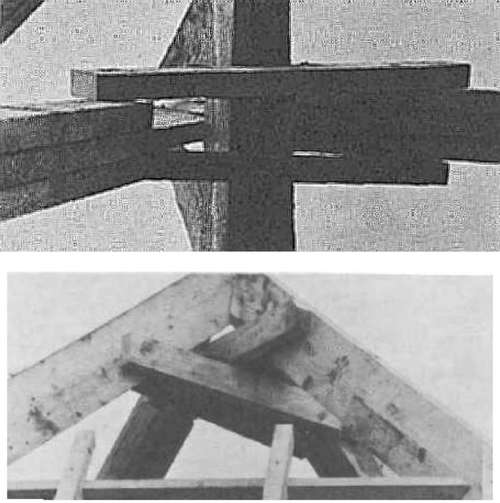
Being permanent structure, pyramids need strong foundations--electrically grounded-- concrete being permeated with metal rods and waste metal to make it conduct. I have gone to a great deal of trouble to get measurements correct so that the correct angles come naturally. Some care must be taken to cut angles so that the apex fits together naturally. I found this to be the most difficult part of the construction. I solved that problem by taking thin cuts off the wood a little at a time.
One method of ensuring absolute accuracy is to drop a plumb bob from the peak, to make sure that it forms a precise right angle (90 degrees) with the floor. Another is to level the foundation by staking the ground and pouring the foundation or stacking concrete blocks to the leveled string.
A door on each side of the structure will give greatest control over excessive heat in summer. In these photos I have shown large panels for the window sides; however, such construction is up to one's circumstances and ability to garner appropriate glazing. If one only intended to use the pyramid in warm weather, the frame alone would be quite sufficient. However, for those who intend to live under the pyramid, it must be sheathed in glass. Otherwise, one must go through the complete task of re-glazing every few years, if one chooses plastic film or Plexiglas that scratches easily.
Winter heating can be achieved by installing warm-water piping around the base of the walls, coupled to a hot water tank similar to one used in a home, plus a circulating pump. A standby heating system of some kind should be provided in case an interruption in electrical supply [to the pump] occurs. Solar panels can be considered, or a heat pump. The drawback with a heat pump system at present is that it also requires electricity to operate. Thus, unless a generator is also supplied for it, such a system cannot serve as backup to a main heating system operating off the same circuit.
Continue to:


My Books

