


Chapter III. Pose And Carriage Of The Hands
Description
This section is from the book "The Laws Of Scientific Hand Reading", by William G. Benham. Also available from Amazon: The Laws of Scientific Hand Reading.
Chapter III. Pose And Carriage Of The Hands
WE shall now begin at the first step in hand-reading, and proceed, by successive stages, to consider everything necessary* to a thorough comprehension of the science. The space given to the consideration of each subject is in proportion to its importance. It will help you greatly to adopt a method in your examinations similar to that followed in succeeding chapters, and follow it with each pair of hands you read. First, pose, then texture, flexibility, consistency, color, nails, etc., in the regular order given here. By adopting a definite method of examination, such as the above, you will never be at a loss where to begin or how to proceed. The first thing you should consider in reading a pair of hands is the manner in which they are naturally carried. To place yourself in the best position to do this, you should locate your chair on the farther side of the room, opposite the door through which your client will enter. From this point you may observe certain indications given by his hands before he reaches you. It is necessary, in order to arrive at correct conclusions in this matter, that the hands should be held naturally, and that your subject should not feel under any restraint or embarrassment.
If the mind is at all disturbed, it will reflect itself in an unnatural carriage of the hands, and you will fail to catch the unconscious gleam of the real inner self. To further this end, your assistant should have the visitor remove hat, coat, and gloves (it will aid materially if this assistant have also the tact to say a pleasant word), so that as the client crosses the floor, he or she may do so carrying the hands in a natural manner, mind at ease, and unconscious that the reading has already begun. It may be stated here that the hand whose owner has little or nothing to conceal opens itself freely to the gaze, and that the hand of one whose deeds and thoughts will not bear inspection wishes to hide itself, or to close the fingers over the palm, studiously concealing it from sight. The mind feels the necessity for hiding its workings, and the fingers, obeying the suggestion, close over the palm. Thus to you will come the knowledge that if your client seems bent on hiding his hands from sight as he crosses your room (1), or if he seems anxious to keep the hand closed as much as possible, which he may try to do even while you are examining it, he has ideas which he does not like to have exposed; he has a dark side to his character, and is probably deceitful, hypocritical, or untruthful.
You must always give these clients the plain truth; do not fear to wound them. Be sure you are right, of course, and do not judge by any one indication, but look for other indications bearing on the same line of investigation, then tell them all you know, and do not be disappointed when they say that you have entirely misjudged them.
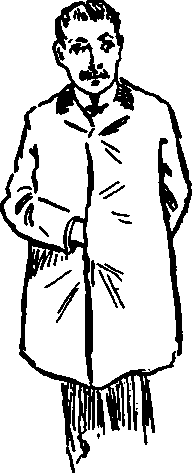
No. 1.
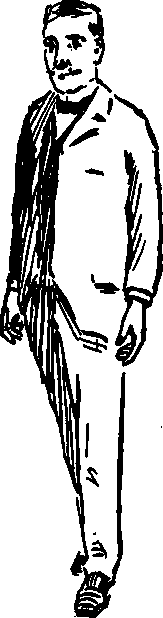
No. 2.
You may next be visited by the man who is merely careful about telling all he knows. He is one who can keep a confidence, or closely hold a business secret. He is not, in gently closing his fingers, hiding a bad thought or a bad trait, but he does not make a confidant of every one he meets. This man will cross your room without any effort to hide his hand from sight (2), and without the studied and evident attempt at secretiveness and the lack of openness which characterizes our hypocritical friend. His hands will be held at his side, the fingers partially closed, and while the hand shows life, and does not hang limp and logy, nevertheless it is not wide open. In this case, the greater part of what the man knows is kept to himself; he is self-contained, cautious, trustworthy; one in whom you may confide; who meets you half way in confidences, and with nothing frivolous in his character. You must, in studying all hands, learn to distinguish a hand that is full of life, is springy, and elastic in its outward look, telling you, even before you have touched it, of the vital energy stored in its owner.
By pursuing such a "study of observation" of the hands of all the people you meet, not trying to individualize in the analysis of their qualities, not mentally trying to class them into types, but merely seeking to get impressions of strength or weakness, attraction or repulsion, that develop under such a study, you will find that every pair of hands has eyes; that they seem to look at you, asking pity, maybe, for their owners, or, that they have mouths, and beseech you to hear their story. This study of the impression created by the mere sight of hands must be practised continually. By following this line of observation, and observing the other directions as to method of practice suggested at the beginning of this chapter, you will know the kind of person with whom you have to deal before he takes his seat in the chair, and you will thus know better how to handle his case. It has seemed necessary to say this here, for, in bands carried as described by the latter type, it is the life, the spring, the elasticity looking out from them that will say to you, "This is the self-contained, prudent man; I must be direct in my statements, say nothing that can imply that I am asking him a question, but tell him the story, not let him tell me."
Continue to:


My Books

