


Pose And Carriage Of The Hands. Continued
Description
This section is from the book "The Laws Of Scientific Hand Reading", by William G. Benham. Also available from Amazon: The Laws of Scientific Hand Reading.
Pose And Carriage Of The Hands. Continued
The next client is one who carries the hands at the side, the fingers nearly open, and the hand dangling in a limp and lifeless manner (3). The whole impression of this hand is that of indecision, and a lack of fixedness of purpose; it indicates one that it would be exceedingly dangerous to entrust with any secret, unless you want it revealed to the first adroit individual who happens along. In this case the mind is lacking in definite ness of purpose; it is ready to receive suggestions, no matter whether they are correct or not, and the subject, being mentally lazy, will not take the trouble to think for himself. The mind is without a fixed purpose, consequently the hand is one which, by its lifelessness and dangling look, shows that it is the servant of a mind that is ready to be lazily directed by some other mind stronger in purpose than itself. Its fault is in being like a sieve, through which all that is told pours readily, and it is coupled with a lack of ability to be self-contained. Number 2 and number 3 are respectively the "close-fisted" and open-handed people in money matters: the first thinks before he spends; the second is the one of whom it is said, "A fool and his money are soon parted." These undecided hands, in coming toward you, will tell you that you may easily impress their owner, and the only trouble will be to keep him from instantly telling you all he knows.
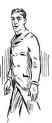
No. 3.
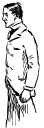
No. 4.

No. 5.
The next subject for our consideration is the one who crosses your room with his hands hanging at his sides, but with the fists firmly closed (4). This does not indicate the bruiser or the bully, for you will find those qualities in another type, but it indicates one who is laboring under great determination. The very act of clenching the fist will indicate plainly that the mind is made up, the determination fixed. The clenching of the fist shows the shutting in of the vital energy, the shutting out of all idea of further parley, and the arrival of the time to act. Thus the degree of clenching of the fist shows the quantity of determination as well as the quality, for if it is merely a gentle closing of the hand, it will show you the firm, determined person; if it is the clenched fist with the ends of the fingers pressing hard into the palms, the person is laboring under scine pressing excitement, which has brought with it determination. It will thus portray to your mind very strong resolution, either the habitual strength of that quality in the subject, or its temporary occupancy of his mind at the time.
The next person who crosses the room may carry the left hand gracefully at the side, the right forearm vertical and resting against the biceps, the wrist curving gracefully, the fingers of Saturn and Apollo close together, and gracefully curved, fingers of Jupiter and Mercury apart and showing a space between them and the other fingers (5). This will show you one who is dominated by the artistic qualities. You will seldom find this pose of the hand in men, but plentifully among women. It is chiefly useful in distinguishing the really artistic nature from the commonplace one carrying the hands in a dead, lifeless way at the side, and it will give you the inkling of a love of the beautiful and tasteful things of life, as possessed by your client. It shows more of the psychic qualities than those belonging to the matter-offact housewife. You can please this subject at once by speaking of grace and beauty as her mainspring, and it will not be hard to find the way to her heart through these channels. As this pose will be most frequently met among the people of refined society, you will have to inform yourself on all subjects pertaining to "proper form," "etiquette," etc.
Thus equipped you will be able better to depict their character and probable outcome than if you were not conversant with the rules of those in the "blue book." Then there is the "Miss Nancy" who crosses with a mincing gait, the left hand and forearm held across the abdomen, the hand drooping at the wrist, and held loosely, the right arm carried vertically, the forearm doubling back on the biceps, the right hand drooping at the wrist and held loosely, with a pair of eye-glasses, a lorgnette, or a smelling-bottle held listlessly in the fingers, and either whirled or swayed gently as he walks (6). This person is "finicky" in the extreme, hypersensitive, and shows an excess of femininity in either man or woman. It is odd to say that a woman can be excessively feminine, and yet this is true, for many lack the elastic, firm femininity that does not mean boldness, but does mean strength. It is the kind which does not give way under discouragement, but with fine womanliness rises to the occasion, and becomes the support and stimulator of husband or family in times when her strength and encouraging words are needed. The excessively feminine woman sinks collapsed when her help is most necessary, and becomes, for the time, an added burden in place of a tower of strength.
In a man it means the "Miss Nancy," caring more for the appearance of dress than for the strength of masculinity. Then there will be the person who seems to find no place for his hands to rest (7); he carries them first up, then down, then in the pocket, then fingering the watch-chain. This person is uncertain in purpose; emotions are passing rapidly through him, and these emotions are not under the control either of mind or will. These people are very often strong characters but need directing.

No. 6.

No. 7.
Then there will come the person who holds the hands in front of the body, or slightly at the side, waving them about as though trying to keep from touching anything (8). If an object should be brought close to these hands, they would instinctively shrink away from it and avoid contact. It looks as though the ends of the fingers contained eyes which were roaming from one place to the other. This person is suspicious, is "sizing up" everything about him, making mental notes of the appearance of yourself, the settings of the room, and is looking for trap-doors and concealed things that are to help you to read him. This action of the mind, showing watchfulness, alertness, and investigation, is reflected in the hands, which roam around evidently searching for information, and in reading this subject it will be well to point out the places in the hand from which you get your information, give him your reasoning frankly, and conceal nothing from him. Handled in this way, these people become your best advocates. There will be some who will cross the room with the fingers toying with the handkerchief, a button on the clothes, the watch-chain, or some other trinket or trifle (9). This subject is nervous, and is momentarily under excitement.
It is not the calm, placid, even temper shown by the one who crosses in a stately manner with the hands easily clasped together in front of her, the palm of one hand up, the palm of the other hand resting in it (10). This is a most eloquent indicator of repose and evenness of temper, one which will present an unruffled front to all exciting circumstances and events. You must not be hurried with this calm person.

No. 8.

No. 9.
Her mind acts with dignity, and more slowly than the average. If you should talk fast and not give time for what you said to be absorbed, you would find her saying to her friends in describing your reading, " I suppose it was good, but really he talked so fast I could not catch all of it."
Then you will be consulted by the bullying person, his fists tightly clenched, his elbows bent, with his arms carried in what I have called the " bow-legged " fashion (11). This is typical of a bruiser and fighter,and you must be exceedingly firm in what you say. You will also have the person who crosses the room rubbing his hands together, as is the fashion in washing them; he rubs one hand against the other in a most sly, oily manner (12). This will tell you of " Uriah Heep," slippery, adroit, hypocritical, untruthful. You cannot depend on him at all, and you must bring out all his qualities, for he is the personification of insincerity.

No. 10.

No. 11.

No. 12.
Then will come the haughty and proud, very much inipressed with his own importance. He will cross your room with a stately mien, the left hand held at the side, the fingers loosely closing, the right arm bent at the elbow, held horizontally across the abdomen, the palm held upward with the fingers closing loosely over it (13). This person is full of self-importance, impressed with his own dignity, and will quickly resent anything like an attempt at familiarity, or anything tending to show that you do not fully agree with him in his estimate of himself. And next you may be visited by a pair of hands hanging limp, heavy in shape, thick and fat, which will seem to belong to a dead person, and mentally they do (14). All is heaviness, density, coarseness, no chance for flights of fancy on your part, no chance for rhapsody. If you attempt a keen analysis, he will blankly stare at you. No use trying to lift him out of his trough of materialism. It can't be done. He wants to know his brother's name, whether he is married, how many children, how long he will live, whether he will be rich, and you cannot lift him above this plane.

No. 13.
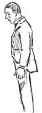
No. 14.
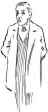
No. 15.
Finally, we meet the person who will cross with an investigating air, the hands clasped behind his back (15). He is extremely cautious, does not know exactly what is going to be done, does not want to fall into any trap, is looking over the ground before he "shows his hand." Deal gently with him; he is timid, he means well, but is suspicious.
From the foregoing illustrations, it is apparent how great an assistance it will be to make a careful study of this chapter. Assume the poses described, and learn to recognize them at a glance. Do not try to commit this chapter to memory, it will do no good unless the mental picture of all these people is in your mind, so that the moment they are seen, that moment they are recognized. Thus before your client is seated, you have much to aid you in your method of handling him.
Lane Library, Stanford University
Continue to:


My Books

