


Mounts And Fingers - How To Judge Them. Part 3
Description
This section is from the book "The Laws Of Scientific Hand Reading", by William G. Benham. Also available from Amazon: The Laws of Scientific Hand Reading.
Mounts And Fingers - How To Judge Them. Part 3
Long fingers and knotty joints show a distressing love of detail (long fingers), and analysis (knotty joints), consequently the subject is painfully slow ; it is the intensifying of both the long-fingered qualities and the knotty joints. Apply these qualities to the Mounts or to only one if found on one finger alone.
Long fingers and smooth joints love detail (which comes from the long fingers), but think much more quickly (because of the smooth joints). Spatulate or square tips make the detail of long fingers more practical. Conic or pointed tips make their possessors think more quickly and lighten some of the severity of the long fingers. Apply all these to the Mounts, or single fingers if only seen on one finger.
Short, critical nails add their distinctive qualities to both the knotty and long fingers.
Color of the nails gives to all the above fingers the qualities peculiar to color.
Hands will be seen in which all the Mounts seem to be equally developed. This shows a well-balanced character, partaking of a general supply of qualities from all the types. These subjects are always more even-tempered, broader in their general views, more amenable to reason, healthier, and more perfectly balanced than those who are of one strongly marked type. In such a case as this, to get the natural type of the subject, see whether one Mount may not have a good line on it or whether a strong finger will not give the key. On each of the Mounts of Jupiter, Saturn, Apollo, and Mercury, it will be important to note the exact apex or tip of the Mount (see 91, three illustrations). This is of value, in that you may discover whether the apex of the Mount is in the exact centre or whether it leans toward one of the other Mounts. In the hand with every Mount of equal development, this will aid materially in determining which Mount is strong enough not to be influenced by any other. If, in this hand, so nearly equal, you do not find the tip of one Mount higher on the Mount or nearer its centre than are the tips of the other Mounts, or if you cannot find a vertical line on any Mount which gives you the key to the type, or if you do not discover that any finger is abnormally long or large, you will have to note which finger has the squarest or most spatulate tip, or whether the first knot is developed and thus determine the type to which your subject belongs.
It is sometimes very hard to handle evenly balanced people; those with pronounced characteristics do not bother you so much. The balanced man is the one who tests your skill. To tell him that he is evenly balanced will not satisfy you have to find out more about him, and to do so you must locate his type. You must learn how to locate the exact tips of the Mounts. I have photographed a portion of the hand which shows the manner in which the capillaries of the skin run (91, first illustration). Note that a little triangle is formed by these capillaries. The centre of this triangle is the exact centre of the Mount. It does not matter that this apex is not on the most prominent or fleshy part of the Mount. Many students have considered the most fleshy part as the top of the Mount; this is incorrect. It is the centre of the capillary triangle which is its apex. To find and use this apex may appear to be insisting on burdensome and unnecessary detail, but if you expect to get below the surface in hand-reading you must be able to recognize at once the slightest displacement of the tips of the Mounts. In coarse skin you can easily locate this apex with the naked eye, but on a skin of fine texture you will have to resort to the glass.
By gaslight, even with the glass, it is almost impossible to locate it.
As a general rule, the apex should lie exactly in the centre of the Mount. If it is nearer the top it elevates the qualities, if towards the base of the Mount it pulls them down.

No. 91a. APEX OF MOUNT.
Mounts and Fingers - How to Judge Them 195
The three worlds apply here as everywhere else. If the apex lies in the centre it shows the Mount to be well placed, and adds great strength to any Mount. In the hand with all Mounts equally developed, if the apex of one Mount is better placed than the others, that one will dominate, and in a puzzling case it will often open the way to a location of the type. If the apex is pulled toward another Mount, it shows that the Mount toward which it leans is the stronger, and it gives up part of its type to the stronger Mount. This will be fully discussed in chapters on the different Mounts, but the general rule is given here.
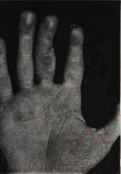
No. 91a. APEX OF MOUNT.
In the seven types of people, all could not have the same degree of perfection, so defects in the types, as well as cases of extremely bad and vicious development, are found. In all cases vertical lines are good lines, while horizontal lines which cut and destroy these lines are bad. The general rule (USE MAGNIFYING GLASS) is therefore laid down that a grille, which is formed by a combination of the two, is a defect of the Mount, and the Mount which has only cross-lines is bad (9a). In cross-lines alone all is obstruction, and there is not even an attempt of the vertical lines to counteract the evil. In the case of the grille there is some good shown by the vertical Mounts and Fingers - How to Judge Them 197 lines, even though marred by cross-lines. In the different types some incline more naturally to evil than others; so a grille or cross-lines on a Mount whose natural instincts are bad means more of evil than on a Mount whose type is naturally good. In examining for defects you must note color and nails. These will show both health defects and defects of character. There are types who naturally become criminals, others are bad on account of their environment or special temptations. The Mounts will show these facts. In examining Mounts always remember excess is as bad as not enough.
Ambition, kept within bounds, is both necessary and useful, but too much of it may make men steal in order to keep up appearances. Lack of ambition is a bad thing, for it usually means little success, but a man who on this account amounts to very little may still be an honest man.
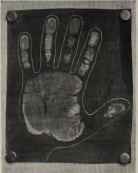
No. 91c. APEX OF MOUNT.
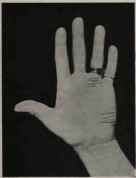
No. 92. CROSS-BARS ON A MOUNT.
In examining the Mounts, in no case fail to look at both hands. In the left hand you may discover a hard Mount, and in the right a soft one. In this case the vigor natural to the Mount has become weakened. The reverse of this combination will produce reverse results. You may find the color in one hand red, yellow, or white, changing, however, to some different color in the other hand. In this case the qualities indicated by color in the left hand have been changed for the qualities shown by the color in the right hand. This will be useful when you wish to tell a subject what kind of a person he was and what he now is. By applying the rules laid down in previous chapters on color, consistency, and development of the left and right hands to the individual Mounts, there will be no trouble in successfully dealing with the Mounts as found in the two hands. The same rules apply to the individual Mounts and fingers as to the whole hand. It is by learning to apply all of the general rules to the individual parts of the hand that you will be enabled to read the mixed combinations so frequently encountered.
Continue to:


My Books

