


The Line Of Apollo. Part 3
Description
This section is from the book "The Laws Of Scientific Hand Reading", by William G. Benham. Also available from Amazon: The Laws of Scientific Hand Reading.
The Line Of Apollo. Part 3
It is easier and more profitable for the palmist, for it is remarkable how clients agree with the reader when told of brilliancy, wonderful perception, latent talents, etc., and each one will say he has always thought this was the case, but was never quite sure of it before. Palmists who have a pleasant story to tell, get the most clients, and this being known to professionals, leads to a system of flattery totally out of proportion to the subject. Most of this is referred to supposed lines of Apollo for corroboration. Our effort here is to reach the facts only, that we may deal with the line just as it deserves, and in order to do this we must limit ourselves to the consideration of the lines whose course between the Mounts of the Moon and Apollo mark them unmistakably as Apollo lines.

No. 435.
The character of the Apollo line indicates the intensity and power of the qualities it represents. The best line is that which is deep and well cut (435). This gives in the highest degree the beneficial qualities of the line, indicates success and reputation, and gives to a subject creative power in whatever world he operates. He is not one who is merely fond of color, painting, and art, but has the creative power which will enable him to produce work of merit. It distinguishes the real artist from the lover of, or dabbler in art, and when the first phalanges of the fingers, especially if that of Apollo, be longest, and a long deep Apollo line cuts the hand, your client is entitled to be told that in the artistic world he may achieve fame. With proper combinations this line is also seen in the hands of celebrated literary men and women. If the second phalanx of the finger be longest, with the first well developed, he will still be the artist, but will also have the ability to make money from his talents. This subject is successful in the business world, and even his money-making is done in an artistic way. In using the word "artist," do not understand that it means only a painter of pictures. It may mean a poet, an actor, a singer, or refer to any other of the artistic callings.
On all sides of his character, the Apollonian loves beauty, and whatever is pleasing to the eye or sense. If the third phalanx be longest, especially if it be thick, and a deep line of Apollo is seen, the subject is not an artist, for he will like chromos better than the old masterpieces, will love high colors, flashy dressing, and will seek to display his taste on all occasions, much to the amusement of people of true artistic feelings, whose society he affects. Such subjects are always money-makers. These three illustrations show the method of applying a deep line to the three worlds of the finger, by giving an intense interpretation to the line, based upon the quality of the subject. A thin line of Apollo (436) will decrease the intensity of the reading. The subject will not have the great creative power of the deep line. If an artist, he will be more guided by the effects produced by other artists, and, whether the mental, business, or material worlds rule, he will achieve less celebrity and make less money. If a line be broad and shallow (437) it will show that little of the Apollonian power is left. The subject will like pretty things, will be fond of artists, will affect a little bohemianism, but will avoid attempting any productions himself.
If the hand be coarse in its development, the taste will be for showy things, and little refinement will be indicated. If the band be refined, the subject will dress in taste, will have an eye for harmony in colorings, his home will be tastefully furnished, and he may do a little dabbling in writing or painting. From this class come the army of literary and art copyists. A chained line of Apollo (438) will indicate an utter lack of artistic talent, although the subject may be impressed with his own knowledge on matters of art, most of which is incorrect. These subjects do not realize their shallowness and most of their effort is expended in talk. In dealing with these lines, apply each one to the subject according to the world in which he moves, and give its defective operation to the affairs of that world. Color in the line of Apollo is not an important consideration, for this line does not bear upon the health of the subject. To a pink colored line give a better estimate of strength than one which is white or yellow.
This is as far as color will be considered as affecting the line of Apollo.

No. 436.

No. 437.

No. 438.

No. 439.
Defects in the line which form special signs, or which destroy its continuity, will impede its best operation. If the line be alternating deep and thin (439) the subject will have a series of successes and failures, but there will be no even, steady operation of a strong line. These subjects make some efforts which bring money and reputation, and then relapse into a state of inaction, which is periodically replaced by other series of efforts followed by stagnation. Such subjects are brilliant "spurters," but cannot be relied upon for continuous action and achievement. If this line be strong when it terminates on the Mount, it is a much more favorable indication of final success and reputation, as the last period of the life will be one of its better efforts. If the line be wavy (440) it indicates that the subject will have a vacillating career. He will be clever and able to do much in his particular world of effort, but will be erratic, unstable, unreliable, and bohemian. These people are versatile, but go off at a tangent, and waste their brilliancy and talents in "chasing butterflies" instead of pushing forward steadily in one direction.
The outcome of such a line is uncertain.
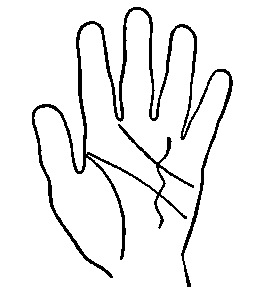
No. 440.
Continue to:


My Books

