


The Line Of Heart. Part 11
Description
This section is from the book "The Laws Of Scientific Hand Reading", by William G. Benham. Also available from Amazon: The Laws of Scientific Hand Reading.
The Line Of Heart. Part 11
If a break in the Heart line has a dot well marked on the end of the broken line (76) it indicates a serious attack of heart disease at the age indicated by its position on the line. A very large, deep dot will indicate a probable fatality, a smaller dot, serious illness which may be overcome. The star is either a brilliant sign when seen on the line, or is an explosion. First locate whether it denotes illness or affection. If illness, then it will be heart disease, a severe attack if it be a small star, or a badly formed one (77). If seen under Saturn it will add the complication of rheumatism of the heart. If the star is large and well formed (78), with the centre exactly on the line, it will indicate the excessive formation, or, as we call it, the explosion. This means sudden heart failure at the age on the line at which the star appears. If after a star the line shows chains (79) the subject will have a serious attack of heart disease from which he will never entirely recover. If after a star there are islands (80) the subject will have a severe attack of heart disease with delicacy afterwards, most pronounced and severe during the periods covered by the islands.
The age at which each event occurs can be read from the line of Heart. If after a star the line becomes thin and narrow (81) it tells that the illness shown by the star destroys the vigor of the heart, which is always weak afterwards, and the affections become cold and views selfish and narrow.
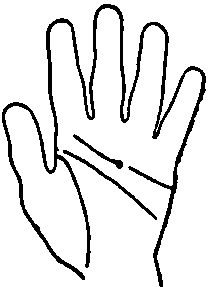
No. 76.
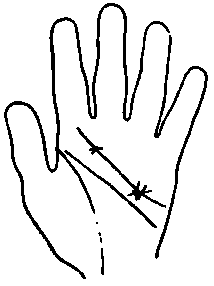
No. 77.
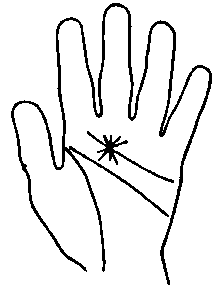
No. 78.
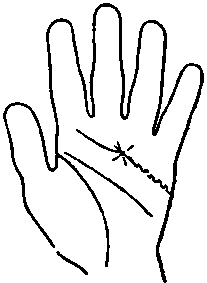
No. 79.
The combinations of defects, and the character of the line in its different parts are possible of infinite variation. All along the line every variation of character means a different operation of the line during the period it lasts. The characteristics of each formation of the line have been previously explained; so in practice apply to each part of the line the characteristics which belong to that kind of a line, reading the age at which these events occur by their position on the line. Use color to strengthen all these matters. Remember big red stars indicate greater intensity than big white ones, and that yellow ones show more nervous, morbid, and ugly qualities. Every defect on the line means an event either of health or affection. Make this distinction by rules already laid down, and then tell what the defect means and how serious it is.
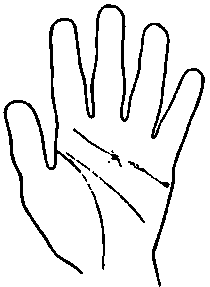
No. 80.
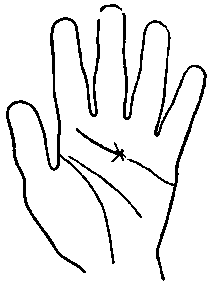
No. 81.
Keep always in mind the theory of the Current, what it is trying to do, and how well the line will enable it to perform its functions. Think of the stream as flowing smoothly or impeded by defects. You have the types as a basis for the whole work, and it is by using and combining this knowledge, and adapting it to each particular case, that you will be enabled to reason out what each event shown on the line means, how it will affect the subject, and whether it is repaired or produces destruction. Go slowly in reading the line; don't expect the meaning to come the first time you look into a hand. Do not become confused because it does not, but think it over carefully. Above all, never allow yourself to be rushed. Don't begin to read because you feel you must "say something." Don't say anything until you have it clearly in mind. Practice will increase the rapidity with which you can work, just as the child grows from the primer to his higher readers. Get the theory in mind first, then practise until you can apply it. All my effort in this chapter has been expended to teach how to read a line by using the general rules and indications and applying them to that line. I have dealt only with changes in the Heart line itself.
Understand each separate Main line thoroughly, and when you have learned them all you will be able to understand all the combinations. The illustrations in this chapter serve only to put you in the way of reasoning out the possible changes in the line - they are only a few of the thousands which are possible. You will find it excellent practise to take pencil and paper and draw different combinations for yourself, learning to reason them out. Remember, reason and good judgment must stand at your side when judging the Heart line, and all other lines as well.
Continue to:


My Books

