


The Line Of Life. Part 10
Description
This section is from the book "The Laws Of Scientific Hand Reading", by William G. Benham. Also available from Amazon: The Laws of Scientific Hand Reading.
The Line Of Life. Part 10
In the same manner a dot on any Mount and the sudden termination of the Life line will show the end to be from an acute attack (shown by dot) of the health defect of the Mount. If a line runs from the end of Life line to the dot, it will make the indication unmistakable. Thus while the termination of the life may not always be read from the Life line, it is read from the other lines and Mounts. If the Life line end suddenly and a dot is seen on Jupiter (260), apoplexy will be the trouble ; if a dot is seen on Saturn, paralysis, and if in this case a star, cross, or dot is seen on the Head line under Saturn, the reading is absolute (261). All of the other Mounts must be handled in the same way when searching for a sudden termination to life. With each Mount disease the one which would kill quickly is the probable one, and a chronic trouble will not be the cause. When a deep Life line ends abruptly there is always a chance that it may continue. Even though the line be short, it is not as serious as if it ended in a cross, star, tassel.

No. 260.

No. 261.

No. 262.

No. 263.

No. 264.
dot, or like sign. Life lines which are deep and strong but short, and sometimes even short thin ones, often cut their way through the hand, forming new channels; for a strong will and determination to live, often prolong the life of many persons with such markings. When the line ends clear, without a defect or tassel, it shows that there is no great impediment at the time, and that care and determination can keep the life going. If a line which begins deep and strong begins to taper as it cuts through the hand, gradually growing thinner as the line advances until it fades away and disappears in the capillary lines (262), it shows that the vitality grows less powerful as age comes on until it almost disappears, leaving the subject weak, nerveless, and feeble. These subjects will not die from sudden diseases, but death will come from exhaustion. They are liable to develop some chronic ailment as the line decreases, and any defect of their type will be almost certain to develop. By making a thorough examination, you can discover the difficulty. This fading Life line does not stand so good a chance to continue the life past the age indicated by its length.
If it be a short line, the subject will begin to decline early and will not live past the end of the line, as he has not enough vitality to create great determination to live. A good Head line is a fine possession with such a disappearing line. If the Life line forks at the termination (263), it shows that the Current separates, and, going in two directions, there is only one half as much chance that the life may be continued past the end of the line as with a single line. If both branches are deep, strong lines, it is more of an indication that life may be prolonged than if the forks are thin lines. This is a case where the vitality wanes, and as division is weaker than union, this forked termination of the Life line shows the rapidly dissipating vitality. If the line be short, small encouragement of long life can be given a subject with such a termination. If these forks are close together (264), it is a better indication than if they diverge widely (265). If the line ends in three prongs (266), the dissipation of the vitality is more complete, and this is more certain if all three of the forks be thin. In this case the vitality will be dissipated when this point is reached.
If the middle fork is strong and deep (267), it may be a new lease of life beginning to manifest itself, and hope may be given that the subject will live past the end of the line. If the line ends in a tassel (268), it shows entire dissipation of the vitality and end of the life. Such tassels are frequently seen from sixty to sixty-five years of age. In those cases it is the natural end of the life. If the tassel appears early in the line it shows premature dissipation of vitality, and death of the subject at the age at which the tassel is seen. In many works on Palmistry this tassel has been given the meaning "Poverty in old age." This is incorrect. I have seen it in the hands of old men who were rich. The vitality was fast diminishing, however, as the age neared the point of the tassel. Sometimes the Life line runs to a certain age and then crosses the hand to a Mount. If there is no health defect on the Mount it will show that the quality of the Mount largely influences the life course of the subject. If a grille, cross, dot, cross-bars, or any defect on the Mount is present, the indications are that the disease peculiar to that Mount took hold of the subject at the age the line deflected from its regular course.

No. 265.

No. 266.

No. 267.

No. 268.

No. 269.

No. 270.
No. 271.
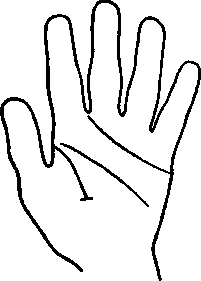
For instance, if at thirty the line be so deflected and runs to the middle of Mount of Moon to a grille, gout or rheumatism will be the disease which afflicted the subject (369). Whenever the line runs to a defect, the disease peculiar to the point where it stops is the one to look for. This marking running to Lower Moon is most frequent in the hands of women, and indicates female weakness. If the line ends in a cross (270), the life will terminate at that age, and the disease can be determined by the usual search through the hand. This is a sudden ending of life, and there will be no lingering illness. The more perfectly the cross be marked, and the deeper its lines, the more certain is the indication. If a cross-bar cuts the end of the Life line (271), it is the sudden ending of the life. In all these cases the usual methods of examination will disclose the cause. It is absolutely necessary with every termination of the Life line to examine both hands. If the line and termination in the left hand be good and strong, and one of the defective terminations is seen in the right, it is certain that something has changed the natural life course. The subject may have acquired a vicious habit which will shorten his days, or may have developed some serious malady.
Continue to:


My Books

